






















Rosalia’s Brit-night and GNTM shake-ups — who feels the impact as live performance and reality TV compete for attention

Live-event audiences and reality-TV viewers are being pulled in opposite directions this awards season, with rosalia’s theatrical Brit performance commanding cultural conversation even as Germany’s Next Topmodel struggles to stabilize ratings and on-screen chemistry. The consequences land first on music audiences, the show’s contestants and the producers who must balance spectacle with viewer appetite.
Who is most affected and how the spotlight is shifting
Here's the part that matters: big-scale music staging and surprise star appearances are proving more effective at grabbing broad attention than manufactured reality-TV stunts right now. That means music fans, contestants and broadcasters feel immediate pressure — audiences decide where their attention (and viewing figures) go, while talent and producers must react rapidly to reclaim it.
Rosalia’s Brit performance — scale, surprise and an award that amplified the moment
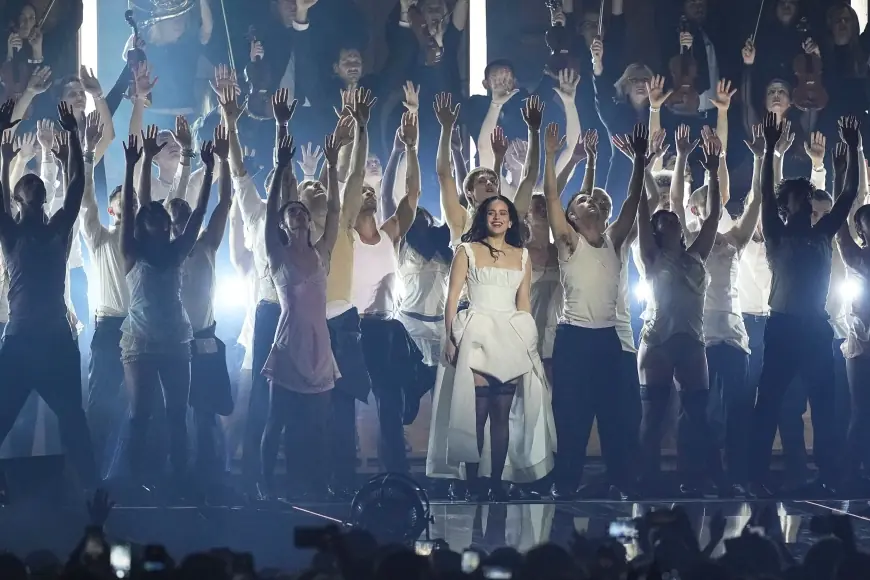
rosalia turned a major awards night into a focal point for theatrical pop: she delivered a full staging of Lux’s lead single, Berghain, using elaborate sets, a live orchestra and a vocal performance the coverage described as flawless. The album Lux, released last year, blends classical and operatic touches with hip-hop and Spanish-infused elements, and the live show leaned hard into that hybridized identity.
In an unannounced appearance, Björk delivered rosalia’s Berghain verse live on stage — a return to that awards platform after more than 30 years away. The combined effect of scale and surprise helped rosalia walk away with the International Artist Of The Year prize, an award the night’s coverage noted she took over named competitors including Sabrina Carpenter, Taylor Swift, Chappell Roan, Bad Bunny, Bruno Mars and Lady Gaga. Her acceptance remarks emphasized gratitude for performing and a call to “keep celebrating the ‘other’-ness” of music, cultures and languages. A later lighthearted segment on the show saw Jack Whitehall praise her performance.
Event round-up pieces from the night collected other big moments too, including performances from Harry Styles, Raye and the evening’s top winner, Olivia Dean.
Episode six of Germany’s Next Topmodel — the angel shoot and a ratings problem
The sixth episode’s central assignment put most contestants in wings, literal angel wings in black or white, but not everyone understood the brief. An eighteen-year-old contestant named Vanessa opened the segment by saying she was excited to “serve Face, ” yet her reaction to the wings suggested confusion about the task. A fleeting hope that pianist Igor Levit might appear as a guest judge evaporated quickly when Heidi Klum announced two fashion icons instead: Nadja Auermann and Armin Morbach.
Auermann framed the shoot as a homage to Peter Lindbergh, a concept only some contestants recognized — specifically Bianca, 47, and Ursula, 54. Vanessa later described the arrival in baffled terms that captured the general misunderstanding: she portrayed one guest as a photographer and the other as a model and said the idea was to shoot in the style of someone who had died, effectively ending the written explanation of the concept for that episode. Morbach immediately focused advice on Bianca, and Klum repeatedly nicknamed him with an elongated pronunciation.
Behind the scenes, the series faces a tougher problem: early-stage ratings after three weeks are described as underwhelming compared with last year. A companion documentary branded as an attached behind-the-scenes project failed to lift interest; past transformations, like the forced makeover of ex-contestant Zoe Saip in 2018 that turned her into a Dolly-Buster look and preceded her elimination, are still referenced in critiques of the show’s approach. A family reunion segment that included Heidi Klum’s children Leni and Henry Samuel drew just 590, 000 viewers and trailed another channel; even a repeated screening of a familiar comedy secured higher numbers. The reporting suggested Klum may need models she did not raise herself to regain stronger audience traction.
Male models, early restyling and on-set pressure
Producers fast-tracked an early restyling and the first major male photoshoot this week, raising nerves among several contestants. Heidi Klum said she would assess “the complete package” up front as the male models posed in slim shorts on a boat for a retro 1950s swimwear shoot photographed by Andreas Ortner on the Spree.
Individual arcs were on clear display: Yanneck felt confident about his physique but still needed practice; Hyan confessed shame about recent weight gain and said the situation felt overwhelming. Trans-man Jill described a long history of discomfort with female-assigned features and the severe strain that eventually compelled him to act to survive; he is also managing hair thinning from testosterone, was forced to remove a hat for the shoot and expressed a wish for fuller hair. Klum suggested a hair system to ease his insecurity. Alexavius revealed a large birthmark he had hidden and was told it made him unique; he described the host’s encouragement as a powerful moment, and the photographer praised his work. Godfrey, who framed photoshoots as his strength, still faced pointed direction from Ortner, an on-set slap and a critique to relax into a more natural 50s look. A water catwalk with a Berghain backdrop and guest juror Baptiste Giabiconi’s teaching preceded a later block of futuristic 80s outfits set to a live DJ in ankle-deep water. One on-set remark celebrated a push for “more plus-size men, ” though that segment cut off in the available copy.
- 2018: Zoe Saip’s forced makeover and exit were cited as a notorious past moment tied to the show’s makeover history.
- Last year: The album Lux was released and is now central to a major live awards staging.
- Björk’s appearance marked her first performance on that awards stage in more than 30 years.
It’s easy to overlook, but these parallel stories—one anchored in grand staging and surprise appearances, the other in format tinkering and contestant vulnerability—are competing for finite viewer attention. The real question now is whether producers will prioritize spectacle or invest in clearer, less polarizing storytelling for contestants.
- rosalia’s large-scale staging and the unbilled Björk cameo pulled concentrated attention to a single awards moment.
- Germany’s Next Topmodel is showing early signs of audience fatigue; companion documentary efforts and family-focused segments have not reversed that trend.
- Contestant wellbeing is a recurring theme: visible insecurities (hair loss, birthmarks, body changes) are becoming part of the narrative and affect on-screen performance.
- Producers will likely have to choose whether to chase viral live moments or rebuild steady viewer trust through clearer concepts and reduced sensationalism.
One final aside: what’s easy to miss is how much a single surprise — an unbilled guest or a singularly staged performance — can redraw public attention overnight; the stakes for both music shows and reality television are quietly, significantly higher because of that.