
























Planets Aligning Tonight: How to See the Six-Planet Parade Near Feb. 28

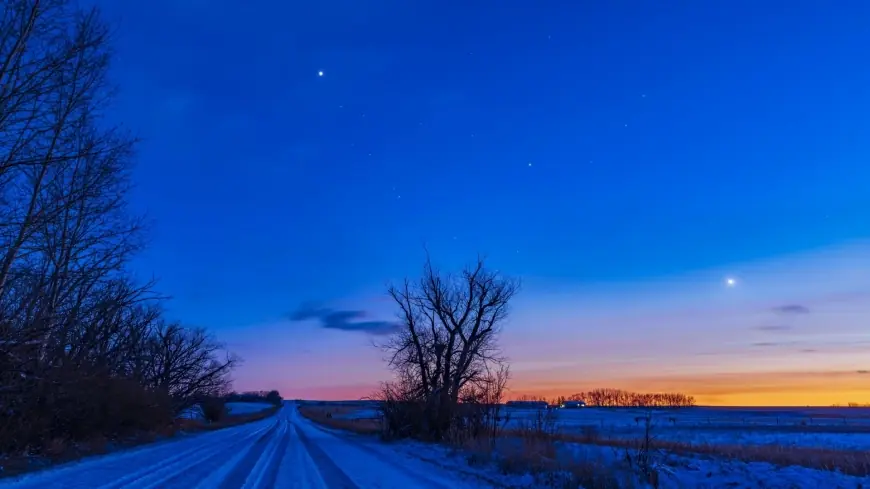
The solar system will stage a six-planet parade this week, with Jupiter, Saturn, Venus, Neptune, Uranus and Mercury arranged in the sky. Planets Aligning Tonight offers a brief window of opportunity for observers, but seeing them depends on preparation, equipment and weather.
Planets Aligning Tonight — Mercury and Venus over the western horizon
Most of the naked-eye planetary action will appear low in the western sky. Mercury will sit roughly 10 degrees above the late-winter skyline — about the width of a clenched fist held at arm's length — with Venus close to its left and struggling in the glow of the setting sun. Because those two planets trail the sun, they will follow the sun out of sight roughly an hour after sunset; they may become momentarily more visible as the sky darkens and they approach the horizon.
Neptune and Saturn's tight separation on Feb. 28
Saturn will be positioned less than 10 degrees to the upper left of Venus, with Neptune lingering nearby. Neptune sits about two degrees to the right of Saturn but is too dim to see without magnification. Under dark skies, a telescope with an aperture of at least 8 inches (200 millimeters) can reveal Neptune's tiny bluish disk. The planet's low placement near the horizon and proximity to the sun's glare make spotting it a challenge on the nights surrounding Feb. 28. Observers are warned to confirm the sun is fully below the horizon before pointing telescopes in that direction.
Jupiter and the waxing gibbous moon in the eastern sky
While the western horizon hosts the faint and fleeting planets, Jupiter will shine high in the eastern sky. A waxing gibbous moon will sit below Jupiter and, due to its reflected light, will obscure some stars in the constellation Cancer on the same night.
Uranus near the Pleiades and where to sweep with a scope
Uranus will require a telescope and careful locating. It can be found by sweeping across a patch of sky about 5 degrees below the Pleiades open star cluster, to the right of the "V" of stars that marks the face of Taurus, during the hours after sunset. Newcomers are advised to use smartphone astronomy apps that employ augmented reality to pin down constellations, planets and other faint targets.
Equipment, safety and the role of apps and location
Viewing success is influenced by preparation: stake out a raised site with an unobstructed horizon well before sunset and bring appropriate optics. Telescopes with sufficiently large apertures are necessary for Neptune and Uranus; binoculars or unaided eyes suffice for the brighter planets when conditions allow. Smartphone stargazing apps can help plot exact local positions so observers do not have to guess. Observers are cautioned to take utmost care with telescopic equipment near twilight and confirm the sun is fully set before aiming instruments.
Community notices, media features and viewing caveats
The editorial coverage around this event includes offers to sign up for a monthly entertainment newsletter for updates on sci‑fi and space movies, TV shows, games and books, and a separate skywatching newsletter highlighting must-see night-sky events, moon phases and astrophotos. A Sci‑Fi Reader's Club offers a sci‑fi short story every month and an invitation to join a virtual community. The publisher notes that when purchases are made through links on its site, it may earn an affiliate commission.
Separately, a regional news site has posted a technical notice explaining that its platform was rebuilt to take advantage of newer technology to make it faster and easier to use and that some older browsers are not supported; the site urges readers to download a modern browser for the best experience. Observers should also hope the weather cooperates, because rain would clearly hinder viewing.
Award-winning night-sky photographer Josh Dury grappled with the sheer scope of the scene along with the glow of the setting sun and other challenges to capture the view; what he was capturing is unclear in the provided context.
What makes this notable is the combination of six visible planets within a single observing season and their varying brightness and horizon positions, which compress the window to catch them together. The timing matters because the planets' low positions and proximity to the sun mean that a raised location, the right equipment and careful timing can be decisive between a successful sighting and a missed parade.