























Dubai Bombing and Regional Retaliation Heighten Risks: Unclear Damage, Intercepted Missiles and Rising Civilian Toll

Why this matters now: The dubai bombing is part of a broader wave of Iranian retaliatory strikes after a sustained US–Israel assault, producing fires at a Dubai luxury hotel, intercepted missiles over multiple Gulf states, and injuries and at least one death. The pattern of impacts on both civilian areas and U. S. military facilities raises immediate risks for civilians, bases and commercial hubs in the region.
Uncertainty and immediate risks after cross‑border strikes
What is unclear in the provided context is the full scale of physical damage and whether military assets were directly hit; several incidents remain described only in verified video or brief official statements. The strikes have produced visible consequences—blazes, plumeing black smoke and running civilians—but the operational state of installations and presence of ships or aircraft at targeted bases is often unknown. The real question now is how sustained the campaign will be and whether further civilian casualties will follow.
Dubai Bombing: what unfolded at the Fairmont The Palm and nearby areas
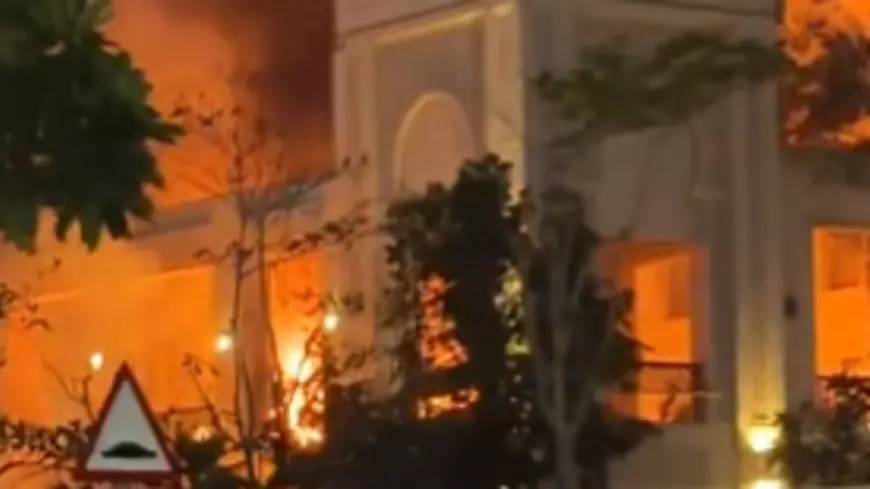
Video verified in the coverage shows a fire raging at Fairmont The Palm hotel in Dubai, with thick black smoke rising above the five‑star property. Another clip taken from the opposite building captures the moment of impact followed by an explosion and a large orange fireball; the person filming appears to fall to the ground. A fire also broke out at a building in the Palm Jumeirah area; emergency response teams attended and the blaze was brought under control after four people were injured and taken to medical facilities. The Fairmont The Palm is described in local material as a luxury hotel with gourmet dining, an award‑winning spa and pools with city views.
Wider Gulf picture: interceptions, base alerts and civilian effects
- Qatar, Bahrain, Jordan and Kuwait — all home to US military bases — said they had intercepted missiles fired towards them.
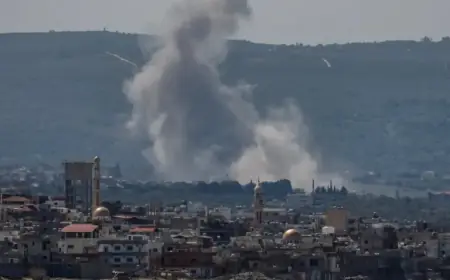
- Huge plumes of black smoke were seen near the headquarters of the US Navy’s Fifth Fleet in Manama, Bahrain; the extent of any damage is unclear and the US has not commented in the provided context.
- Doha’s defence authorities said several missiles were intercepted that apparently targeted the al‑Udeid air base, described in the coverage as the largest US base in the region.
- Authorities in Bahrain confirmed an attack on Naval Support Activity Bahrain, the base that serves as a home port for anti‑mine vessels and logistical support ships, though it is unclear if any ships were present at the time.
- Video from Manama shows a drone striking a tower block and exploding into a yellow fireball; explosions were also heard in Kuwait and a drone at the international airport reportedly caused minor injuries to several employees and limited terminal damage.
Casualties, military notices and political reactions
Within the provided material, several casualty reports and alerts appear: three Kuwaiti soldiers were injured by shrapnel when a base housing US personnel was targeted; a health ministry reported 12 people injured during and after the strikes but it is unclear whether the three soldiers are included in that toll. Kuwait’s Ali Al Salem Air Base was described as suffering minor injuries to three armed forces members and some material damage after air defences engaged ballistic missiles and drones.
An emergency alert posted by the Israel Defense Forces instructed personnel in an industrial zone in the Isfahan region to evacuate immediately and advised residents of Mazraeh village to stay inside until morning. Central Command material in the coverage says the US military suffered no combat casualties after Iran responded with hundreds of missiles and drones; CENTCOM forces were described as having defended against the attacks with minimal damage to US installations and no impact on operations.
Political leaders reacted strongly: the US president publicly proclaimed that Ayatollah Ali Khamenei is dead and framed that outcome as justice for the Iranian people; this remains a developing and contested claim in the provided context. Turkey’s president said the US‑Israeli strikes violated Iran’s sovereignty, warned the region risks being "dragged into a circle of fire, " and urged urgent diplomatic efforts toward a ceasefire and revived negotiations. A French leader told an emergency defence council that France had not been warned of or involved in the US‑Israeli strikes.
Local civilian warnings, closures and public mood
Around 240, 000 British citizens live in the UAE and were advised to remain indoors or in a safe place and to stay away from windows. People were filmed running for shelter in Dubai as air‑raid sirens sounded and at least three big blasts were heard over the city; residents reported a second wave of missiles seen flying over residential areas. In Abu Dhabi a series of explosions were followed by confirmation that one person was killed by falling debris after the UAE said it had intercepted missiles; defence officials emphasized readiness and measures to confront threats. The UAE’s airspace was closed as a precautionary measure.
Micro timeline of the sequence captured in the coverage
- Initial US–Israel strikes described as massive and ongoing prompted threats of retaliation.
- Iran launched retaliatory strikes across the Middle East; missiles and drones were intercepted in multiple Gulf states.
- Fires and explosions were recorded in Dubai (Fairmont The Palm and Palm Jumeirah), Manama and Kuwait; injuries and at least one death were reported.
One forward signal that would indicate a new phase is sustained confirmation of damage to key military infrastructure or additional civilian fatalities in urban centers.
Here’s the part that matters: civilians, commercial hubs and a cluster of US bases are all in the line of effect, and several incidents remain only partially documented. What’s easy to miss is how few concrete operational details are available about weapons impacts at specific bases; that absence raises the risk of miscalculation.
Writer's aside: The pattern—interceptions over multiple states, visible fires in dense urban areas, and high‑profile political claims—signals a volatile mix of military and diplomatic pressure. The picture could change quickly as more verification becomes available.