
























Dortmund Vs Bayern: How Fans, Players and the Title Race Felt the Klassiker Aftershock

Who felt the immediate fallout of the Klassiker most? From travelling supporters to individual players and the title race, the picture is mixed after the high-stakes Dortmund vs bayern clash. The match shifted momentum for people inside the stadium, hardened Bayern’s position in the title fight and deepened scrutiny on Dortmund’s mental state following a recent heavy European exit.
Dortmund Vs Bayern — first-mover impacts on supporters and squad morale
Fans were the most visible beneficiaries: Bayern’s travelling supporters celebrated exuberantly with the players after the final whistle, with the squad publicly thanking the loyal contingency that had accompanied them to Dortmund. For Dortmund’s home crowd, the match compounded existing worries tied to the club’s earlier Champions League exit in Bergamo, which has clearly affected squad confidence.
Match snapshot and final score (embedded detail)
The Klassiker at Signal Iduna ended 3: 2 in favour of the visitors. The contest was described as high-quality and close; the away victory was framed as a result that could effectively decide the championship race. Key goal actions included a move finished to make the score 1: 1 after a Kimmich chip to Serge Gnabry, who headed the assist to Kane, and a left-foot direct finish by Joshua Kimmich to make it 3: 2. Minutes cited in assessments: the 1: 1 movement tied to the 54th minute and Kimmich’s 3: 2 at the 87th minute. The game produced a sequence of leads and equalizers, including a 2: 2 draw triggered in the 83rd minute.
Player-by-player pressure points and substitutions
- Jonas Urbig — was little tested overall, had no chance on the 0: 1 by Nico Schlotterbeck and on the 2: 2 by Daniel Svensson; available interventions were made (grade noted as 3 in the assessment).
- Konrad Laimer — industrious with many metres covered, struggled at times to control Dortmund’s variable wings and was substituted in the 90th minute for Tom Bischof (grade 3. 5).
- Jonathan Tah — initially late on the Dortmund goal by Nico Schlotterbeck but recovered to win important duels (grade 2).
- Dayot Upamecano — strong in pressing and forward defending but repeatedly left exposed in his back, a factor at the 2: 2 when Daniel Svensson peeled away from his marker on a Marcel Sabitzer cross (grade 3).
- Josip Stanišić — provided stability on the right by winning duels and contributing both offensively and defensively (grade 2).
- Aleksandar Pavlović — offered ball security and helped Bayern’s build-up by drifting left to free Laimer, though not always defensively stable (grade 2. 5).
- Joshua Kimmich — regained form after weaker weeks, acted as leader: the chip to Gnabry that led to the 1: 1 and his left-footed 3: 2 were decisive; he was replaced in stoppage time by Leon Goretzka (grade 1. 5).
- Luis Díaz — worked hard and covered much ground but had little visible impact on the outcome (grade 3. 5).
- Serge Gnabry — active in press and attack, his header created Kane’s goal; he was substituted in the 61st minute for Jamal Musiala (grade 2).
- Michael Olise — assessment in the provided context is unclear in the provided context.
Matthäus’ switched prediction and what it signals
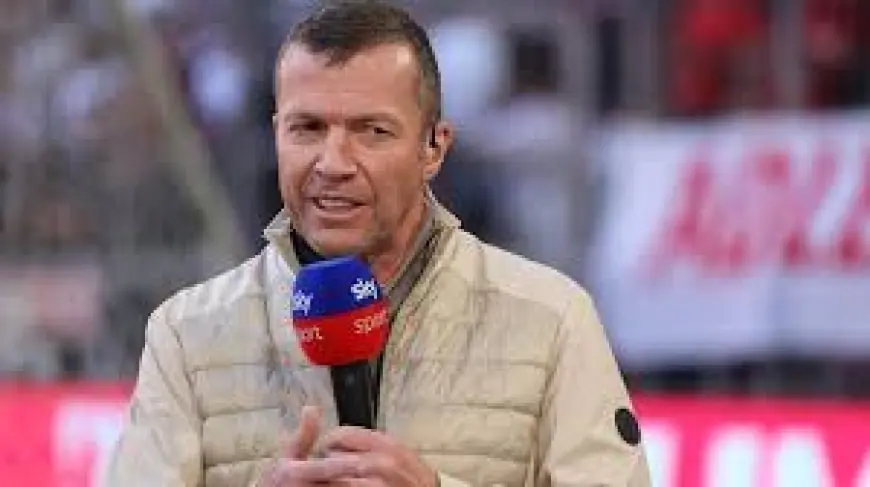
Lothar Matthäus, the 64‑year‑old record international and 1990 world champion, changed his tip for the match shortly before kickoff: having earlier tipped a draw before Bergamo, he now named Bayern the favourite. He cited Dortmund’s embarrassing Champions League exit at Atalanta (1: 4) and argued that the club made many mistakes and handed opponents gifts, undermining confidence. Matthäus identified distractions at Dortmund — naming Guirassy and Adeyemi as problems and singling out intermittent lack of effort from individuals like Bensebaini — and contrasted that with a Bayern squad he considers uniformly willing to give everything since Kompany’s arrival. He still urged Dortmund to use their crowd, play with belief and maintain the second-half intensity shown in the first meeting across 90 minutes.
Here’s the part that matters: Matthäus doubted that a single Klassier win would erase the league gap. He stated that Bayern hold an eight-point cushion and suggested that the neutral fan would have preferred a five-point distance; removing that eight-point lead in one match would be extraordinarily unlikely — a shock likened only to Kaiserslautern’s historic title under unusual circumstances.
- Bayern players celebrated with their travelling fans immediately after the final whistle, visibly thanking the group and joining them in front of the fan curve.
- The Signal Iduna encounter and the recent Atalanta loss are framing Dortmund’s current public narrative about consistency and distraction.
- Substitutions of note: Gnabry off for Jamal Musiala (61'), Laimer off for Tom Bischof (90'), Kimmich off for Leon Goretzka (stoppage).
The real question now is whether the psychological hit from Bergamo and the visible roster distractions will be addressed internally at Dortmund, or whether Bayern’s away resilience will translate into an irreversible swing in the title race. It’s easy to overlook, but the sequence of individual performances and the post-match celebrations send both an emotional and competitive signal about how each club is coping with pressure.
What’s easy to miss is that the match combined tactical moments, individual redemption for key players and a public morale boost from fan-player interaction — a layered outcome that affects more than the points table.