

























Sl Vs Pak: Pakistan Win but Exit T20 World Cup as New Zealand Advance on Net Run-Rate

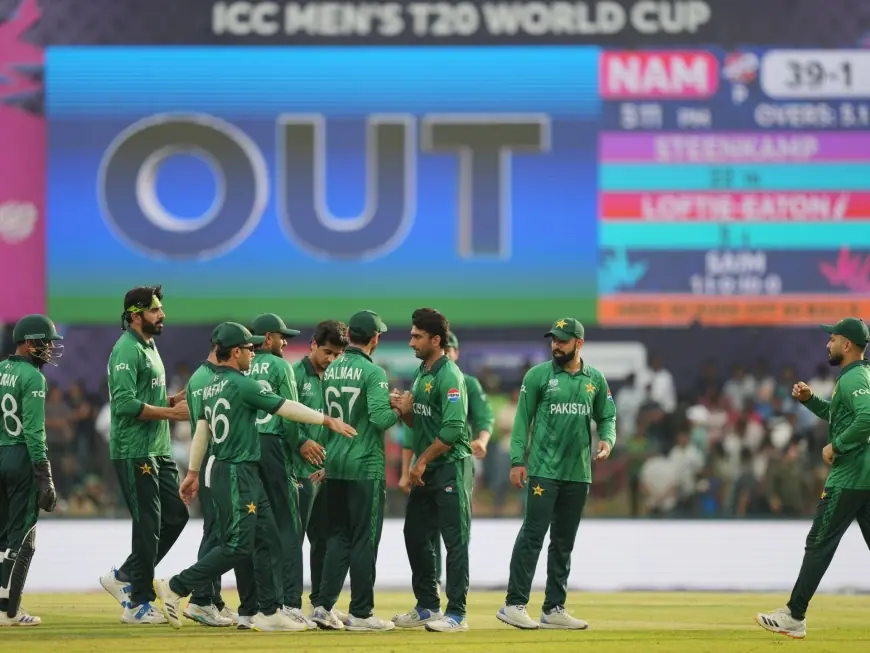
In a decisive Super Eights match at Pallekele Cricket Stadium, sl vs pak ended with Pakistan edging Sri Lanka by five runs but still being eliminated from the ICC 2026 Men’s T20 World Cup. The result mattered because New Zealand secured the second semi-final berth on net run-rate despite losing earlier, leaving Pakistan short of the knockout stage.
Sl Vs Pak at Pallekele Cricket Stadium
The fixture was played at Pallekele Cricket Stadium in Pallekele on Saturday, February 28, scheduled for 7pm local time (13: 30 GMT). Sri Lanka, already eliminated from progressing, won the toss and elected to bowl. Pakistan posted 212 for 8 in their 20 overs; Sri Lanka managed to pass 148 in the chase but fell five runs short.
Sahibzada Farhan and Fakhar’s record first-wicket stand
Sahibzada Farhan produced a century as he and Fakhar shared a record-breaking 176 for the first wicket. Farhan finished the tournament with 383 runs, the most by any batter in a single edition of the men’s T20 World Cup. Pakistan’s 212-8 was built around that opening partnership, but the margin proved insufficient for qualification goals laid out before the game.
Selection moves: Babar, Ayub and Mirza omitted
Pakistan entered the match after changing personnel, dropping Babar, Ayub and Mirza and bringing in Nafay, Naseem and Abrar. Fast bowler Salman Mirza reiterated that the team’s focus had been squarely on beating Sri Lanka, regardless of other results, as Pakistan sought the specific net-run-rate target needed to reach the semis.
Salman Ali Agha on dew, Usman Tariq and batting frailties
Pakistan captain Salman Ali Agha said dew was a factor and that the team could not execute plans fully. He singled out an off-day for Usman Tariq while praising Farhan as the lone exceptional batter in a campaign during which Pakistan’s middle order remained a concern. Agha noted that an extra 10–15 runs would likely have changed the equation.
Net run-rate math hands New Zealand semi-final slot
New Zealand clinched second place in Group 2 on net run-rate and advanced to the semi-finals. Pakistan needed more than a simple victory: to leapfrog New Zealand they had to beat Sri Lanka by roughly 65 runs or chase any target in fewer than 13 overs, with both scenarios dependent on the first innings total. New Zealand had held second place earlier, but their defeat by England opened a window that Pakistan attempted to exploit; nonetheless the final net-run-rate calculations favoured the Kiwis.
Sri Lanka campaign swings and Dasun Shanaka’s reaction
Sri Lanka’s path into the Super Eights had included wins over Ireland and Oman and a shock upset of Australia that sealed qualification from the group stage, before a surprise defeat by Zimbabwe cost them top spot. In the Super Eights, Sri Lanka lost to England and New Zealand and were already out of contention when they faced Pakistan. Captain Dasun Shanaka said it was a closer game at the end, praised Shaheen Afridi’s late bowling, acknowledged missing two key bowlers, and apologised to the fans while expressing belief the team can do well in the future.
Pakistan’s campaign arc and remaining schedule for coverage
Pakistan’s tournament featured a nervy three-wicket win over the Netherlands decided in the final over, victories over the United States and Namibia, and a heavy defeat to India in Colombo. Their first Super Eights fixture against New Zealand was washed out in Colombo before a loss to England, in which England’s Harry Brook produced a century in Kandy. England finished Group 2 as winners after beating both Pakistan and Sri Lanka and then securing top spot with a win over New Zealand.
Broadcast and match-day coverage had included pre-game build-up from 10: 30 GMT and radio commentary, with fans invited to engage through event features. Coverage will continue with the final block of Super 8 matches, beginning at 09: 15 GMT on Sunday with South Africa versus Zimbabwe, followed by India against West Indies.
What makes this notable is how narrowly defined qualification criteria — a 65-run victory or a sub-13-over chase — turned a clear on-field win into tournament elimination, underscoring that in this edition net run-rate, not just wins, decided who advanced.