























Shane Lowry’s putting slide at Cognizant Classic fuels concerns over five-week stretch

shane lowry opened the Cognizant Classic with a 70, leaving him one under par and well adrift of the clubhouse leader. The immediate issue is his putting: a substantial loss on the greens that, in the context of a five-week playing run, could have consequences for the weeks ahead.
Shane Lowry’s putting at PGA National
The 2019 Open Championship winner’s first-round score left him near the top of the leaderboard only by virtue of strong iron play; he gained more than four strokes on approach but lost 2. 29 strokes to the field with the putter, the 12th worst performance on the greens on Thursday. That combination — elite approach play offset by poor putting — produced a 70 and left Lowry nine shots behind the leader, Austin Smotherman, who sits nine under par.
Lowry’s decision to play the Cognizant Classic while on a stretch of consecutive tournaments is central to the explanation offered for his struggles. He acknowledged that the week is easier to handle because it is a home event and cited logistical relief: he said he can drive to Bay Hill next week and avoid flights, and that being at home allows family to attend upcoming events, including The Players. "I think the fact I’m staying at home this week makes it easier. I get to drive to Bay Hill next week, so there’s no flights. I get to see my family. They get to come to Bay Hill and The Players, " he said.
That home comfort appears to have limited protective effect on the greens. The concrete numbers are stark: an opening-round 70, a net loss of 2. 29 strokes on the greens, and a nine-shot gap to the leader. Those figures make clear why Lowry must rely on his approach play if he hopes to move up the leaderboard this week.
PLOS ONE study, five-week stretch and Cognizant Classic positioning
The timing matters because the Cognizant Classic sits between four significant stops on the PGA Tour schedule: the Pebble Beach Pro-Am, the Genesis Invitational, the Arnold Palmer Invitational and The Players. The field here is thin by design; many top players, including Rory McIlroy and Scottie Scheffler, are not playing this week so they can rest before The Players. Lowry, in contrast, is competing during a gruelling five-week stretch.
Research published in PLOS ONE in February 2025, led by Xiaoyang Pan and colleagues, linked mental fatigue from extended play to a particular decline in putting. The study concluded that putting draws heavily on visual processing, motor coordination, strategic decision-making and emotional control, and that mental fatigue weakens those systems. Importantly, the study found that when fatigue is present it often first manifests in putting, even if the player does not subjectively feel tired.
What makes this notable is that Lowry’s weakest measurable area this week aligns directly with the study’s finding: his putting, not his long game, has shown the largest deficit. If fatigue is the cause, the practical effect is a heightened risk that his short-game struggles will persist into Bay Hill and The Players — tournaments Lowry plans to play as part of his current schedule.
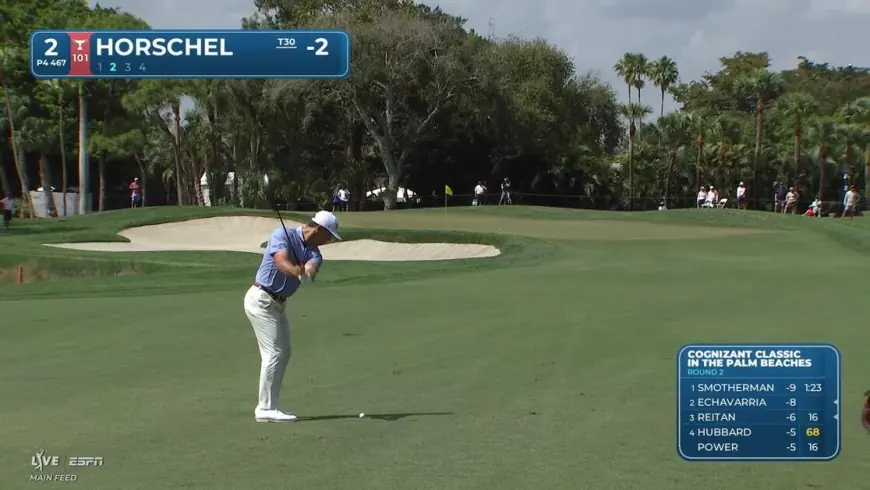
There are immediate, observable consequences. Lowry’s approach play has kept him within striking distance on paper, but a gap of 2. 29 strokes on the greens is unlikely to evaporate without correction. Meanwhile, others in the field produced moments that underscored how scoring opportunities are being converted: Billy Horschel hit a 116-yard approach to seven feet and converted the birdie on the par-4 second hole, an example of how sharp short-game execution is translating into low scores this week.
The broader implication is that Lowry’s calendar choice — prioritizing five consecutive weeks with a home stop — may be a tactical trade-off between comfort and cumulative fatigue. Whether his putting regains form over the next rounds will determine if those choices cost him at Cognizant Classic and potentially at the high-profile events that follow.