


















State of the Union Medal ceremonies reshape recognition for veterans — Eric Slover and a 100-year-old Navy captain take the spotlight

Who feels the change first are the recipients and the people closest to them: eric slover, a wounded helicopter pilot from the raid that captured Nicolás Maduro, and E. Royce Williams, a 100-year-old retired Navy captain whose Cold War dogfight was long classified. Both men received the nation’s highest combat honor during a single State of the Union address, shifting how wartime secrecy, legislative waivers and public recognition intersect for veterans and lawmakers.
Immediate impact on colleagues, families and policy: Eric Slover and E. Royce Williams
Two distinct threads converged in the House chamber at the U. S. Capitol on Feb. 24, 2026. One honored decades-old Cold War secrecy embodied by Williams; the other acknowledged a recent, contested operation in which eric slover was wounded. The presentations changed the immediate standing of both men in public and official memory: Williams, acknowledged at age 100, received a decoration that had been withheld by classification and timing rules; the helicopter pilot who took part in a raid that captured Nicolás Maduro received the Congressional Medal of Honor while still identified as wounded from that operation.
What happened onstage and how the awards were presented
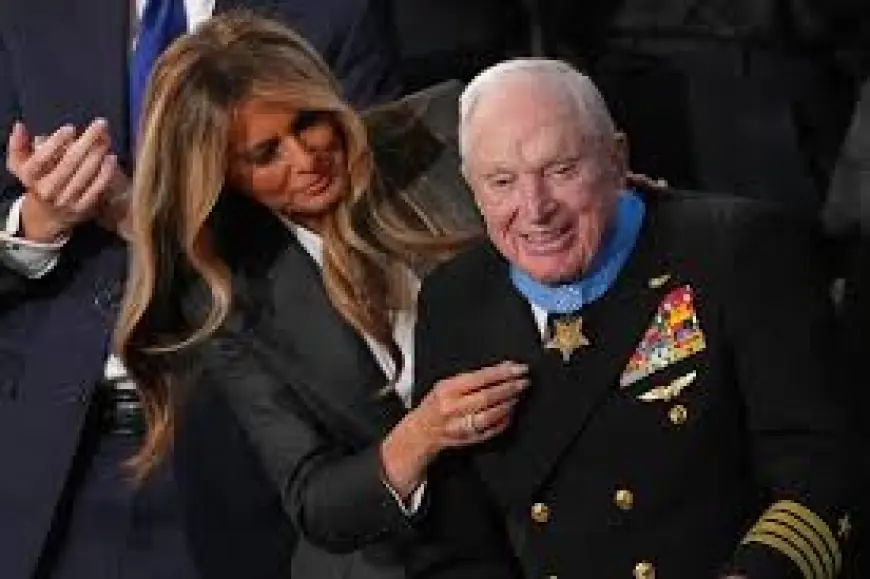
President Trump presented Medals of Honor during the State of the Union address to a joint session of Congress in the House chamber. First lady Melania Trump placed the medal on E. Royce Williams as he stood; Mr. Trump also presented the medal to the helicopter pilot tied to the Maduro raid. Officials noted that the pilot identified by the president as the lead CH-47 Chinook pilot was Army Warrant Officer 5 Eric Slover; references in the event material also identified him as a U. S. Army Chief Warrant Officer. The pilot had been wounded during the raid that captured Venezuelan President Nicolás Maduro.
Key historical details kept and revealed
Williams’s Vietnam-era-era? No — Williams’s action dates to the Korean War era in 1952, when he engaged seven MiG-15 fighters in what is described as a half-hour dogfight and shot down four Soviet aircraft. Soviet involvement was classified for decades, and Williams has said he was instructed to keep the clash secret and did not tell even his wife. After his aircraft was struck, he guided the damaged plane to a high-speed landing on an American carrier rather than eject over frigid water. Records and archival material became public only after the collapse of the Soviet Union, and three years ago Williams received the Navy Cross. Separately, last year lawmakers authorized the president to bestow the Medal of Honor in this case by waiving the longstanding five-year time limit that typically governs the award.
Statements and legislative threads that led here
Members of Congress pushed for Williams’s recognition; Republican Rep. Darell Issa of California pressed for the retired Navy pilot to receive the Medal of Honor and described the nearly 35-minute engagement nearly 70 years ago as heroic and life-saving for fellow pilots, shipmates and crew. The president called Williams earlier in the month before the presentation. Recent coverage had noted the plan to present at the address earlier on the day of the event.
- Medals given during State of the Union: unusual public timing and precedent.
- E. Royce Williams: 100 years old; credited with downing four MiG-15s in a roughly half-hour engagement in 1952; instructed to keep the action secret; awarded the Navy Cross three years ago.
- Eric Slover: identified as the lead CH-47 Chinook pilot and wounded in the raid that captured Nicolás Maduro; presented the Congressional Medal of Honor during the same address.
- Legislative waiver: last year lawmakers set aside the five-year award requirement for Williams, enabling the Medal presentation.
What’s easy to miss is how the two presentations compress different eras of American conflict — a classified Cold War air engagement and a recent raid — into a single public moment, forcing rapid reconciliation of secrecy, timing rules and public recognition.
Timeline highlights and immediate signals
- 1952 — Williams’s aerial engagement with seven MiG-15s during the Korean War period (characterized as one of the most intense of that conflict).
- Three years ago — Williams received the Navy Cross.
- Last year — lawmakers authorized a waiver of the five-year Medal of Honor rule for Williams.
- Feb. 24, 2026 — Both E. Royce Williams and Eric Slover received Medals of Honor during the State of the Union address in the House chamber at the U. S. Capitol.
The real question now is how public recognition given in this format will affect veterans who served in classified or politically sensitive operations and the legislative pathways used to clear timing or secrecy barriers. Short-term signals to watch for include additional official releases of operational details and any follow-up statements from lawmakers who advocated for the awards. Recent updates indicate some detail remain classified or unclear in the provided context, so further clarification may follow.