
























Space dangers and discoveries: the worst thing for the ISS and the largest image of the Milky Way’s heart

Space presents two urgent, contrasting stories this week: a detailed primer on why a puncture wound is the worst thing that could happen to the International Space Station and a newly released ALMA mosaic that maps the Central Molecular Zone in unprecedented chemical color. Both developments matter because they reveal gaps — in orbital safety and in our picture of star formation — that shape near-term decisions for engineers and astronomers alike.
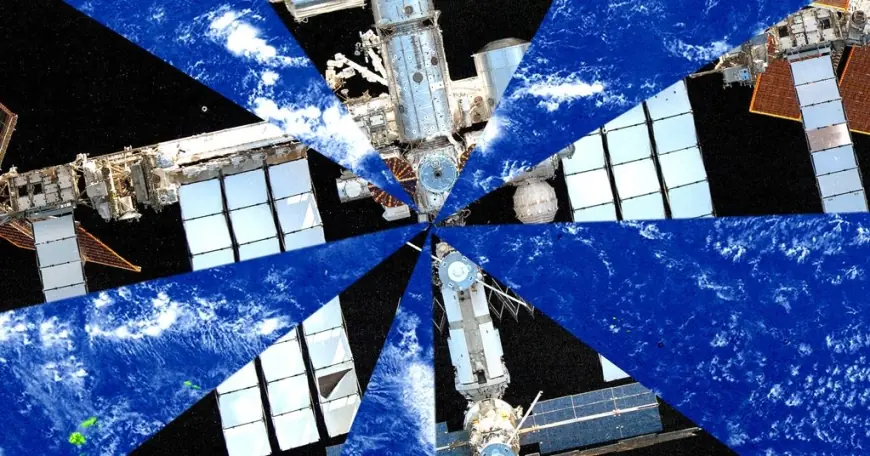
Space hazard: a puncture is the single worst outcome for the ISS
In the vacuum of space, debris — spent rocket stages, splintered satellites and micrometeoroids — numbers in the millions and often travels at about 17, 000 mph. Those fragments routinely collide with each other, producing exponential littering; most pieces are tiny and many are not near the station’s altitude, but the area is not completely clean. Debris pelts the station all the time, and noticeable dents and cracks line the exterior.
Defenses, detection and the remaining gap
There are active measures to reduce collision risk. The Space Surveillance Network is a bevy of sensors the military uses to track space debris, and NASA monitors an exclusion region nicknamed the "pizza box" — a no-fly zone around the station. When objects are predicted to enter that box with at least a 1 in 100, 000 chance of collision, mission controllers order avoidance maneuvers: firing thrusters to move the station and dodge the trash. That technique has been used dozens of times since the first module launched in 1998.
But limits remain. The tracking system monitors only about 45, 000 larger pieces and sensor noise exists; risk thresholds can miss stuff, sometimes badly. The debris tracker is designed to catch pieces 10 cubic centimeters and larger, while on-station armor like the Whipple Shield is built to stop debris up to about 1 cubic centimeter. Fabric-y buffers protect some systems, but that leaves a measurable gap. In 2025, Chinese astronauts were briefly stranded at their station after debris struck their return vehicle, underscoring the operational consequences when gaps are exploited.
What a breach looks like and how crews respond
A full breach would let cabin atmosphere seep into vacuum and set off alarms; pressure gauges would confirm that the station has almost certainly been hit. The speed of the leak helps indicate how much time the crew has to respond: a 0. 6-centimeter-wide hole leaves roughly 14 hours to plug the leak, while a 20-centimeter hole leaves less than a minute. If there is time, astronauts and cosmonauts will attempt to plug the leak or close the hatch to the affected section — the same approach used to manage a minor leak in the station’s PrK module for a number of years, which basically worked.
There is a hard deadline in such scenarios. Once pressure falls to around 490 mm Hg, critical systems risk breaking down and astronauts could suffer hypoxia, an oxygen deprivation so debilitating they could become delirious. If nothing else can be done, the crew would need to go to their crew vehicles and leave the station. Other low-probability emergencies that could force the same outcome include a fire from machinery shorting or a toxic ammonia leak, though those are even more unlikely.
Risk estimates and the element of luck
Past risk assessments emphasize that a wounded station would reflect rotten luck as well as system limits. Scientists in 2017 estimated the odds of the worst-case scenario at 1 in 121. As of late 2025, NASA estimated the risk of debris causing a depressurization event in any six-month period to be between 1 in 36 and 1 in 170.
Space imaging breakthrough: ALMA paints the Central Molecular Zone in color
A separate development from a telescope in Chile has produced the largest image ALMA has ever captured, an antenna-network mosaic that zeros in on the Central Molecular Zone (CMZ) — the cold, dense set of gas clouds at the heart of the Milky Way. The new image covers a region more than 650 light-years across; a light-year is nearly 6 trillion miles (9. 7 trillion kilometers).
The mosaic displays the complex distribution of molecular gas with specific colors assigned to different molecules: sulphur monoxide appears cyan, silicon monoxide green, isocyanic acid red, cyanoacetylene blue and carbon monosulphide magenta. Stars in the foreground were observed at infrared wavelengths using Y, Z and J filters. An inset is labeled as an ALMA CMZ Exploration Survey image where those molecules are shown in different colours.
What the ALMA mosaic reveals about star formation
The CMZ is a region packed with an intricate network of dense, cold gas that flows along filaments and often collapses into clumps capable of forming stars. That collapse process is far more extreme in the CMZ than at the galaxy’s edge. As part of ACES (the ALMA CMZ Exploration Survey), the team determined the chemical composition of this molecular gas, detecting dozens of different molecules ranging from complex organics like methanol and ethanol to simpler species like silicon monoxide.
Survey leader Steve Longmore of Liverpool John Moores University emphasized that studying star birth in the CMZ helps scientists understand how galaxies grew and evolved. The region shares features with galaxies in the early universe, where stars formed in chaotic, extreme environments. The CMZ spans roughly the size of three full moons in the night sky, so even ALMA, composed of 66 radio antennas across Atacama Desert regions of northern Chile, could not image it all at once; the resultant image was stitched together from smaller individual observations.
"It’s a place of extremes, invisible to our eyes, but now revealed in extraordinary detail, " said Ashley Barnes of the European Southern Observatory about the new view. The mosaic should help scientists investigate how stars live and die in the extreme environment around the Milky Way’s central supermassive black hole, Sagittarius A* (Sgr A*).
Breaking space news, the latest updates on rocket launches, skywatching events and more! When you purchase through links on our site, we may earn an affiliate commission. Here’s how it works. Sign up to a monthly entertainment newsletter to keep up with coverage of the latest sci-fi and space movies, TV shows, games and books. Discover this week's must-see night sky events, moon phases, and stunning astrophotos — sign up for the skywatching newsletter. The site also hosts a Sci‑Fi Reader's Club.
Finally, one line in the source material is incomplete: ALMA astronomer Kath... unclear in the provided context.