
























Fact-Check: Trump State Of The Union Was Longest in History, Multiple Claims Challenged

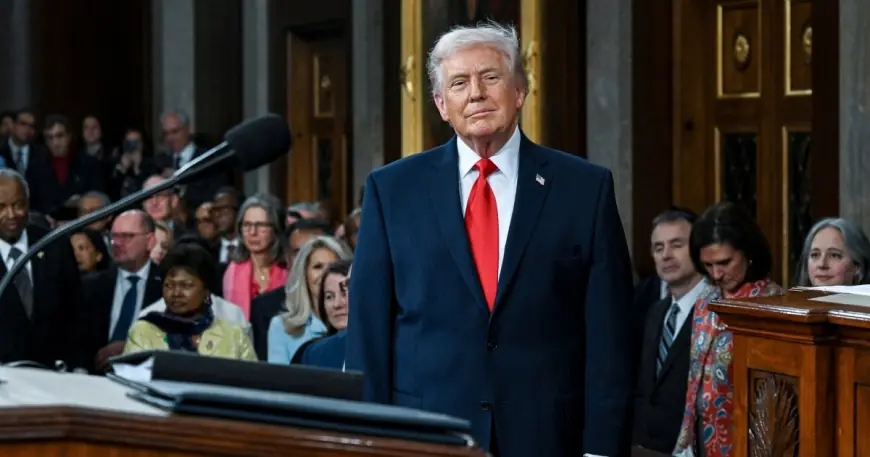
President Donald Trump delivered the longest State of the Union address in history on Tuesday night, a speech that highlighted his administration’s economic policies and immigration enforcement while assailing Democrats and the previous administration. The trump state of the union included a number of specific statistical claims that government agencies and policy analysts have since evaluated for accuracy.
Key Claims in Trump State Of The Union
Throughout the address the president made a string of assertions about the economy, crime and the military that were presented as definitive. Independent policy analysts and federal agencies have challenged several of those statements as exaggerated, misleading or false. What makes this notable is that many of the contested claims tied programmatic changes to immediate social outcomes, blurring the line between enacted policy and realized impact.
SNAP and One Big Beautiful Bill
In the speech the president said, “We have lifted 2. 4 million Americans — a record — off of food stamps. ” Nearly 42 million Americans currently rely on the Supplemental Nutrition Assistance Program, informally known as food stamps. The Center on Budget Policy and Priorities projects that around 2. 4 million people are expected to lose eligibility because of new work requirements enacted in the One Big Beautiful Bill. Those work rules require adults ages 55 to 64 and parents whose youngest children are at least 14 to document 80 hours per month of work, education or volunteering to maintain SNAP benefits; without that documentation they become eligible for food stamps for only three months within a three-year period. The law also removes exemptions that previously covered veterans and people experiencing homelessness. The timeline for enforcing those requirements varies by state, so some of the reductions in assistance have not yet occurred, and there is no proposed federal program in the provided context to replace lost food assistance.
Warrior Dividend and the Defense Department
The president said, “Every service member recently received a Warrior Dividend of $1, 776, ” and added that the money came from tariffs. That attribution is false. The Defense Department stated in December that the payments of $1, 776 were delivered to 1. 28 million active-duty service members and 174, 000 reserve members using a supplemental housing fund that Congress appropriated as part of last summer’s massive domestic spending bill. The internal Pentagon News Service noted the payments were distributed as a nontaxable supplement to recipients’ regular monthly housing allowance. Jules W. Hurst III, the acting comptroller for the Defense Department, thanked President Trump, Chairman Roger Wicker, Chairman Mike Rogers and other members of Congress for making the Warrior Dividend possible through the One Big Beautiful Bill Act.
Metropolitan Police Department Crime Data for Washington, D. C.
The president said there is “almost no crime” in Washington, D. C., and claimed murders in January were down close to 100% from a year earlier. Metropolitan Police Department data show crime has fallen in all but one category in 2026 so far; the only increase in 2026 is assault with a dangerous weapon. The department’s figures also show declines in 2025 compared with 2024 across all violent crime and property crime categories. Still, it is not accurate to say there is almost no crime in the city: since Jan. 1 there have been nine homicides, 126 assaults with a dangerous weapon and 322 motor vehicle thefts. Year-to-date homicides are down 67% from the prior year span named in the provided context.
Prescription Drug Cost Claim Unclear in the Provided Context
The president said, “I am also ending the wildly inflated cost of prescription drugs. Other presidents tried to do it, but they never could. They didn’t even come close. ” The provided context does not include documentation or an official assessment that confirms or refutes that specific claim, so its accuracy is unclear in the provided context.
The address stands out both for its length and for how many of its headline assertions hinge on recent policy changes in the One Big Beautiful Bill and on short-term statistical shifts. Agencies and policy analysts have traced causal links from enacted provisions to projected program effects, but varying state timelines and the source of appropriated funds have complicated the immediate public takeaways from the speech.