
















Medal of Honor at the State of the Union: Chief Warrant Officer Eric Slover and Captain Royce Williams

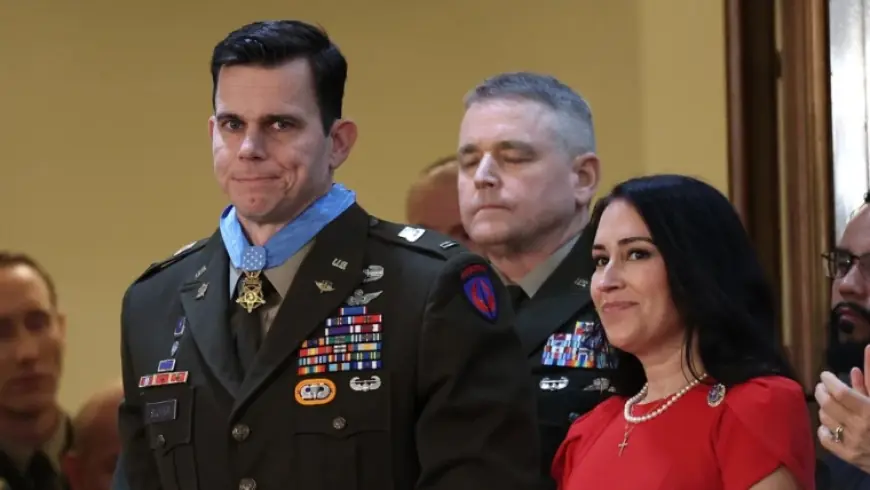
In one of the most powerful moments in State of the Union history, President Trump presented the Congressional Medal of Honor to two American warriors on Tuesday night — a feat never before accomplished during an annual address to Congress. Chief Warrant Officer 5 Eric Slover and retired Navy Captain Royce Williams became the first recipients of the nation's highest military honor ever awarded during a State of the Union, drawing bipartisan standing ovations from the full chamber.
Chief Warrant Officer 5 Eric Slover — The Maduro Raid Hero
Chief Warrant Officer Eric Slover already proved his mettle in the skies over Afghanistan, receiving the Distinguished Flying Cross for actions during a rescue mission that turned into an intense firefight. In January 2026, his proven abilities were required once again, this time over Caracas, as part of Operation Absolute Resolve — the daring raid to capture Venezuelan dictator Nicolás Maduro.
In the early morning hours of January 3, helicopters from the 160th Special Operations Aviation Regiment carrying Delta Force special operators arrived at Maduro's compound in Venezuela's capital of Caracas. Slover was piloting a CH-47 Chinook helicopter as the operation's flight lead as the U.S. troops reached Caracas. As Slover prepared to land, his helicopter came under machine gun fire "from every angle," and Slover was shot four times in his leg and hip.
What Eric Slover Did Under Fire — The Defining Moment
"Eric maneuvered his helicopter with all of those lives and souls to face the enemy and let his gunners eliminate the threat — turned the helicopter around so the gunners could take care of business — saving the lives of his fellow warriors from what could have been a catastrophic crash deep in enemy territory," Trump said. After Slover safely landed the Chinook, he told his co-pilot, who was also wounded, "Take over; I'm about ready to pass out."
Slover maintained control of the aircraft despite his wounds, executed the insertion, and ensured his crew successfully executed their objectives. He then piloted the aircraft back to the USS Iwo Jima. Within three hours, another team of helicopters would exfiltrate the assault team. Slover is still recovering from his wounds and was standing with the assistance of a walker when he received the award. A total of seven Americans were wounded in the operation.
The announcement of Slover's award marks a break with recent patterns, as he was awarded the medal just 52 days after his mission — a short turnaround similar to what was seen in World War II. Lt. Gen. Jonathan Braga, the commander of U.S. Special Operations Command, presented Slover with the Medal of Honor in the gallery overlooking the House chamber. Trump also said 10 other service members who took part in Operation Absolute Resolve will be receiving medals at a private White House ceremony.
Captain E. Royce Williams — 100 Years Old, A Secret Kept for Decades
The second Medal of Honor recognized a very different chapter of American military history. Retired Navy Captain E. Royce Williams, 100 years old, was honored for aerial combat during the Korean War — a dogfight that remained classified for decades due to Cold War sensitivities. In 1952, flying a Grumman F9F Panther, Williams engaged seven Soviet MiG-15 fighter jets in blizzard conditions over the Sea of Japan. Outnumbered and outgunned, he shot down four enemy aircraft while sustaining more than 200 bullet strikes to his own jet. His story remained largely unknown for more than half a century.
The Korean War Mission That Was Kept Secret for 50 Years
Williams and another American pilot were flying off the coast of the Korean Peninsula when they encountered seven Soviet MiG-15 fighter jets. The Soviet aircraft opened fire, and Williams struck one of the MiGs while his fellow American pilot pursued it. Then, flying alone, he engaged the remaining aircraft, downing three more Soviet planes while maneuvering through hundreds of rounds of incoming fire. Williams was instructed to keep the airborne clash a secret — a rare and politically fraught confrontation between American and Soviet forces at a moment when the two Cold War adversaries were intent on avoiding open war. For decades, he spoke of it to no one, not even his wife.
Williams' feat remained unknown to the public for decades because the Soviets were not directly involved in the war at the time. The fight lasted 35 minutes and ended with Williams guiding his bullet-ridden F9F-5 aircraft onto an aircraft carrier that worked hard to help him land safely.
The Medal of Honor Ceremony — A Historic First
This marks the first time that a president has awarded the Medal of Honor — the U.S. military's highest honor for valor in combat — during a State of the Union address. "Tonight, at 100 years old, this brave Navy captain is finally getting the recognition he deserves. He was a legend long before this evening," Trump said. Williams stood, and First Lady Melania Trump placed the medal around his neck. The chamber stood in applause for several minutes.
Rep. Darrell Issa, who introduced and helped secure passage of the "Valor Has No Expiration Act," eliminated the five-year statute of limitations for Medal of Honor awards — the very legislation that made Williams' recognition possible. "The heroism and valor he demonstrated for more than 35 harrowing minutes almost 70 years ago in the skies over the North Pacific and the coast of North Korea unquestionably saved the lives of his fellow pilots, shipmates, and crew," Issa said.
Trump framed both awards within a broader patriotic theme as the country approaches its 250th anniversary in 2026. "Everything our nation has done, everything we have achieved has been the work of those few great lifetimes," he said. The two Medal of Honor presentations cut through the partisan atmosphere of the speech with something simpler and harder to politicize: sacrifice.