
























Hurricane Melissa Aftermath: 95 Dead, Water and Health Systems Strained as Jamaica Moves into Recovery

hurricane melissa carved a path of extreme destruction with a Category 5 landfall in Jamaica and heavy impacts across Hispaniola, Cuba and the southeastern Bahamas. The scale of infrastructure damage and public-health strains has shifted the response from immediate rescue to sustained recovery, with water, disease surveillance and school repairs at the center of relief efforts.
Development details — Hurricane Melissa
The storm’s lifecycle was rapid and well-documented. A tropical wave that moved off Africa was first flagged for development on Oct. 16 and reached the Windward Islands and the eastern Caribbean Sea by Oct. 19. It was designated Invest 98L as it organized, and was named Tropical Storm Melissa at 2 a. m. EDT on Oct. 21. Warm Caribbean waters and weakening wind shear allowed the system to intensify quickly: winds rose from 70 mph at 7 a. m. on Oct. 25 to 130 mph 24 hours later. Melissa reached Category 5 intensity at 7 a. m. on Oct. 27 and maintained that peak for roughly 30 hours before making landfall in Jamaica at 1: 25 p. m. EDT on Oct. 28.
The storm’s peak intensity included sustained winds recorded at 190 mph during its strongest phase, and forecasters noted an extraordinary burst of electrical activity in the eyewall with at least 600 lightning flashes recorded in 30 minutes. The National Hurricane Center tracked these rapid changes, while NOAA had issued outlooks suggesting tropical cyclone formation weeks in advance. Meteorological analysis showed that reduced wind shear and very warm sea-surface temperatures drove the explosive strengthening that culminated in the catastrophic landfall.
Context and escalation
Melissa was the third Category 5 hurricane of the season and was the strongest tropical cyclone worldwide in 2025. One hurricane expert, Michael Lowry at WPLG-TV, noted that only four other Atlantic hurricanes have spent as much time at Category 5 intensity, underscoring the storm’s unusual severity. The storm’s slow northward turn prolonged extreme conditions over Jamaica, amplifying destructive winds and rainfall.
Those meteorological extremes translated into widespread infrastructure failure and cascading humanitarian needs. Habitats and services that were already vulnerable before the storm—due to poverty and structural inequities—were pushed into crisis, complicating both immediate relief and longer-term recovery work.
Immediate impact
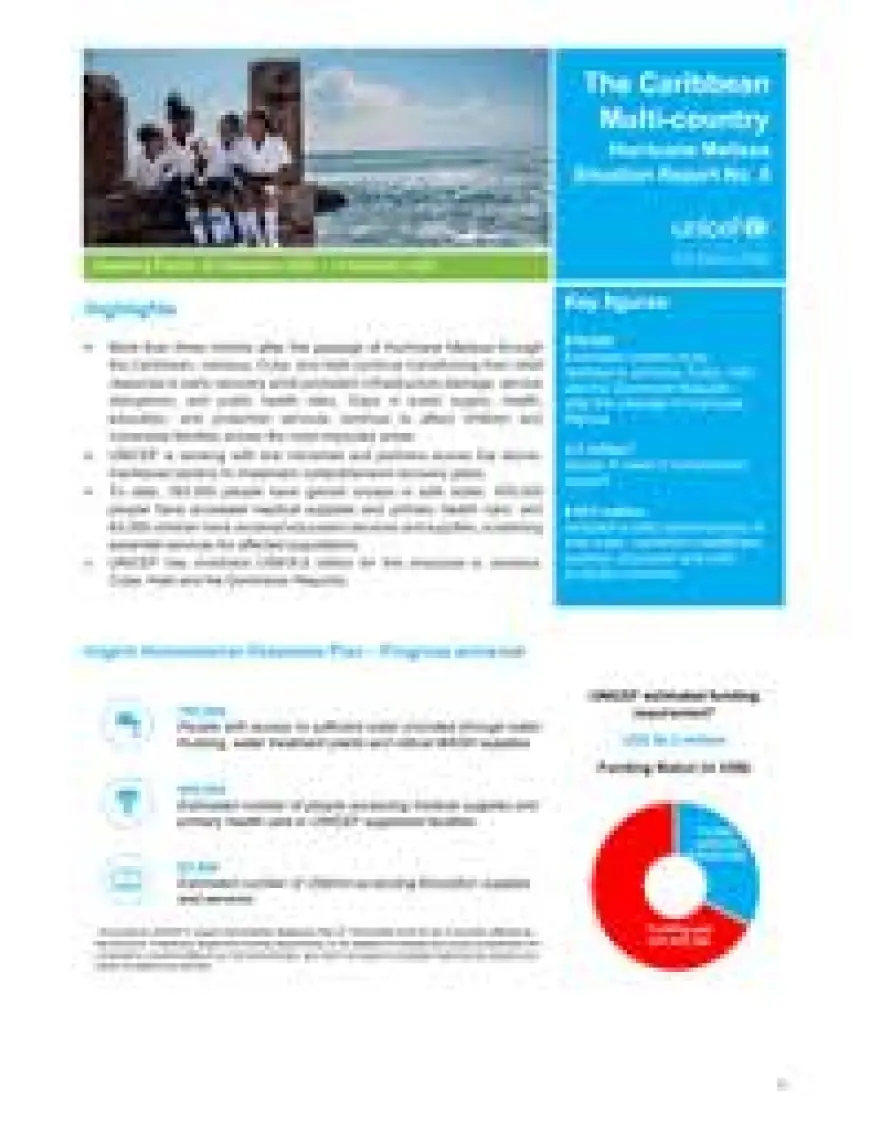
The confirmed human toll stands at 95 deaths across Jamaica, Haiti, the Dominican Republic and Cuba. In Jamaica, public health authorities, including the Ministry of Health and Wellness, continue active disease surveillance and water-quality testing in the hardest-hit parishes. Post-storm health data show 124 suspected and 40 confirmed cases of leptospirosis, with 14 suspected deaths linked to the bacterial disease. Two tetanus cases and one related death have also been recorded. Health services have adapted through mobile clinics, community outreach and shelter-based care while gaps in equipment and infrastructure remain.
Basic utilities and services are in uneven recovery. Water supply has been restored to 93 percent of customers, leaving about 42, 000 connections without service. Electricity has been restored to all hospitals nationwide. The education sector resumed classes at the start of January 2026 with all 1, 010 public schools reopened in some form; those schools had previously served roughly 169, 698 students. Nevertheless, damage persists: 56 early childhood institutions were affected, impacting approximately 2, 398 children aged 2–6. Repairs are under way, with 189 public schools assigned to contractors and another 96 scheduled for repairs. Fifteen schools remain in use as shelters for 161 people while measures are in place to maintain learning continuity.
Forward outlook
Recovery has moved from emergency response into an early-recovery phase, and multiple milestones are being tracked. Disease surveillance and water-quality testing continue as priorities, with indications of a declining trend in new leptospirosis cases but persistent public-health risks. Repair timetables for schools and childcare centers are established: nearly 300 institutions are either assigned for repair or scheduled, while sheltering operations remain necessary for displaced residents until homes are restored.
What makes this notable is that the combination of sustained Category 5 intensity, prolonged landfall impacts and pre-existing service inequities has produced a complex recovery that hinges on restoring basic utilities and rebuilding educational and health infrastructure. The near-term benchmarks—full water reconnection for the remaining 42, 000 customers, completion of assigned school repairs, and continued reductions in disease incidence—will be the clearest indicators of whether communities can shift from crisis to durable recovery.