


















State Of The Union: A vintage Trump show that told us little in the state of the union

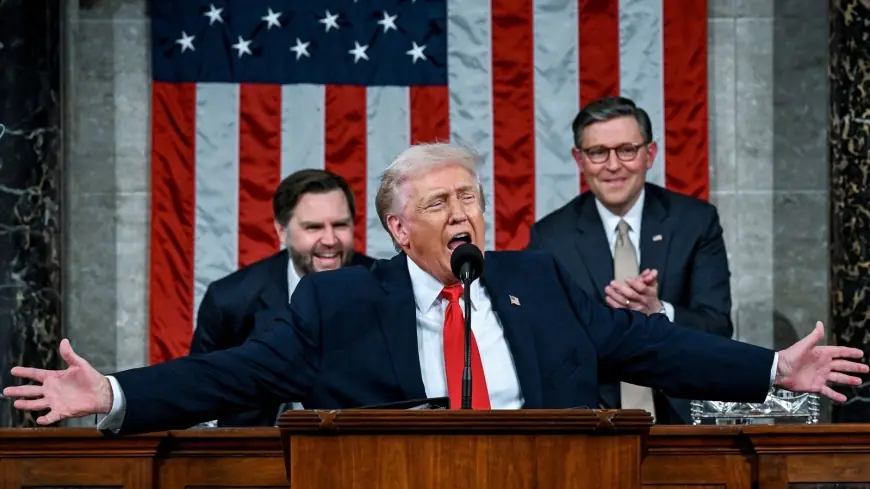
President Donald Trump delivered a 1 hour, 48 minute state of the union that leaned on familiar themes and showmanship but offered few concrete advances on key policy questions. The speech mattered because it was the longest such address in history, came amid mounting Iran tensions and a legal setback on tariffs, and arrived as the president’s approval metrics and Republican standing in a midterm year were under strain.
Length, tone and the feel of a Capitol Hill performance
Trump’s address lasted 1 hour and 48 minutes, a stretch that surpassed the previous record of 1 hour and 28 minutes set by Bill Clinton in 2000. The evening often resembled a TV game show, peppered with tributes and awards and the sort of stagecraft that has become associated with the president’s campaigning style in 2024. Observers heard a lot of material they had heard before; the address was described as vintage Trump and, in some assessments, a news event lacking a clear new news line.
Hardline Iran posture, questions about imminent action
Hardline comments on Iran and nuclear weapons featured among the speech’s dominant themes. The president revealed Iran is working on missiles that could reach the United States and at points sounded like a leader on the brink of military action; everyone in the chamber would have been listening for clues. One assessment of the policy said Trump’s plan for Iran isn't working - he has three options. Ultimately, his remarks offered a holding position that did not advance his public stance, although he continued to beat the drums of war.
Tariffs, the Supreme Court and a Section 122 proclamation
The speech came after the US Supreme Court ruled last week that large portions of the reciprocal tariffs announced earlier were illegal, a decision described as the most substantial setback the Court has handed any of his policies. Trump lambasted the justices over the ruling, albeit less harshly than in prior public attacks. The full court had been invited but on Tuesday only four of the nine justices were present in the chamber: Chief Justice John Roberts, and Justices Amy Coney Barrett, Elena Kagan and Brett Kavanaugh.
When he approached the front row, Trump shook the hand of Roberts; the two shared a serious look, a possible sign of lingering tension after the levies ruling. Cameras also caught Amy Coney Barrett, whom Trump nominated during his first term; she showed no emotion as he called the ruling "disappointing" and "unfortunate. " In response to the reversal, Trump said he would turn to other laws and announced a new 15% tariff that he said would replace the levies the high court struck down. He implemented the tariff by proclamation under a law identified as Section 122, which the context notes gives the president power to impose tariffs up to 15% for 150 days, at which point Congress must step in. On Tuesday he said "congressional action no go dey necessary" and later said the tariffs would replace the income tax. Separately, the trade representative indicated tariffs will rise for some countries.
Economy, affordability and domestic measures cited by the president
Trump used the address to sell his stewardship of the US economy, saying his policies had produced a "turnaround for the ages" and opening with the line: "Our nation is back: bigger, better, richer and stronger than ever before. " He closed with a similarly expansive promise: "Our future will be bigger, better, brighter, bolder and more glorious than ever before. " He pointed to Wall Street’s continued strength and strong job numbers while glossing over slower-than-expected growth in 2025. Inflation, the speech acknowledged in context, has eased somewhat but has not "plummeted"; January data from the Bureau of Labor Statistics showed food prices were still 2. 9 percent higher than the same period the prior year.
On affordability, Trump largely blamed Democrats, including former President Joe Biden, whose term ended over a year ago when Trump took office, saying: "Their policies created the high prices; our policies are rapidly ending them. " He highlighted a TrumpRx website intended to offer potentially cheaper medications to people without insurance, said he had struck a deal with tech companies to keep utility bills low despite demands from AI data centres, and pointed to an executive order limiting Wall Street investment firms from buying single-family homes in bulk. Yet the speech was delivered amid notes that Americans "aren't feeling it in the numbers he needs, " that the president’s popularity has plummeted in the polls, and that his approval rating has slumped to the lowest since his second term began — a political standing that requires shoring up Republican deserters in a crucial mid-term election year. It remains unclear if his claims will produce the electoral bump needed to hold the House and Senate in November.
Spectacle, guests and partisan protests
Beyond policy, the evening included theatrical moments: tributes and awards, a reunion between Venezuelan politician Enrique Marquez and his niece, and a tribute to the late Charlie Kirk. The president was described as showbiz-ready and comfortable on stage, and he condemned political violence. Opposition was also evident: dozens of Democrats, including some in leadership, did not attend and instead held rallies in Washington in opposition to the president and his agenda. Inside the chamber the absence of many Democrats left rows of seats empty on one side from multiple camera angles, and some of the Democrats who did attend staged their own protests.
Other items mentioned around the address included a plan to send a "great hospital boat" to Greenland to "take care of the sick" and a directive to release government files on "alien and extraterrestrial life, " both noted alongside the president’s broader evening of announcements and stagecraft.