














Mexico Cartel leader killed as Puerto Vallarta burns and soccer matches are postponed

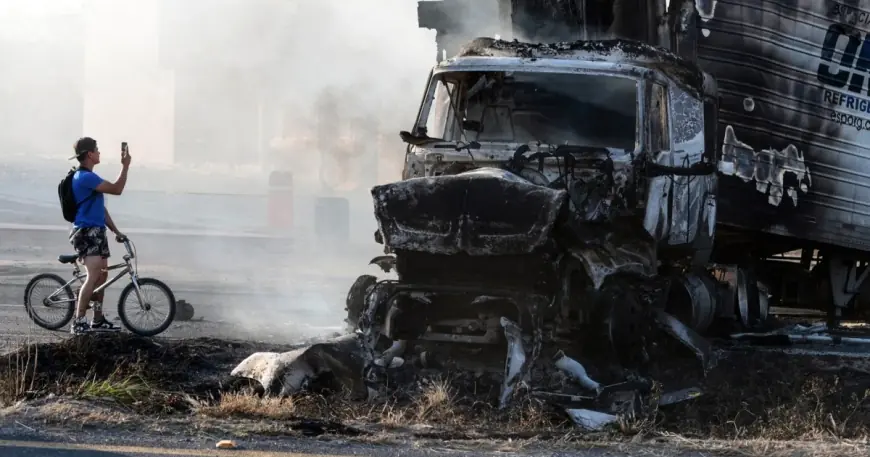
The Mexican military killed Nemesio Rubén Oseguera Cervantes, known as El Mencho, and the country saw an immediate security backlash that left Puerto Vallarta smoldering and sporting events disrupted. The incident involving the mexico cartel has prompted travel disruptions, school cancellations and a request for security reviews ahead of major international matches.
How El Mencho died and differing location accounts in Jalisco
The coverage states the Mexican military killed Nemesio Rubén Oseguera Cervantes, nicknamed "El Mencho, " the head of the New Generation drug cartel. One account describes a shoot‑out 180 miles east of Puerto Vallarta in the state of Jalisco. Another account says he was wounded in Tapalpa, Jalisco, about a two‑hour drive southwest of Guadalajara, and died while being flown to Mexico City. Mexico had offered a $15 million reward for his capture.
Puerto Vallarta: smoke, burned vehicles and a city on edge
Smoke filled the sky as shops and cars were set ablaze, allegedly by cartel members, and tourists and residents cowered. Burned‑out shells of vehicles remained on the streets and damaged stores were heavily scorched. Streets were deserted Monday as locals and tourists heeded remain‑in‑place orders, and schools in several states canceled classes. Road closures affected some travelers' ability to get to airports, U. S. and Mexican embassy and consulate.
Eyewitness accounts: two waves of attacks and targeted barricades
Witnesses described coordinated chaos. Marcus Brady, a Chicago resident currently in Puerto Vallarta, said the violence came in two waves starting early Sunday morning: initial fires on the main road and bridges in and out of the Zona Romántica, concentrated behind the foothills, followed by a second, worse wave that struck inside the zone. Brady said buses and taxis had been positioned at intersections as barricades during the night and then set on fire so the blockades would last all day. He said the intent was to terrify and to send a message to the Mexican government and to American and Canadian tourists.
Jim Beck, an American tourist who sheltered in his Puerto Vallarta hotel, said he saw taxicabs blown up and blocking the streets and that it was the first time he felt fear. Yoni Pizer said he, his husband and friends had to run for their lives from what he described as members of the Jalisco New Generation Cartel; gunmen were following and shooting, attacking cars and pulling out drivers. Pizer's SUV was torched, and a passerby helped them escape. Steven Polito, a drag performer who divides his time between New York City and Puerto Vallarta, said he was struck by how "unusually quiet it was" when he went to the gym at 8: 30 a. m. Sunday and that the scene was very different when he left around 10: 00 a. m.
Video showed several cars in the parking lot of a Costco set ablaze. Social media footage captured sirens blaring and passengers and workers running through the airport in Puerto Vallarta; images showed a long line of people hiding behind ticket counters, and it was unclear why the sirens went off or why people were running.
Mexico Cartel fallout: burnings, roadblocks, and postponed matches
Following El Mencho's death, cartel members burned cars and blocked roads in nearly a dozen Mexican states. The violence led to the postponement of four high‑level soccer matches Sunday after the Mexican army killed the cartel leader in a town close to Guadalajara. Two top‑tier games were postponed — Queretaro vs. Juarez FC in the men's tournament and Chivas vs. America in the women's league — and two matches in the second division were called off.
Mexico's national team has a friendly against Iceland scheduled for Wednesday at the Corregidora stadium in Queretaro; the Mexican soccer federation has not made any public moves to postpone it and the team was training as planned on Monday ahead of the game. FIFA's inter‑confederation playoff for two of the remaining six World Cup spots is set to be played in Guadalajara and Monterrey in March, and the world soccer governing body requested a status report on security from the Mexican federation on Monday ahead of the games. Guadalajara is scheduled to host four World Cup games in June, including two involving South Korea; co‑host Mexico, Spain, Uruguay and Colombia will also play there.
The CJNG — Cartel Jalisco Nueva Generación — is considered the most powerful cartel in Mexico, with an estimated 19, 000 members and operations spanning 21 of the 32 states. It has been designated a foreign terrorist organization by the Trump administration.
Meanwhile, the Mexican Open, an ATP tennis tournament, was set to begin Monday at the GNP Arena in Acapulco, Guerrero; organizers issued a statement Sunday saying that "the tournament's operation continues as normal. "