




















Connor Hellebuyck’s 41-save night reshapes who felt the Olympic gold most — teammates, rivals and even political figures

Who felt the impact first was obvious: Team USA’s roster, Canadian attackers who left the ice stunned, and public figures who turned a game-saving stop into a nickname. Connor Hellebuyck’s 41 saves kept the gold-medal match tied and forced overtime in a 2-1 U. S. victory, and the ripple effects were immediate — on-ice momentum, locker-room belief and a political quip that stuck.
Impact on teammates, opponents and public figures after Connor Hellebuyck’s night
Here’s the part that matters: Hellebuyck’s sequence of stops altered how the game felt in real time. Teammates rallied around those saves; opponents watched grade-A chances evaporate; outside observers turned a single dramatic stop into a wider cultural moment by dubbing him a wartime-style nickname that drew an on-the-record endorsement. That shift carried beyond the scoreboard — it shaped celebration, commentary and the postgame imagery of an American flag-draped goalie circling the ice.
Key plays and scoreboard essentials
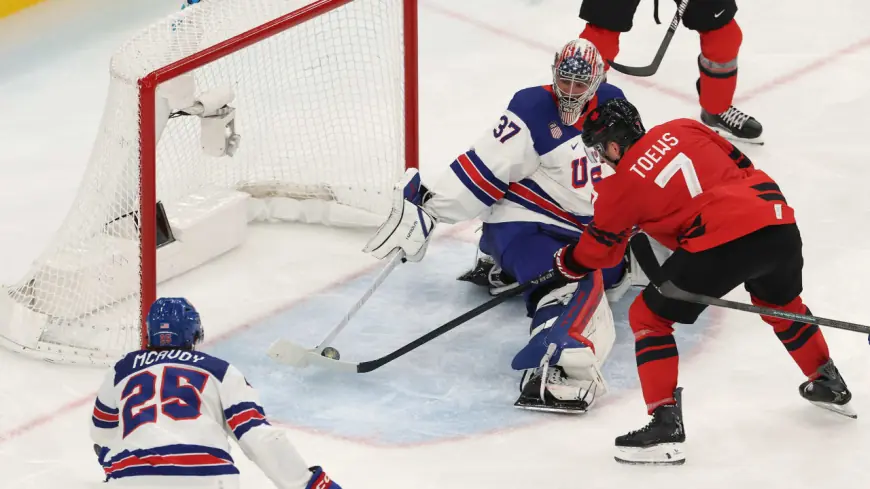
Score and decisive plays compressed: Team USA won 2-1 in overtime, with Jack Hughes scoring the game-winner past Canada’s netminder Jordan Binnington. Connor Hellebuyck finished with 41 saves. He made a pivotal stop on a Devon Toews shot in the second period, using only his stick to keep an apparently open net out and preserving a 1-1 score that held through the third period and into overtime.
- Hellebuyck allowed a goal to defenseman Cale Makar in the second period but followed with several key saves that kept the U. S. alive.
- Canada missed other high-quality chances; assistant captain Nathan MacKinnon failed to convert a wide-open net in the third period.
- The game was played at an arena in Milan tied to the Milano Cortina 2026 Winter Olympic Games on Feb. 22, 2026; the arena name appears with variant spellings in the available information (unclear in the provided context).
- After the final horn, the 32-year-old goalie skated alone with an American flag on his back as the crowd roared, and he said after the game, "It's a dream come true. "
What's easy to miss is that the stick-and-blade detail is described in slightly different ways across accounts: one description emphasizes a last-second turn with his right hand and paddle placement, another highlights reaching behind and making the blade contact. Both point to the same effect — an improbable stop in tight quarters.
Reactions, comparisons and what veterans highlighted
Former goalie Mike Richter was flabbergasted and compared the moment to the work of celebrated Olympic netminders, invoking names from past tournaments and noting he watched the save repeatedly. Richter emphasized the trait he admires most: a goalie who refuses to give up on the puck. Defenseman Charlie McAvoy called the Toews stop the turning point, recounting that he was shouting from the bench that the play would be remembered. Canada forward Sam Bennett noted that Canada generated looks but ultimately had to "tip your hat" to the goalie, saying sometimes a goalie simply steals a game.
Richter’s own past includes backstopping a U. S. team to a high-profile win against Canada in 1996, a detail he brought into his reaction as context for how rare and significant such saves can feel.
The nickname, the endorsement and immediate aftermath
A social media account called Hellebuyck the "Secretary of Defense, " and U. S. Secretary of War Pete Hegseth endorsed that label, saying, "Now we have a Secretary of War…and a Secretary of Defense!" The context notes that Hegseth previously held that title before the agency he heads became known as the Department of War last September. That exchange fed into a broader show of American pride after the win over Canada.
The real question now is how this performance will reshape Hellebuyck’s standing either in future international play or in longer-term narratives about U. S. goaltending — confirmation will come through subsequent starts and how opponents adjust to him.
Mini timeline
- Feb. 22, 2026 — Match played in Milan during the Milano Cortina 2026 Winter Olympic Games; Hellebuyck makes the pivotal second-period stick save and finishes with 41 saves.
- Game ends 2-1 in overtime after Jack Hughes scores the winner past Jordan Binnington; the 1-1 tie held through the third period before overtime.
- The result gave the U. S. its first Olympic men’s hockey gold since 1980 — a year recalled when Jim Craig made 36 saves in a 4-3 victory, noted in the same set of reflections as a historical echo (stated as "on this very day 46 years ago" in the available material).
Key takeaways:
- Connor Hellebuyck’s 41 saves were the single-biggest on-ice factor in shifting momentum for Team USA.
- Opponents had multiple high-quality chances that went unrewarded, including a missed open net by Nathan MacKinnon in the third.
- Veteran voices framed the Toews stop as elite-level desperation and effort — a characteristic that often defines memorable Olympic performances.
- The political nickname and public endorsement amplified the moment into a cultural marker beyond sport.
- Confirmation of lasting impact will depend on future starts and how Hellebuyck’s peers and opponents respond.
Sportscaster Jim Gray discussed the victory and a correspondent named Madison Scarpino reported on the postgame scene; those on-ice and off-ice reactions combined to make a single night feel larger than one game. The real test will be whether this performance becomes a defining moment in Hellebuyck’s career rather than a brilliant peak.