

























New York Hit by 'Near Impossible' Travel, Road Bans and Massive Outages as Northeast Blizzard Forces Millions Indoors

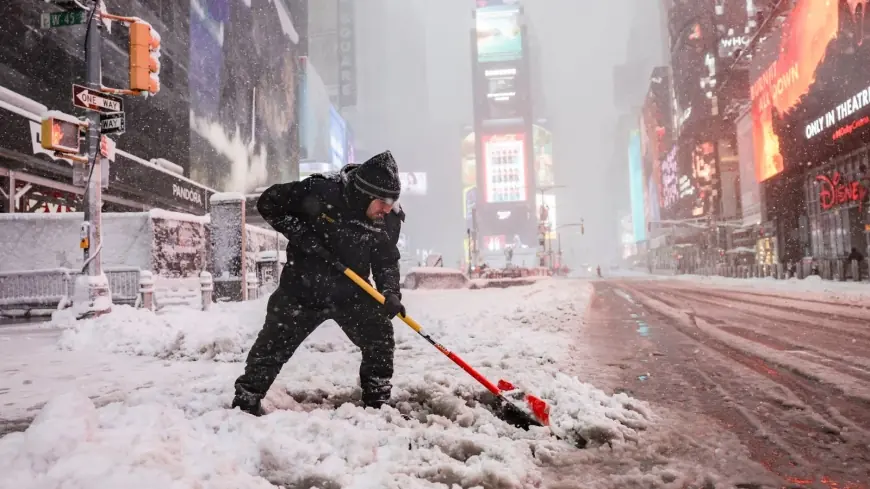
Who feels the impact first: commuters, emergency crews and power customers. In new york the storm has created whiteout and 'near impossible' travel conditions that have shut roads, grounded thousands of flights and left hundreds of thousands without power — all while city crews work 12-hour shifts to keep streets moving. Here’s the part that matters for residents and services on the front lines.
New York impact: travel banned, sanitation crews mobilized and a historic blizzard warning
Non-emergency road travel has been banned in New York City because of dangerous blizzard conditions. The city’s mayor, Zohran Mamdani, says 2, 300 snow ploughs and 700 salt spreaders are operating, and 2, 600 sanitation workers are deployed in 12-hour shifts. New York's Department of Sanitation is described as working around the clock to keep NYC moving. It is the first time in nine years that New York City has been under a blizzard warning; the mayor called it the 'first old-school snow day since 2019. ' Snow in parts of the city is shin-deep, trees have fallen across streets, and time-lapse footage shows the Empire State Building engulfed by snow overnight. A man was seen skiing in Central Park as more than 19 inches fell there; some areas have seen more than two feet.
Storm snapshot and geographic sweep
- Winter storm warnings stretch from North Carolina to northern Maine, with warnings also in parts of eastern Canada.
- Six states declared a state of emergency: New York, New Jersey, Massachusetts, Connecticut, Delaware, and Rhode Island; additional warnings were issued in Pennsylvania, Maine and New Hampshire.
- Blizzard warnings now cover almost 70 million people across the region.
- Parts of the country have seen over 32 inches (83 cm) of snow fall.
Snow is expected to persist through Monday, with some areas near the northeast coastline forecast to see a total of one to two feet by Tuesday morning. The storm will then move toward the Canadian Maritimes, while southern New England and New Jersey may see relief by late Monday. Maine could see heavier snow and gale-force winds into the evening as the storm moves east.
Air travel and school disruptions
Flight cancellations are widespread but counts vary: one flight-tracking tally exceeded 5, 600 cancellations on Monday, another count listed more than 5, 000 cancelled flights, and a separate total counted 5, 300 cancelled with more than 700 delayed. Nearly 90% of flights out of JFK airport were cancelled, with the figure even higher at LaGuardia and in Boston. School classes in New York City, Boston and Philadelphia have been cancelled or moved online.
Power outages, hardest-hit states and local effects
Hundreds of thousands of customers have lost power across the northeast. As of Monday afternoon, more than 600, 000 homes and businesses were without power. A power-outage tracking site listed almost 650, 000 homes affected after the storm intensified across several states; one state-level tally showed nearly 300, 000 without power in Massachusetts, including 85% of customers in Barnstabel County (which includes Cape Cod and surrounding areas). New Jersey had about 125, 000 without power. In Massachusetts, another figure showed roughly 255, 000 homes without power.
Wind, pressure concerns and what could follow
Wind gusts up to 60 mph were recorded, with wind chills measured at -15°C (5°F) in New York. A meteorologist warned that conditions were expected to rapidly deteriorate and that the storm could possibly become a bomb cyclone — a storm that drops at least 24 millibars in pressure over 24 hours — and may meet that definition when the system finishes. Parts of the northeast may not be fully in the clear on Tuesday: a cold low pressure system moving out of the Upper Great Lakes is forecast to bring more snowfall to some areas, including parts of Michigan; that system was described as 'set to pack a punch, ' with travel disruptions likely.
What’s easy to miss is the scale of municipal effort paired with infrastructure strain: thousands of ploughs and crews are active while outages and travel bans keep people at home across multiple states.
Edited by Brandon Livesay and Oliver O'Connell in New York.
The real question now is how quickly power and flights can be restored and whether the follow-on low from the Great Lakes will prolong disruptions. If you’re wondering why this keeps coming up, look at the combination of heavy snowfall totals, strong gusts and the pressure changes that can escalate a storm into rapid intensification.
Key signs that will indicate the next phase: restoration tallies dropping below the current outage figures; updated flight tallies moving from cancelled to delayed to resumed; and whether the follow-up low actually brings additional measurable snowfall to the already-hit zones.