

























Supreme Court Strikes Down Trump Tariffs: SCOTUS Tariff Ruling Sends Shockwaves Through Markets

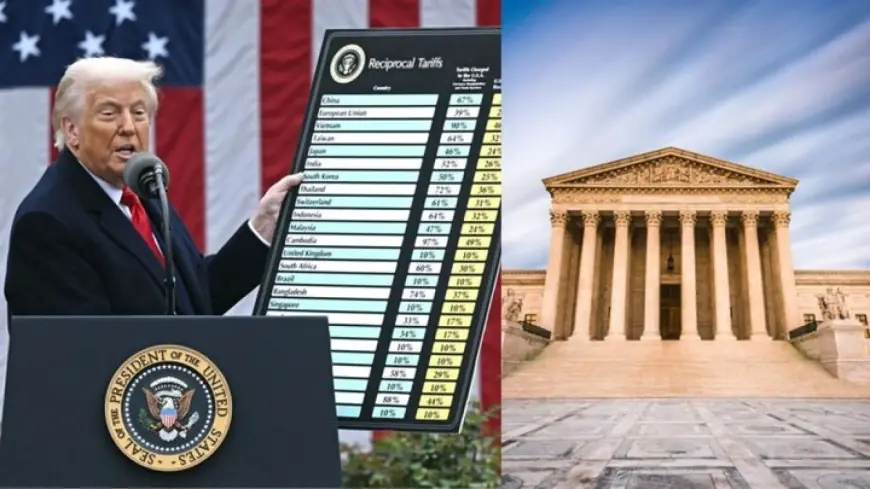
In a landmark 6-3 decision delivered February 20, 2026 at approximately 10:00 AM ET, the Supreme Court struck down President Donald Trump's sweeping IEEPA tariffs, ruling that the International Emergency Economic Powers Act does not grant the president authority to unilaterally impose tariffs. The Supreme Court tariff ruling — arguably the most significant economic case to reach SCOTUS in years — immediately rattled the Dow Jones, S&P 500, and Nasdaq while forcing the Trump administration to scramble for alternative tariff authorities.
The SCOTUS Tariff Ruling: What the Supreme Court Decided
Chief Justice John Roberts wrote the majority opinion in Learning Resources, Inc. v. Trump, joined by Justices Sonia Sotomayor, Elena Kagan, Neil Gorsuch, Amy Coney Barrett, and Ketanji Brown Jackson. Roberts wrote that Trump had asserted "extraordinary power to unilaterally impose tariffs of unlimited amount, duration and scope," but pointed to no statute authorizing IEEPA to apply to tariffs.
Justices Clarence Thomas, Samuel Alito, and Brett Kavanaugh dissented. In his dissent, Kavanaugh warned the federal government "may be required to refund billions of dollars to importers who paid the IEEPA tariffs."
The Supreme Court ruling on tariffs does not affect industry-specific duties. Section 232 tariffs on steel, aluminum, autos, and heavy trucks remain in place and are estimated to raise $635 billion over the next decade.
Trump Tariffs Struck Down: The IEEPA Legal Background
Trump relied on IEEPA — a 1970s-era emergency law — to levy the import duties challenged in the case. That law allows a president to "regulate … importation" during emergencies, but the businesses noted the words "tariff" or "duty" never appear in the law.
The Court found that treating IEEPA as tariff authority "would represent a 'transformative expansion' of the President's authority over tariff policy" and replace "the longstanding executive-legislative collaboration over trade policy with unchecked Presidential policymaking."
The Supreme Court tariff decision confirmed lower court rulings. The U.S. International Court of Trade unanimously ruled the IEEPA tariffs illegal on May 28, 2025, a decision upheld by the U.S. Court of Appeals on August 29, 2025.
Trump's Response: Section 122 and a New 15% Global Tariff
Trump did not accept the Supreme Court ruling quietly. The president announced a "10% global tariff" hours after the decision and on Saturday raised it to 15%, invoking Section 122 of the Trade Act of 1974.
Trump called the ruling "deeply disappointing." He also warned on Truth Social that countries attempting to leverage the SCOTUS tariff decision in trade negotiations would face even higher duties. Scott Bessent, Treasury Secretary, previously signaled the administration held "lots of other authorities that can be used" if IEEPA tariffs were struck down.
Section 122 has never been invoked in its 50-year history and will almost certainly face its own legal challenge.
Refunds: What Importers Need to Know
| Item | Detail |
|---|---|
| IEEPA tariffs collected (est. through Feb. 20) | ~$160 billion |
| Potential refund pool (Penn Wharton estimate) | Up to $175 billion |
| Case remanded to | U.S. International Trade Court |
| Timeline for refunds | Months; process expected to be complex |
| Section 232 tariffs affected? | No — remain in effect |
The case has been remanded to the U.S. International Trade Court to address the refund question. If IEEPA tariffs are fully refunded to importers, it would erase nearly three-fourths of the new revenues from Trump's tariff program.
Stock Market Today: Dow Jones, S&P 500, and Nasdaq React
Markets delivered a split verdict across two sessions:
Friday, February 20 (ruling day): The S&P 500 advanced 0.69% to close at 6,909.51, the Nasdaq gained 0.9% to 22,886.07, and the Dow Jones Industrial Average added 230.81 points, or 0.47%, closing at 49,625.97.
Monday, February 23 (post-weekend tariff hike): The Dow Jones fell 635 points, or 1.3%, after Trump raised global tariffs to 15%. The S&P 500 shed 0.6% and the Nasdaq dropped 0.7%. Gold futures surged more than 2%, while Bitcoin slid below $65,000.
What Happens Next: Tariff News and Trade Uncertainty
Despite the Supreme Court ruling, tariffs are not going away. Trump said he would use other avenues to tax imports, and he's looking at additional measures that would require Commerce Department investigations.
U.S. trading partners cautiously welcomed the ruling, but expressed concern that tariffs could still arrive in other forms, keeping the situation murky for businesses globally. The European Commission has demanded full clarity from Washington, and trade deal partners from Canada to China are reassessing their positions.
The SCOTUS tariff ruling is a historic rebuke of executive overreach — but with Section 122 tariffs already in place and a White House vowing to find every available legal tool, America's tariff battle is far from over.