

























Jamaican Bobsled Team Backed by New York Mechanic as Caribbean Crews Battle at Winter Games

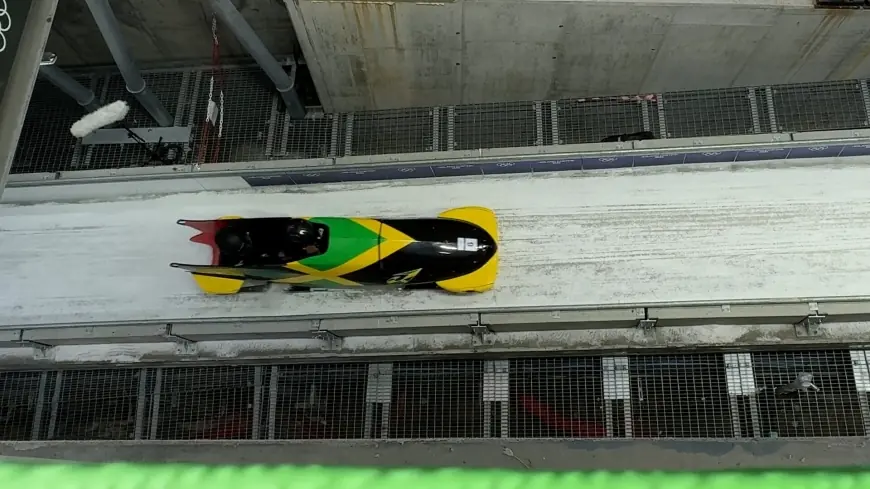
The jamaican bobsled team has leaned on a devoted mechanic based in western New York to maintain fragile sleds amid vibration and wreckage, while Caribbean rivals have been making headlines with mixed on‑track results and cultural reverberations from the film Cool Runnings. The combination of hands‑on engineering and media attention has shaped both performance and public perception at these Winter Games.
Development details: Jamaican Bobsled Team mechanic, media and results
Dave Kiernan, who identifies himself as the mechanic with the Jamaican bobsled team, lives and works near the training track in western New York and traces much of his mechanical experience to tuning cars and racecars. He previously worked on vehicles at the track formerly known as Miller Motor Sports Park in Tooele, Utah. Kiernan says sleds suffer intense noise and vibration that frequently break carbon fiber and welds, and he emphasized the importance of meticulous repairs in a sport where outcomes are decided by hundredths or even thousandths of a second.
On the media side, the current Jamaican four‑man squad has leaned into the island’s cinematic past: the team appears in an ad for a short‑term lodging company that is full of references to the 1993 film Cool Runnings. The island’s bobsledders have returned to the four‑man race this year with an explicit aim of bettering the 1994 Jamaican team, which finished 14th.
Context and escalation
The Winter Games environment has exposed two parallel narratives: one technical, one cultural. Mechanically, Kiernan contrasts cars with bobsleds by noting cars have engines and many parts, while bobsleds demand intimate attention to human elements and structural integrity. He and his crew have responded to frequent damage—citing broken carbon fiber and welds—by keeping sleds functional between heats and events. What makes this notable is how narrowly defined margins in timing magnify the consequences of every mechanical failure.
Culturally, Cool Runnings remains a touchstone decades after its release, especially among non‑Jamaican audiences. On the island, reactions are more mixed: the film initially drew enthusiasm and memorable audience moments when it first screened, but for some Jamaicans it also became a persistent shorthand for the country in foreign encounters. That split in feeling has resurfaced as the team embraces playful nods to the movie while pursuing competitive improvement on the ice.
Immediate impact
Mechanical preparedness and media visibility have immediate effects on performance and public attention. On the ice in Cortina, the Trinidad and Tobago two‑man sled—piloted by 33‑year‑old Axel Brown with brakeman De Aundre John—finished 25th out of 26, posting an overall time of 2: 51. 05 and finishing ahead of one nation. Brown described meeting the team’s primary goal of not finishing last as "mission accomplished. " The pair produced their quickest run in heat three but, finishing outside the top 20, did not advance to the final heat.
For Trinidad and Tobago, qualification itself carried significance: the nation managed to qualify for both the two‑man and four‑man events for the first time, a task described as demanding. Brown, who raced for Team GB for seven years before switching to represent his mother’s nation, called qualification a victory in its own right and will return to competition in the four‑man event later this week.
Forward outlook
Mechanics will remain central as crews prepare for remaining heats and the four‑man races. The Jamaican squad’s use of nostalgic imagery in advertising coincides with an explicitly competitive aim—surpassing the 1994 finishing mark of 14th in the four‑man event—which adds pressure to both performance and equipment upkeep. For Trinidad and Tobago, the next measurable milestone is the four‑man event entry later this week, following their 25th‑place finish in the two‑man competition; that entry represents the completion of a dual‑qualification process achieved for the first time.
Officials, athletes and support staff face a tight timeline: with heats concluded and team schedules moving into four‑man racing, mechanical repairs, sled setup and final runs will determine who advances and who leaves the Games without a final‑heat appearance. The broader implication is evident: small technical margins and cultural narratives are intertwined, shaping both results on the ice and how Caribbean bobsledding is seen off it.