
























Pilot's haunting final words before 1980 crash as flights tenerife turned deadly

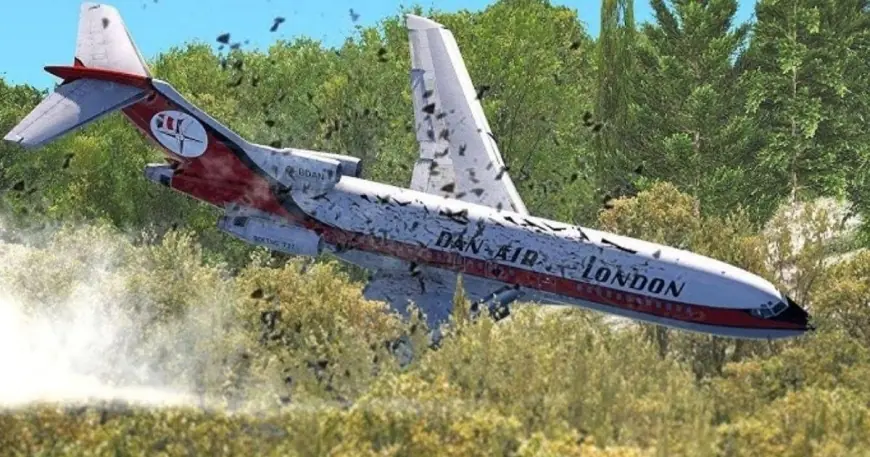
On April 25, 1980, a routine holiday flight from Manchester to Tenerife ended in catastrophe, killing all 146 people on board. New reconstructions of the final minutes highlight a chain of decisions, a missing readback and desperate cockpit warnings that could not prevent the Boeing 727 from striking mountainside terrain.
What unfolded on the approach
The aircraft departed in clear circumstances and had flown uneventfully for about three hours. Problems began as the jet neared Tenerife North: unusual winds forced air traffic control to switch approaches to Runway 12. Tenerife North sits at roughly 2, 000 feet elevation and, in poor visibility, the surrounding terrain presents a severe hazard to arriving aircraft.
Without radar coverage at the tower, the controller on duty used procedural techniques to manage traffic. With another aircraft already inbound to the same runway, the controller instructed the Dan-Air crew to enter a holding pattern. At 9: 18 AM ET the controller conveyed a left-hand holding instruction over the frequency. The captain acknowledged with a single "Roger" but did not read back the detailed heading and manoeuvre the controller had given. That omission would prove critical.
Instead of establishing a published holding pattern aligned with the coastline or over water, the crew executed a single left-hand circuit and adopted a heading of roughly 150 degrees. That track took the jet into mountainous terrain where the minimum safe altitude was well above the flight's current level. The aircraft consequently descended below safe height while the crew believed they were over water.
Final minutes inside the cockpit
As the aircraft continued the improvised holding action, confusion mounted in the cockpit. One pilot questioned the geometry of the hold, noting that it "doesn't parallel with the runway or anything". A short time later the ground proximity warning system activated, screaming "pull up, pull up!" into the flight deck. Instead of initiating a positive climb, the captain made a sharp right turn. That manoeuvre steepened the descent profile and reduced the margin to terrain.
Flight recordings capture the tension in the final seconds. The flight engineer can be heard urging, "let's get out of here, " followed by frantic warnings of "bank angle, bank angle!" The crew's last efforts could not avert impact: the aircraft collided with the slopes of Mount La Esperanza at an altitude around 5, 450 feet, just short of the summit. The crash occurred at approximately 5: 20 AM ET on April 25, 1980, when local time was about 9: 20 AM.
Aftermath and lessons
The accident eliminated 146 passengers and crew and prompted scrutiny of communications, procedures and the layout of holding patterns for the airport. Investigations emphasized the importance of explicit readbacks between controllers and flight crews, a stronger reliance on standardised holding patterns, and the critical role of onboard warning systems when terrain clearance margins shrink.
Tenerife had already been the scene of the world's deadliest aviation disaster three years earlier, underscoring how the island's geography and weather can amplify small errors into tragedy. This 1980 crash remains a stark example of how human factors, procedural gaps and challenging operating environments combine to produce fatal outcomes.
Modern procedures and technologies have reduced—but not eliminated—such risks. The reconstruction of these last moments serves as a reminder that clear, unambiguous communication and adherence to published procedures are essential safeguards when flights to Tenerife and other challenging destinations operate under pressure.