
























Swiss train avalanche: Five injured as commuter service derails near Goppenstein

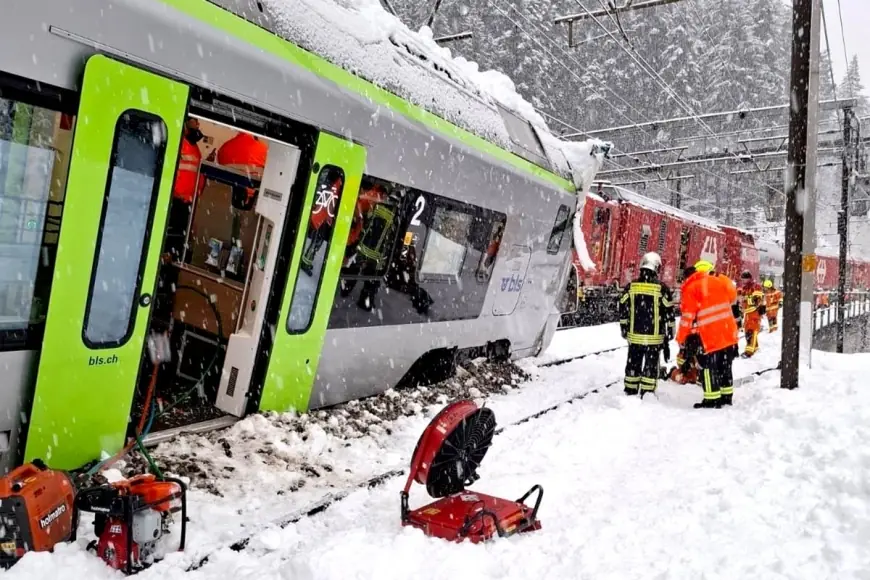
Early Monday, a regional commuter train derailed after a snow slide crossed the tracks near the village of Goppenstein, injuring five people and prompting a full evacuation of passengers. Emergency teams reached all 29 travellers on board and moved them to safety while investigators probe whether the avalanche caused the accident.
What happened
The derailment took place at about 1: 00 AM ET as the train emerged from the Lotschberg rail tunnel on its journey from Spiez to Brig. Police said the avalanche may have crossed the line shortly before the train passed, forcing several carriages off the tracks near Goppenstein, a transport hub at the tunnel’s southern exit.
All 29 passengers were evacuated from the stricken train. Five people suffered injuries; four were treated at the scene while one person was taken to hospital. Mountain rescuers, ambulance teams and an air ambulance were deployed to assist with evacuation and medical care. Snow remained on and around the tracks as crews secured the site.
Conditions and wider avalanche danger
The derailment occurred amid a period of heavy snowfall and storms that have left large swathes of the western Alps at heightened avalanche risk. The region around Goppenstein was under the second-highest warning level—grade four on a five-step scale—indicating very dangerous conditions. The national institute monitoring snow and avalanches has warned that fresh, heavy snow layers over weaker internal layers have produced an unstable snowpack across the mountains.
Over recent days avalanches across the Alpine arc have claimed lives and prompted evacuations. Authorities closed roads and moved residents in vulnerable valleys; one nearby village evacuated around 50 people in response to the heavy snow. Rescue services and mountain safety officials have urged skiers and hikers to stay on marked slopes and to check avalanche bulletins before heading into the mountains.
Response and the investigation
Emergency services focused first on rescuing and treating passengers, then on stabilising the scene and reopening the rail corridor. Local police said they had cordoned off the area while search and rescue teams worked. The regional operator suspended services on the affected line pending assessments of track damage and safety conditions.
The public prosecutor’s office has opened a formal investigation to establish the precise cause of the derailment and to determine whether the avalanche directly hit the train or if snow and debris on the line led to the accident. Authorities will also review weather and avalanche warnings in force at the time, operational procedures for running trains through high-risk zones and how quickly emergency protocols were enacted.
For now, the incident underscores the broader challenge facing transport and mountain communities during an intense winter spell: heavy and wind-deposited snow can overload fragile layers in the snowpack, turning otherwise familiar valleys and routes into hazardous terrain. Officials have reiterated safety guidance for anyone in the Alps and warned that until conditions stabilise, natural and human-triggered avalanches remain a significant threat.