
























Brignone Roars Again: Giant Gold, Rivals Kneel — and Sofia Goggia Falls Silent

Federica Brignone claimed a stunning second gold at the Winter Games, producing a composed, almost clinical giant slalom run that left the field in awe. At 8: 25 AM ET she crossed the line to complete a remarkable comeback season, while one of her country’s best-known racers, Sofia Goggia, saw hopes evaporate in the second run and offered little visible reaction afterwards.
Dominant run and a historic double
Brignone posted the winning combined time of 2: 13. 50, adding giant slalom gold to the super-G title she took just days earlier. The victory underlined a career-defining return from injury: she had resumed racing in November after a long layoff and managed to peak when it mattered most. The lines she drew were precise and measured — edge control, clean transitions and an economy of movement that neutralized any rough snow or traps in the course.
The result also reinforced Brignone’s standing among the most decorated Italian winter Olympians. At 35 years and 213 days she became one of the oldest champions in the sport’s Olympic history, further burnishing a legacy built on consistency and resilience.
Gesture of respect: rivals on their knees
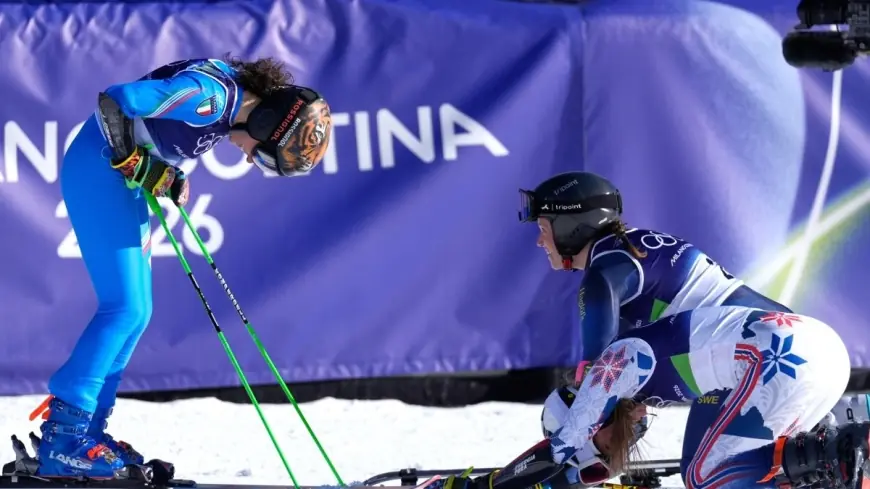
When Brignone pulled into the finish area the emotional reaction from her competitors was immediate and striking. The second-place tie — shared by Sweden’s Sara Hector and Norway’s Thea Stjernesund — dissolved into a spontaneous show of admiration: both women ran to Brignone and sank to their knees at her ski boots, a rare, almost theatrical acknowledgement of the Italian’s performance. The embrace that followed was warm and genuine, framed by the stunned but celebratory crowd on the Toffane slopes.
The tableau spoke to the gap Brignone created on the day: athletes who had every reason to race through pain or caution instead chose to honor the best run, a moment that mixed competitive humility with recognition of a champion’s courage and craft.
Sofia Goggia’s silence and missed chance
Sofia Goggia began the event in promising fashion but unravelled in the second run. Once perched in medal contention, Goggia dropped to 10th place by the end, finishing 0. 87 seconds off the winning pace. The slide was a dramatic reversal for a racer known for fearless attacking lines; the second descent exposed errors and a loss of rhythm that cost precious tenths.
Unlike several of her peers who joined in the post-race embraces, Goggia remained distant and notably quiet in the hospitality area. There was no visible celebration or public exchange with Brignone in the immediate aftermath, a contrast that lent the podium ceremony a more private, introspective flavor for the Italian camp. Whether the silence reflected disappointment, physical strain or something more complex, it underscored how thin the margins are at the top level: one run can define a day.
Behind the medal trio, Lara Della Mea produced an emphatic recovery, climbing from 15th after the first run to finish fourth and narrowly miss the podium by a handful of hundredths. Her charge added another subplot to a race full of twists — and reminders that Olympic runs can rewrite narratives in a single descent.
Brignone’s double gold will dominate headlines, but the race also left clear takeaways about competitive temperament, comeback resilience and the emotional textures of elite sport. For Goggia, the disappointment will be immediate and sharp; for Brignone, the moment is a quiet coronation earned with technique, guts and a hard-won confidence that still seems to surprise even those closest to her.