

























Understanding Eclipse Pairs: The Science Behind Solar and Lunar Phenomena

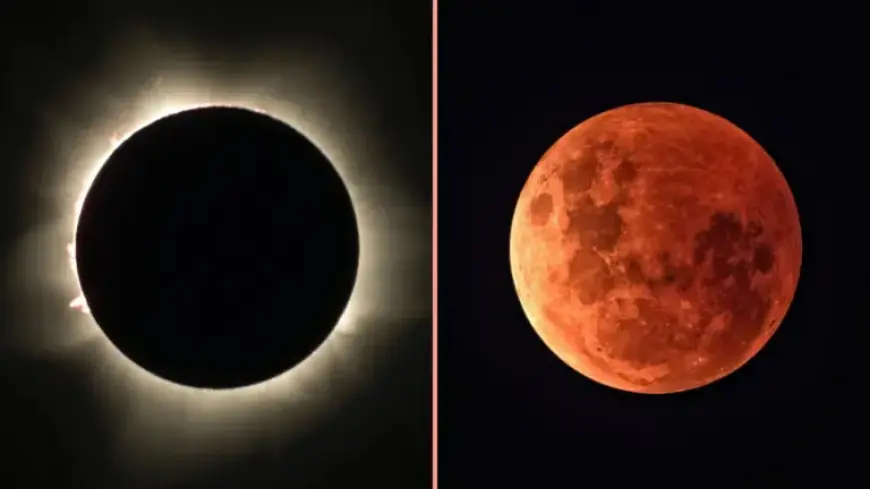
The occurrences of solar and lunar eclipses have captivated humanity for centuries. These celestial events, however, are not random spectacles; they follow a predictable pattern governed by the alignment of the Earth, moon, and sun.
Understanding Eclipse Pairs
Eclipses occur in pairs during distinct periods known as eclipse seasons. Each season lasts between 31 to 37 days and takes place roughly every six months. There are generally two eclipse seasons each year, during which solar and lunar eclipses can happen.
What is an Eclipse Season?
An eclipse season arises when the new moon and full moon align closely with the Earth’s orbital plane, known as the ecliptic. Eclipses can only occur when:
- A solar eclipse happens during a new moon.
- A lunar eclipse occurs during a full moon.
This alignment is called syzygy, which is crucial for eclipses to take place. Outside these eclipse seasons, eclipses cannot occur, even though new and full moons happen every month.
Why Aren’t Eclipses Monthly Events?
Despite new moons recurring approximately every 29.5 days, eclipses remain rare occurrences. This is largely due to the tilt of the moon’s orbit, inclined about five degrees relative to the ecliptic. Most new moons and full moons miss the precise alignment necessary for an eclipse, occurring slightly above or below the sun and Earth.
The Role of Lunar Nodes
Understanding lunar nodes is pivotal for grasping eclipse patterns. These points represent where the moon’s tilted orbit intersects the ecliptic. When the sun approaches a lunar node, eclipses become possible:
- A new moon near a node produces a solar eclipse.
- A full moon near the opposite node results in a lunar eclipse.
Over time, the lunar nodes regress westward, shifting the timing of eclipse seasons by approximately 19 days each year.
Upcoming Eclipse Seasons in 2026
In 2026, two eclipse seasons will provide spectacular viewing opportunities. The first season occurs from February to March.
First Eclipse Season of 2026
The first eclipse season kicks off on February 17, 2026, with an annular solar eclipse, characterized by a “ring of fire.” This phenomenon occurs when the moon covers 96% of the sun and will be visible from parts of Antarctica and southeastern Africa. A partial eclipse will be observed in broader regions.
Following this, on March 3, 2026, a total lunar eclipse will occur. Observers in East Asia, Australia, the Pacific, and parts of western North America will witness the moon turn a reddish hue as it passes through Earth’s shadow for 58 minutes and 18 seconds.
Second Eclipse Season of 2026
The second eclipse season in 2026 takes place in August, featuring a total solar eclipse on August 12. This event has not been seen since April 2024. The total eclipse will be visible along a narrow path across Greenland, Iceland, and northern Spain, allowing observers to experience total darkness for several minutes.
A partial lunar eclipse will follow on August 28, 2026. Although less dramatic than a total lunar eclipse, the partial eclipse will still mesmerize viewers across North America, South America, Europe, and Africa as shadows dance across the moon’s surface.
Eclipses are not merely stunning visuals; they represent the intricate dance of celestial bodies. By understanding eclipse pairs and the science behind them, enthusiasts can enhance their appreciation of these awe-inspiring phenomena.