
























Men’s Olympic Ice Hockey Schedule and Results: Knockout Round Set After Final Group-Day Results


Men’s ice hockey at the Olympic Games has moved from scoreboard watching to survival mode. The preliminary round wrapped on Sunday, February 15, 2026, Eastern Time, setting the field for the qualification round on Tuesday, February 17, followed by quarterfinals on Wednesday, February 18. From there, it’s a straight shot to the medal games on the weekend.
Below is the men’s Olympic hockey schedule in Eastern Time, plus the most important results and what they mean for the bracket.
Men’s Olympic hockey results: what happened in the final day of group play
Sunday’s slate reshaped seeding and locked in the direct quarterfinal teams:
-
United States beat Germany 5–1 to finish 3–0 in group play, powered by two goals from Auston Matthews and steady goaltending from Connor Hellebuyck.
-
Canada beat France 10–2 to secure the top overall seed in the knockout bracket.
-
Switzerland edged Czechia 4–3 in overtime in a high-swing game that mattered for placement and matchups.
-
Denmark beat Latvia 4–2, a result that helped sort out the qualification round pairings.
The key takeaway: the United States earned a direct quarterfinal berth but did not claim the top overall seed, which affects matchup difficulty and the “who plays whom” puzzle on the road to medals.
Men’s Olympic hockey schedule: knockout round dates and times in Eastern Time
Qualification round — Tuesday, February 17, 2026 ET
These are win-or-go-home games to decide who advances into the quarterfinals:
-
Germany vs France — 6:10 a.m. ET
-
Switzerland vs Italy — 6:10 a.m. ET
-
Czechia vs Denmark — 10:40 a.m. ET
-
Sweden vs Latvia — 3:10 p.m. ET
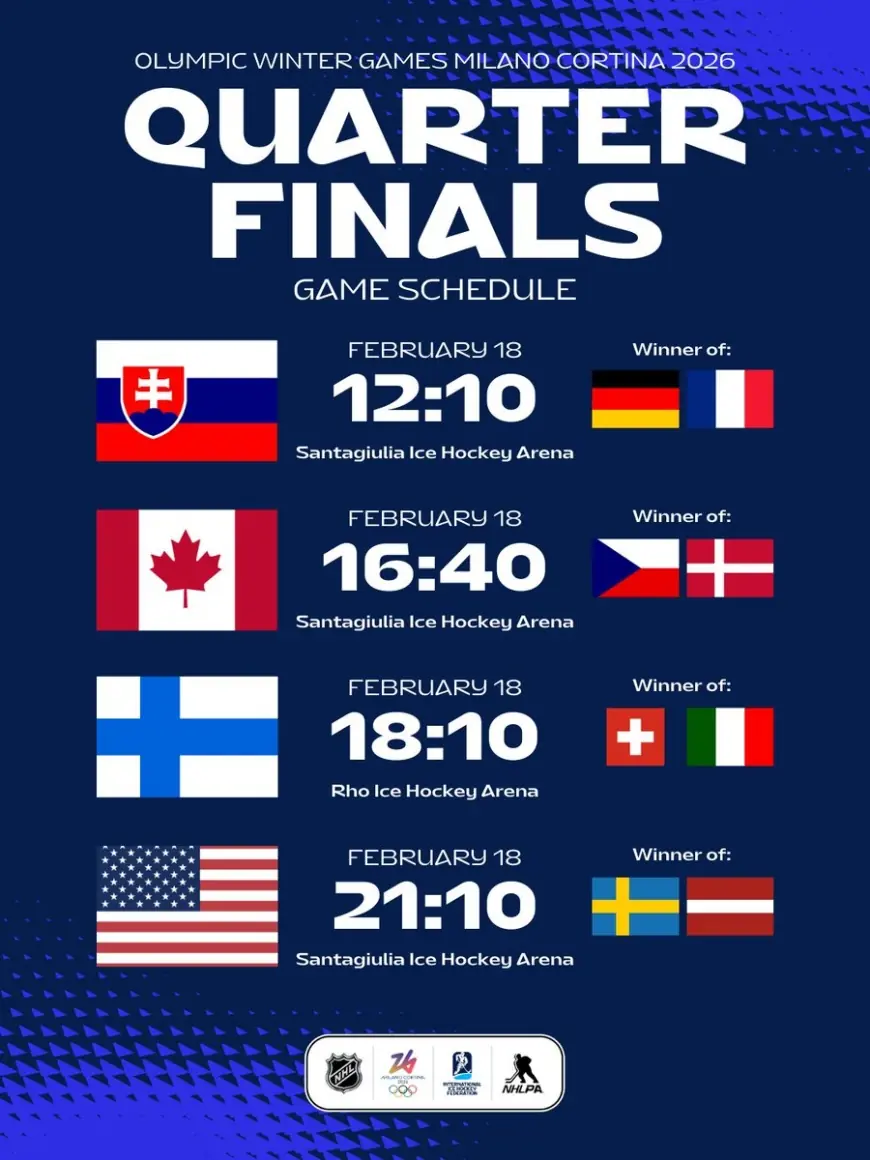
Winners advance to the quarterfinals and are labeled as bracket placeholders until those games are complete.
Quarterfinals — Wednesday, February 18, 2026 ET
Group winners and top seeds enter here, facing the qualification-round winners:
-
Slovakia vs Winner of Qualification Game 1 — 6:10 a.m. ET
-
Canada vs Winner of Qualification Game 3 — 10:40 a.m. ET
-
Finland vs Winner of Qualification Game 2 — 12:10 p.m. ET
-
United States vs Winner of Qualification Game 4 — 3:10 p.m. ET
For Team USA, this is the moment the tournament truly starts. A clean quarterfinal puts the Americans two wins from gold.
Semifinals — Friday, February 20, 2026 ET
-
Semifinal 1 — 10:40 a.m. ET
-
Semifinal 2 — 3:10 p.m. ET
Medal games — Saturday and Sunday, February 21–22, 2026 ET
-
Bronze medal game — Saturday, February 21 at 2:40 p.m. ET
-
Gold medal game — Sunday, February 22 at 8:10 a.m. ET
Behind the headline: what the schedule tells you about how medals are won
This calendar is built to reward two things: seeding and stamina. Teams that earned a direct quarterfinal spot avoided an extra elimination game, which reduces injury risk and preserves top players for the most difficult opponents. In a short tournament, one extra game can be the difference between skating fresh in a semifinal and hanging on late.
The second-order effect is tactical. Coaches shorten benches as soon as the bracket begins, leaning on top lines and trusted defense pairs. That makes goaltending even more decisive: a goalie like Hellebuyck can erase the damage of a tired shift or a penalty-filled stretch, but only if the team in front stays disciplined.
What we still don’t know
-
Which “winner slots” will land in the toughest quarterfinal matchups, especially on the U.S. side of the bracket.
-
Whether any teams carry injuries into the knockout round that don’t show up clearly in results.
-
How special teams will swing outcomes once opponents tighten defensively and scoring chances shrink.
What happens next
Tuesday’s qualification round will decide the quarterfinal field, and then Wednesday’s quarterfinals will define the medal favorites. If the United States keeps converting power plays, limits penalties, and gets calm, consistent goaltending, it has a realistic path to the final. If games turn chaotic—penalties, odd-man rushes, and momentum swings—Olympic hockey has a way of producing upsets fast.
If you want, tell me which team you’re following (Team USA, Germany, or another), and I’ll lay out their exact path game-by-game from here, including the earliest possible semifinal and medal-game times in ET.