

























Ocasio-Cortez Presents Working-Class Vision in Munich Amid Minor Missteps

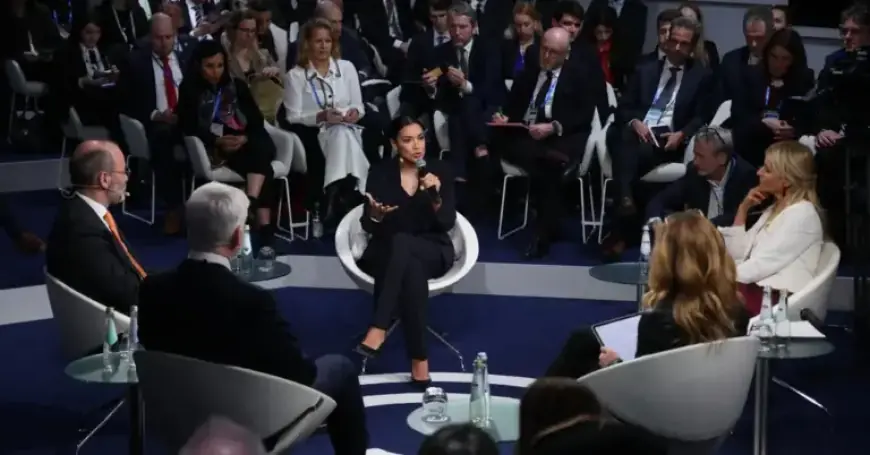
Representative Alexandria Ocasio-Cortez, a prominent progressive voice from New York, recently participated in the Munich Security Conference, an event typically dominated by discussions of international security. This year, she uniquely positioned her working-class perspective within the context of global issues, specifically addressing the relationship between income inequality and authoritarianism.
Addressing Income Inequality and Authoritarianism
During her two panels at the event, Ocasio-Cortez emphasized that rising income inequality contributes to social instability. “Extreme levels of income inequality lead to social instability,” she expressed, underscoring the need for urgent economic reforms. She argued that if economic gains are not delivered to the working class, societies risk falling into isolationism governed by authoritarian regimes.
Her comments reflect a broader concern among progressives regarding the social contract between government and citizens. “In order to combat far-right populism, we must strengthen our relationships with Western allies,” she stated, suggesting a need for cooperation in addressing global challenges.
Political Aspirations in Focus
Ocasio-Cortez’s presence in Munich sparked speculation about her future political ambitions, particularly a potential presidential run. The conference provided her a platform to engage with key political figures, including Democrats like California Governor Gavin Newsom and Connecticut Senator Chris Murphy, all of whom shared concerns about the current administration’s foreign policy.
- Potential Presidential Run: Ocasio-Cortez’s attendance fueled discussions about her possible candidacy in 2028.
- Democratic Commitment: Many attendees reaffirmed the party’s dedication to maintaining strong ties with European partners.
When asked about her approach to a wealth tax during the panels, Ocasio-Cortez maintained a sense of humor, though her responses highlighted her relative inexperience in foreign policy matters. Some critics noted her struggle with certain questions, particularly regarding U.S. military commitments abroad.
Challenges and Critiques
One notable moment occurred when she hesitated on how the U.S. should respond to a potential Chinese invasion of Taiwan. This inexperience drew attention online, with conservative commentators capitalizing on her momentary uncertainty. Ocasio-Cortez did, however, display clarity on issues like U.S. military intervention in Iran, stating, “There’s still so much runway, so much more we can do to avoid that scenario.”
Contrasting with Trump’s Approach
Throughout her discussions, Ocasio-Cortez consistently contrasted her vision with former President Trump’s policies. She criticized Trump’s steps away from international alliances, asserting that his leadership could lead to a world dominated by authoritarian figures. “They are looking to withdraw the United States from the entire world,” she warned, advocating for a proactive global stance.
The Munich Experience
Her participation also highlighted the evolving landscape of Democratic politics, particularly in the context of foreign relations. Political experts observed that her presence at the conference was significant, as it was seen as a step towards expanding her understanding of global issues. Political strategist Julius van de Laar remarked on how the conference resembled “Munich University,” in its role of educating potential presidential candidates in foreign policy.
Overall, Ocasio-Cortez’s trip to the Munich Security Conference underscored her emerging role as a leader within the Democratic Party. While her performance included moments of uncertainty, her commitment to advocating for working-class Americans on an international stage set a vibrant tone for future political discourse.