

























Cheops Uncovers Ancient Era Late Bloomer

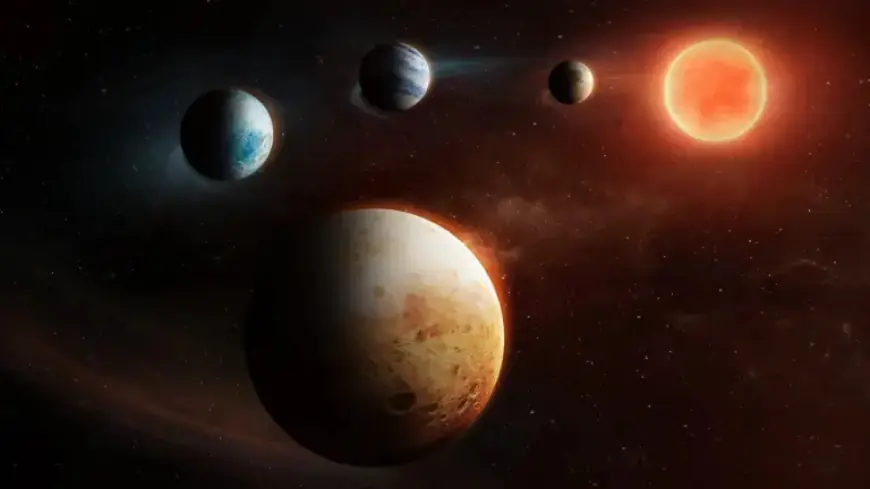
Recent findings from the European Space Agency’s Cheops satellite reveal intriguing details about the planetary system surrounding the star LHS 1903. This discovery challenges the widely accepted theories of planetary formation, particularly due to the unusual arrangement of the system’s planets.
Discovery Overview
Researchers observed four planets orbiting LHS 1903, a cooler M-dwarf star, using Cheops and additional telescopes. The analysis, led by Thomas Wilson from the University of Warwick, indicated that the innermost planet is rocky, while those following it are gaseous. However, the most surprising revelation was the identification of a fourth planet, the farthest from LHS 1903, which also appears to be rocky.
Planetary Arrangement
- First Planet: Rocky
- Second Planet: Gaseous
- Third Planet: Gaseous
- Fourth Planet: Rocky
This configuration creates an “inside-out” system where rocky planets exist at varying distances from their star—contrary to established expectations.
Challenges to Established Theories
Current models of planet formation suggest that rocky planets typically form closer to their stars, where strong radiation strips away gas. In contrast, distant rocky planets are rare, often surrounded by vast gaseous atmospheres. The unusual formation pattern indicated by LHS 1903 leads scientists to question traditional theories.
Investigating Formation
The Cheops team explored various hypotheses to explain this anomaly. They considered the possibility of asteroid or comet impacts altering the fourth planet’s atmosphere or the planets having swapped positions. However, simulations ruled out these scenarios. Instead, the evidence suggests that the planets may have formed sequentially.
A Late Bloomer in Planet Formation
This new insight introduces the concept of “gas-depleted” planetary formation. The outer rocky planet likely formed in an environment lacking sufficient gas—a condition that would typically inhibit the creation of such planets.
As Dr. Wilson noted, “This discovery provides the first evidence for a planet that formed in a gas-depleted environment.” The implications of this finding could reshape our understanding of planetary formation across the universe.
Implications for Planetary Science
Isabel Rebollido, a Research Fellow at ESA, highlighted how these discoveries invite a reassessment of our understanding of planetary systems. “As we encounter diverse exoplanet systems, we are forced to revisit and refine our traditional theories,” she stated.
Improving observational technologies continues to unveil unique planetary systems. They challenge the notion that our Solar System is typical and raise questions about the diversity of planetary orders and formations in the universe.
Conclusion
The findings surrounding LHS 1903 signify a major advancement in our understanding of planet formation. They not only illustrate the diversity of planetary systems but also underline the need for ongoing research into the complexities of the cosmos.
For more updates on space exploration and scientific discoveries, visit Filmogaz.com.