

























Astronomers Baffled by Unusual ‘Inside-Out’ Planetary System

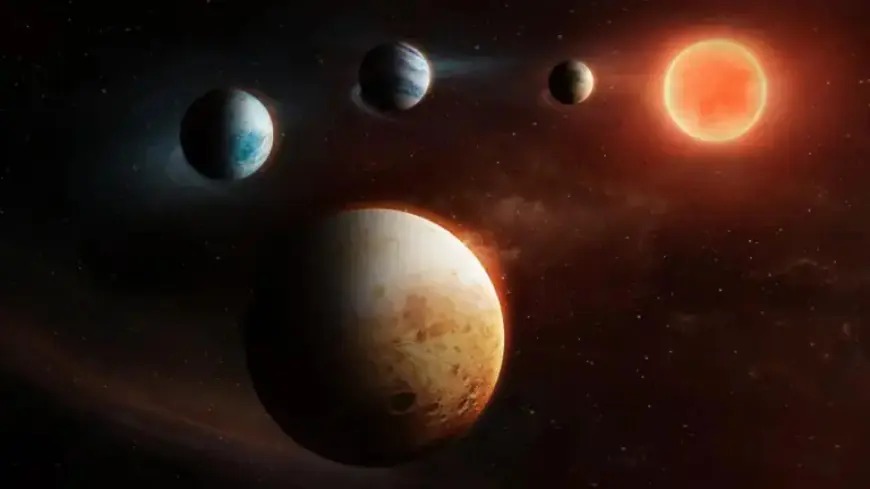
Recent findings from an international team of astronomers have revealed an unusual ‘inside-out’ planetary system surrounding the red dwarf star LHS 1903. This star, located in the Milky Way’s thick disk, has puzzled researchers by presenting a planetary arrangement that challenges established theories of planet formation.
Overview of the Discovery
Initially, scientists believed that the configuration of rocky inner planets followed by gas giants was consistent across the universe. However, LHS 1903 defies this expectation. The discovery involved multiple telescopes, revealing a total of four planets orbiting this cooler and dimmer star. While the first planet is rocky, the following two are gas giants, leading to a surprising fourth rocky planet much farther out.
Details on LHS 1903
- Star Type: Red dwarf
- Location: Milky Way’s thick disc
- Planets: Four identified planets
- Discovery Date: Recent observations, ongoing analysis
Planetary Configuration
The order of the planets in this system is rocky-gaseous-gaseous-rocky. According to Thomas Wilson, the lead author of the study published in the journal Science, this arrangement is atypical. He noted that rocky planets are usually found closer to their home stars due to intense radiation that depletes gas away from rocky cores.
Puzzle of Planet Formation
Researchers faced the challenge of understanding how a rocky planet could exist so far from its star. Traditional theories suggest simultaneous formation of planets in a protoplanetary disc, where dust clumps together under gravity. However, Wilson theorizes that the fourth planet may have formed after the system had become gas-depleted.
Implications of the Findings
This discovery may redefine our understanding of exoplanet systems. Since the 1990s, astronomers have identified over 6,000 exoplanets, predominantly using methods that detect variations in stellar brightness. Isabel Rebollido from the European Space Agency emphasized the need to rethink previous planet formation theories, given the diverse types of planetary systems now being observed.
Conclusion
The unusual ‘inside-out’ configuration of LHS 1903 serves as a testament to the complexity of planetary formation in the universe. As researchers continue to explore these celestial wonders, they may uncover more instances that challenge established scientific narratives.