
























Liu Jiayu injury update after halfpipe crash at the Milan-Cortina Winter Games

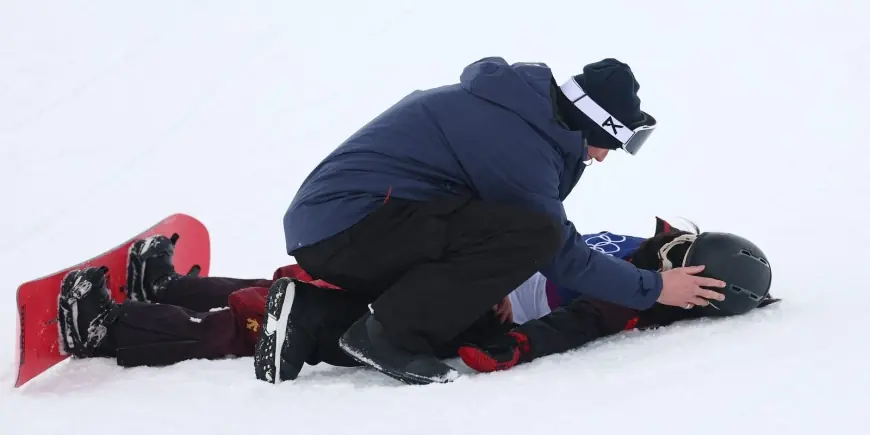
Chinese snowboarder Liu Jiayu was taken from the course on a rescue sled Wednesday, February 11, 2026, after a hard fall during women’s halfpipe qualifying in Livigno, Italy. The competition paused for several minutes as medical staff treated her on the snow before transporting her to the on-site medical center.
Early medical assessment shared publicly later in the evening indicated she was unlikely to have suffered a cervical spine injury, though her injury was described as related to head impact. No detailed diagnosis, imaging results, or return-to-competition plan had been confirmed publicly as of late Wednesday night ET.
The crash that stopped qualifying
The incident occurred on Liu’s second run in qualifying. She lost control near the end of her run and went down heavily in the bottom of the pipe, with the fall drawing an immediate response from on-course medical personnel. Witnesses described her lying motionless for a short period while staff stabilized her before moving her off the venue.
Event staff halted action for roughly 7–10 minutes while the response took place. The pause, along with the careful transport procedure, suggested concern about potential head or neck trauma—standard protocol in high-speed falls where an athlete’s head, shoulders, or back take significant force.
Liu Jiayu injury update
Public information released after the on-course evaluation pointed to a head-impact injury rather than a cervical spine injury, based on initial checks. Beyond that initial indication, her condition remained unclear at this time. There has been no confirmed statement detailing:
-
whether she required hospital transfer beyond the venue medical center
-
whether she was diagnosed with a concussion or other head injury
-
whether she will undergo further testing overnight into Thursday, February 12, 2026 (ET)
In the absence of confirmed medical specifics, the most concrete update remains that she was treated on site, transported off the course, and evaluated by medical staff, with initial checks making a spine injury less likely.
What it means for her event status
Liu scored 62.75 points on her first run and ultimately finished outside the cutoff to reach the final, placing 14th when only the top 12 advanced. That means the immediate competitive question is less about her participation in the halfpipe final and more about her broader health status for any additional events, training sessions, or media obligations during the Games.
For athletes, the next steps after a head-impact fall typically hinge on neurological screening and symptom monitoring over the next 12–24 hours. If symptoms worsen—headache, dizziness, nausea, confusion—medical teams often escalate evaluation and restrict activity. If symptoms stay mild or absent, some athletes can return to controlled training after clearance, but timelines vary and depend on clinical findings rather than the calendar.
Why the response looked so serious
The on-snow stabilization and rescue transport were consistent with best practices for suspected head and spine injuries in freestyle snow sports. Even when an athlete appears alert afterward, medical teams often proceed cautiously because adrenaline can mask symptoms, and certain injuries are not obvious immediately.
Halfpipe crashes can also create complex injury patterns: a rider may land on an arm or shoulder, whip the head back, or strike the face while sliding. Early descriptions of Liu’s fall included force to the upper body and a violent backward bend—mechanisms that commonly trigger precautionary immobilization until a spine injury is ruled out.
What to watch next
The most meaningful next update will be any confirmation on whether Liu was cleared from the venue medical center, transferred for imaging, or placed in a concussion protocol. If a public medical bulletin is released, the key items to look for will be:
-
confirmation of consciousness and neurological status
-
whether CT or MRI imaging was performed
-
diagnosis language (for example, “concussion” versus “under observation”)
-
any stated timeline for activity restriction or follow-up evaluation
Until then, any claims beyond the initial assessment should be treated as unconfirmed.
Sources consulted: Associated Press; Xinhua News Agency; International Olympic Committee; ESPN