
























Canada to Manufacture and Export Future Cars Globally, Declares PM Carney

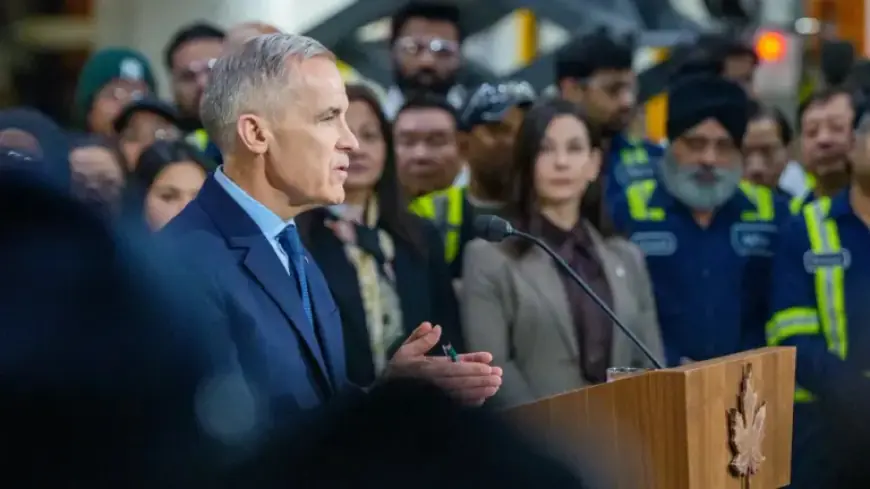
Prime Minister Mark Carney announced a bold initiative for the Canadian auto sector, aiming to position the country as a leader in future vehicle manufacturing. During his visit to Beijing, he revealed plans to permit up to 49,000 Chinese electric vehicles (EVs) into Canada each year, at a tariff of 6.1%. More than half of these EVs are expected to be priced below $35,000 within the next five years.
Canada’s Automotive Future
Carney emphasized the significance of this strategy for Canadian workers, assuring support for the manufacturing of lower-emission, autonomous, and affordable vehicles. He stated, “The choices we make now will shape the Canadian auto industry for decades to come.” His vision promotes a transition to a stronger and more independent Canadian economy.
Joint-Venture EV Plant with Chinese Automakers
Industry Minister Mélanie Joly disclosed that the government is in discussions with Chinese automakers about establishing a joint-venture EV assembly plant. This partnership aims to enhance Canada’s export capabilities. Potential collaborations may involve Canadian auto parts suppliers such as Magna International, Linamar, and Martinrea International.
- Active conversations are ongoing with notable automakers including BYD Co. and Chery Automobile Co.
- Ottawa-based software developer QNX, owned by BlackBerry, might also play a role in this venture.
Pricing and Market Dynamics
Small SUVs currently dominate the Canadian EV market, accounting for nearly half of all sales. J.D. Power analysts suggest that the initial Chinese EV exports will likely focus on compact and subcompact models, with competitive pricing. Estimates indicate that these vehicles could be priced 10% to 15% lower than their Canadian counterparts.
| Vehicle Type | Average Canadian Price | Projected Chinese Price |
|---|---|---|
| Subcompact EVs | $42,000 | $35,700 – $37,800 |
Strategic Measures Amidst Trade Tensions
This announcement followed the creation of an auto task force in partnership with Ontario, aimed at protecting jobs and strategizing investments amid US tariff concerns. Joly indicated that the government would review its approach to EV mandates as part of a comprehensive strategy for the auto sector.
However, provincial reactions have been mixed. Ontario Premier Doug Ford criticized the agreement, expressing concerns about potential risks to the province’s auto industry and labeling foreign vehicles as “spy vehicles.”
Trade Agreements and Benefits
The Canada-China trade agreement is an important aspect of this strategy. In return for the allowance of 49,000 EVs, Canada will benefit from reduced tariffs on Canadian canola exports. This collaboration reflects the complexities of global trade relationships, particularly in the auto sector.
In conclusion, Carney’s strategy aims to foster a competitive Canadian auto industry, enhance job creation, and establish the nation as a hub for future vehicle manufacturing. As Canada prepares for the influx of Chinese EVs, it also seeks to strengthen its domestic production capabilities, navigating the complexities of international trade.