






















Lake Erie ice crack stretches roughly 80 miles as near-freeze triggers safety warnings

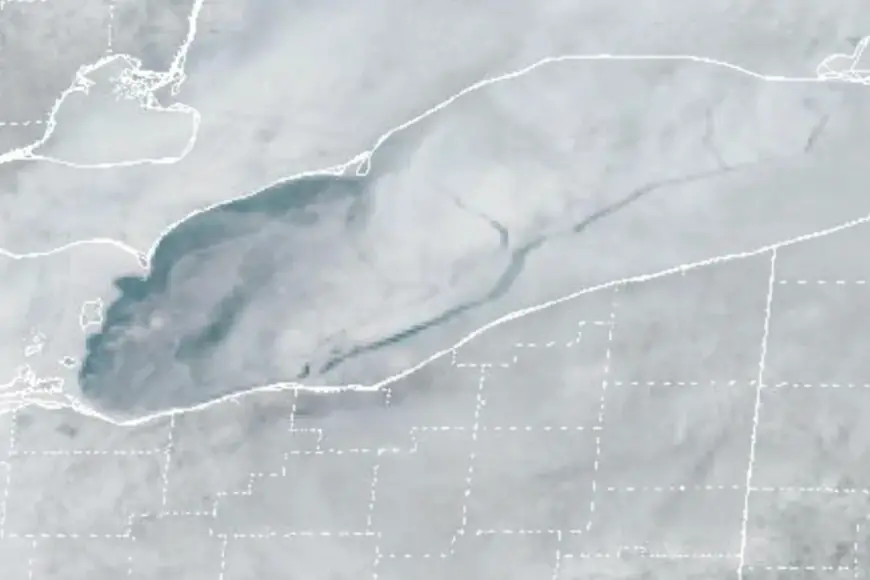
A massive fracture has opened across Lake Erie’s winter ice cover, creating an eye-catching line visible in satellite imagery and raising renewed warnings for anyone venturing onto the frozen lake. The crack—estimated at roughly 80 miles long—formed as Lake Erie pushed toward an unusually high ice-coverage milestone in early February, a combination that can make the surface look deceptively solid even as it shifts and breaks under wind and pressure.
Officials around the lake have emphasized that large fractures can widen quickly, isolate sections of ice, and strand people far from shore—especially during brief warmups or wind shifts that move ice like a slow, rigid sheet.
What the Lake Erie ice crack looks like
Satellite views captured a long, jagged seam cutting across the central basin, with the fracture extending from Canadian waters toward Ohio. The break resembles a fault line: one side of the ice sheet nudged away from the other, leaving a dark ribbon of open water or thin, newly formed ice in between.
The crack’s size is also part of what makes it risky. A fracture that long often indicates broad-scale movement across the lake’s ice cover—not just a local weak spot near shore. Even if ice remains thick on either side, the gap can become an impassable barrier in minutes if it widens.
Why it formed now: wind, pressure, and rapid ice growth
Large Great Lakes fractures typically form when the ice sheet experiences competing forces:
-
Strong wind shifts can push the ice pack in one direction and then reverse it, creating stress lines that split.
-
Pressure ridging builds when moving sheets collide, forcing ice to buckle, crack, or stack.
-
Thermal expansion and contraction—especially after rapid temperature swings—can create loud “ice quakes” and long fractures.
This year’s setup added another factor: a rapid jump in ice coverage. A largely connected sheet can behave like a single, giant plate. When it moves, the stress can express itself as a dramatic, lake-spanning crack rather than many small breaks.
Near-100% ice coverage is not a safety signal
Lake Erie’s ice coverage surged into the mid-90% range in early February, a rare level in the modern record and a headline-grabber for residents around the shoreline. But near-total freeze-over can increase risk for recreation, not reduce it.
When a lake looks uniformly white, it’s easier to assume “everything is frozen.” In reality, ice thickness can vary sharply due to currents, underwater springs, wave action, and the lake’s own circulation. A single fracture can also create a moving boundary—meaning the route you used to walk out may no longer exist when you try to return.
Rescues and close calls highlight the danger
The crack has surfaced alongside multiple safety calls around the western basin near Ohio, where ice fishing and winter recreation are common. In one recent incident, two people went into the water after an ATV encountered a significant crack several feet wide roughly two miles north of Port Clinton. Crews rescued them and reiterated warnings about traveling on the lake even when it appears stable.
Officials have also stressed that rescue conditions can be challenging. Fractures can separate ice into floating panels, and wind can push those panels away from shore. Even short distances become dangerous in frigid water, where cold shock and hypothermia can set in quickly.
Key takeaways
-
The fracture spans roughly 80 miles and reflects large-scale ice movement, not a local shoreline crack.
-
High ice coverage can make the lake look safe while hiding weak spots, seams, and moving ice.
-
Wind shifts can rapidly widen fractures and strand people on drifting ice.
What to watch next: winds, warmups, and navigation impacts
The next few days’ weather pattern will matter more than the current thickness reading. A modest warmup can soften or flood cracks near the surface, while strong winds can push ice sheets and reshape the fracture line again.
Mariners and shoreline communities are also watching for operational impacts. Icebreaking activity in harbor approaches and shipping lanes can increase as thick ice consolidates, and shifting slabs can clog channels even when the lake looks “locked in” from shore.
For the public, the practical guidance remains consistent: admire the rare freeze from land, treat visible cracks as hard boundaries, and assume the ice can change faster than you can react—especially on a lake as shallow, wind-sensitive, and fast-freezing as Erie.
Sources consulted: NOAA Great Lakes Environmental Research Laboratory, U.S. Coast Guard, Associated Press, AccuWeather