

























Revolutionary Light-Based Computer Redefines Technology

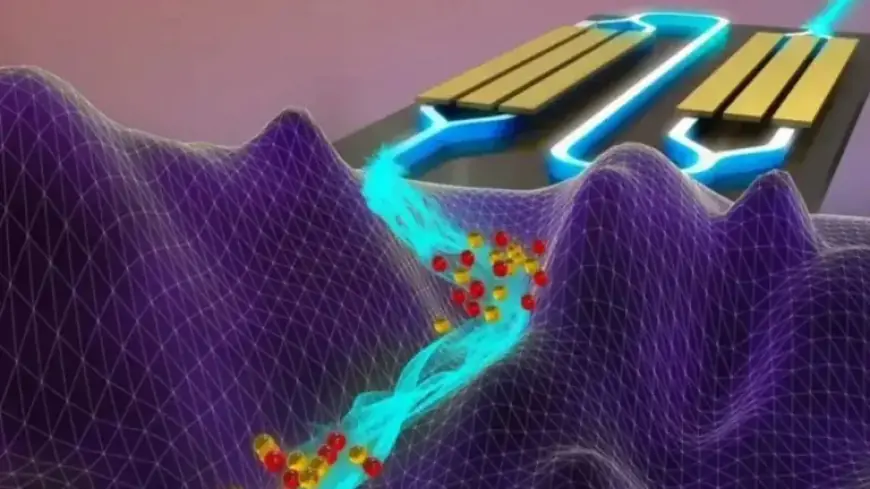
A groundbreaking development in computing technology has emerged from the work of engineers at Queen’s University in Canada. They have introduced an Ising machine that utilizes light pulses instead of traditional binary bits to solve complex optimization problems. This innovative device operates at room temperature, making it accessible and practical for various applications.
Revolutionary Light-Based Computer Redefines Technology
The Ising machine represents a significant departure from conventional computing methods. It is grounded in a physics model that transforms optimization problems, which typically require identifying the best choice from an extensive array of potential solutions.
Understanding Optimization Problems
Optimization challenges are prevalent in many real-life scenarios, such as:
- Package delivery route efficiency.
- Cryptography solutions.
- Protein folding complexities.
For instance, considering delivery routes, the complexity escalates dramatically. With just five delivery points, there are 12 possible routes. This number balloons to 180,000 with ten stops and further skyrockets to over 60 million billion routes with twenty stops. Bhavin J. Shastri, the study’s senior author, points out that with fifty stops, the solutions increase to a scale requiring a timeframe beyond the age of the universe to evaluate all options.
How the Ising Machine Works
This innovative machine functions by simulating a collection of interacting magnets, which naturally settle into an equilibrium representing the most efficient solution. It does this through the manipulation of light, utilizing standard components such as lasers, fiber-optic cables, and modulators commonly found in Internet infrastructure.
- The Ising machine operates using five basic components.
- It achieves 256 spins (equating to 65,536 couplings).
- Its capacity allows for billions of operations per second while maintaining stability at room temperature.
The transition to a light-based system not only replaces magnets but also enhances efficiency and problem-solving capabilities. Shastri conveyed, “It’s a way to turn light into a problem solver.”
Future Potential and Applications
While the new Ising machine will not replace supercomputers or quantum computers, its design is specifically tailored for distinct optimization tasks. This specialization suggests a promising future for its application in real-world scenarios.
The research team plans to collaborate with industry partners on pilot projects to explore the practical capabilities of the Ising machine further. Their focus will revolve around addressing tangible optimization challenges in various fields.