
























Utah earthquake near Lehi: M3.5 jolts Wasatch Front, no damage reported

A small earthquake centered in northern Utah County rattled parts of the Wasatch Front this week, prompting a fresh wave of “did we just have an earthquake?” searches from Lehi to Salt Lake City. The most widely felt event was a magnitude 3.5 quake on Thursday, Feb. 5, 2026, with shaking reported across multiple communities and no immediate reports of serious damage.
For Utahns asking about an “earthquake today” or “just now,” seismologists typically caution that small quakes can be followed by additional minor tremors, but larger, damaging aftershocks are not the most common outcome after a mid-3 magnitude event.
What happened near Lehi
The quake struck in the early afternoon on Feb. 5 and was shallow enough to be widely felt. Residents described brief shaking—often a quick jolt or a rolling sensation—consistent with the type of motion that travels efficiently through the populated Wasatch Front corridor.
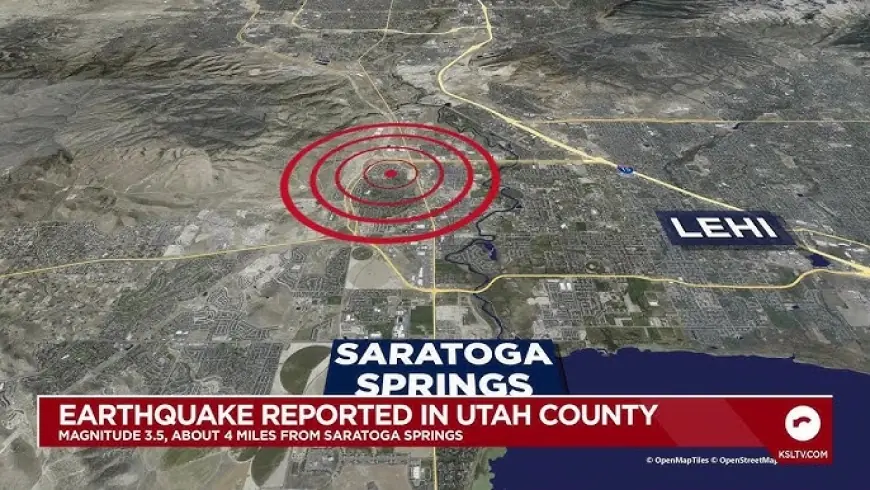
The epicenter was in northern Utah County, in the area west of Lehi and near Saratoga Springs/Thanksgiving Point, placing it close to a region that frequently experiences small-to-moderate seismic activity.
Key details: time, magnitude, depth
Here are the core numbers for the quake that drove most “Lehi earthquake today” queries this week. Times are listed in Eastern Time (ET).
| Detail | Value |
|---|---|
| Date | Thursday, Feb. 5, 2026 |
| Time | 2:53 p.m. ET |
| Magnitude | 3.5 (local magnitude) |
| Location | Near Saratoga Springs, west of Lehi (northern Utah County) |
| Depth | About 7.7 km (approx.) |
Was there an earthquake just now in Utah?
On a normal day, many Utah “just now” searches are triggered by a small quake, a mine blast, wind-related house movement, or even a distant event felt faintly indoors. The best real-time indicator is the most recent reviewed seismic listing for the area.
As of Sunday, Feb. 8, 2026 (ET), the most widely felt, confirmed event near Lehi in recent days remains the Feb. 5 magnitude 3.5. Smaller quakes can occur without being broadly felt, and many are only noticed by a small number of people close to the epicenter.
What people felt — and why a 3.5 can be noticeable
A magnitude 3.5 is usually not damaging, but it can be very noticeable when it is shallow and close to populated areas. Northern Utah County and the greater Salt Lake City region sit along active faults and fault zones, and local ground conditions can amplify shaking in certain neighborhoods.
That’s why two people in different parts of the metro area can describe the same quake differently—one feels a sharp thump, another feels a gentle sway, and someone else doesn’t notice anything at all.
What comes next: aftershocks and readiness
After a mid-3 quake, it’s possible to see additional small events in the same general area over the following days. These are usually weaker than the main jolt and may be felt only near the epicenter. If you feel a second tremor, it does not automatically mean a larger quake is imminent, but it is a reminder that Utah is earthquake country.
Emergency managers emphasize simple, repeatable actions: if shaking starts, get low, take cover under sturdy furniture if possible, and hold on until it stops. Afterward, check for hazards like gas smells, broken glass, and unstable items on shelves—especially in garages and kitchens where heavy objects are stored.
For residents along the Wasatch Front, the long-term takeaway is less about any single small quake and more about routine preparedness: securing heavy furniture, knowing how to shut off utilities if needed, and having a basic kit that doesn’t depend on last-minute shopping.
Sources consulted: U.S. Geological Survey; Utah Earthquake Program; University of Utah Seismograph Stations; Associated Press