Giant Phantom Jellyfish Spotted Off Argentina Rekindles Deep-Sea “Ghost” Mystery as New Footage Shows a Rare Giant Drifting Near the Twilight Zone

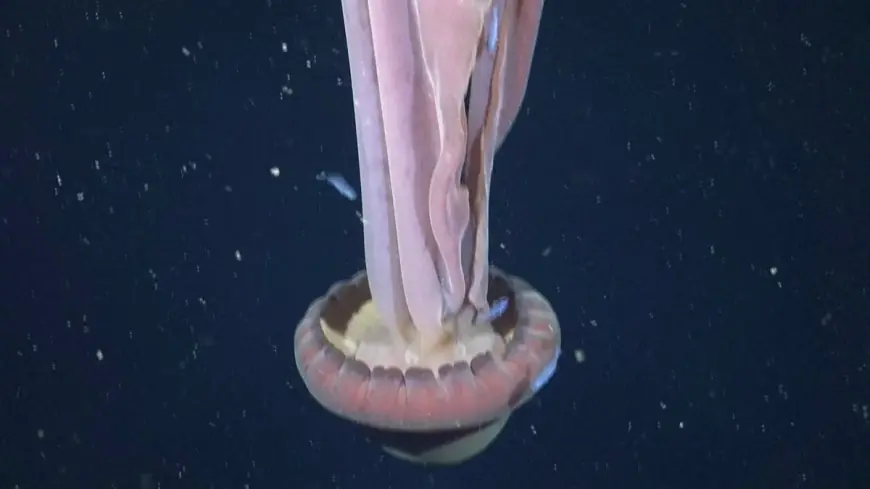
A “giant phantom” has resurfaced in the global imagination this week, after researchers filmed a rarely seen deep-sea jellyfish drifting in the South Atlantic off Argentina. The animal—commonly called the giant phantom jellyfish—appears in footage as a pale, bell-shaped body trailing four long, ribbon-like arms that can extend many meters, giving it an otherworldly, floating-curtain look in dark water.
The sighting, recorded during an ocean science expedition and amplified widely online on Wednesday, February 4, 2026 ET, is drawing attention because this species is infrequently documented despite being believed to be broadly distributed across the world’s oceans. The video also arrived with a broader set of expedition findings in the same region, helping turn a single surreal clip into a bigger narrative: the deep ocean is still under-mapped, under-observed, and full of large animals that remain effectively “unknown” to most people.
What happened: the “giant phantom” encounter that scientists rarely get on camera
Researchers operating a remotely controlled deep-sea vehicle recorded the jellyfish at roughly 250 meters below the surface, a depth that sits near the boundary where sunlight fades and the ocean becomes a perpetual dim zone. The animal’s bell can reach about a meter across, and its four mouth arms can extend up to around 10 meters long.
Unlike many jellyfish people encounter near beaches, this species does not rely on long, stinging tentacles in the same way. Instead, it uses its arms like drifting nets, ensnaring small fish and plankton as it pulses forward. In the newly shared footage, the jelly’s slow, deliberate movement makes it look less like a “swimmer” and more like a living parachute.
Giant phantom jellyfish: why this specific species triggers outsized fascination
This animal is a perfect storm for viral attention: enormous, ghostlike, and rarely seen alive. That rarity is partly real—documented encounters are limited—but it is also a product of where it lives. Most observation equipment and most human activity stay near the surface. The deep midwater, sometimes called the ocean’s “living space,” is vast and difficult to sample consistently.
The result is a psychological mismatch: an animal can be widely distributed and still feel mythical if humans seldom see it. When footage does appear, it becomes instant proof-of-life for a part of the planet that still feels like science fiction.
What’s behind the headline: incentives, stakeholders, and why the footage matters
There is a scientific incentive and a public incentive, and they overlap.
For researchers, capturing clear footage is valuable because it supports basic biology questions that remain surprisingly unresolved for many deep-sea animals: where they occur, how they feed, how they reproduce, and how they fit into food webs. A single good observation can refine habitat assumptions and improve how future surveys target depth ranges.
For the public, the incentive is wonder. Deep-sea videos offer a rare kind of awe that is not polarizing or political. That attention can translate into greater support for ocean science, but it can also oversimplify the story into a monster-of-the-week cycle.
Stakeholders include ocean research organizations, marine biologists, policymakers who fund or regulate deep-sea exploration, and fisheries and conservation groups interested in how midwater ecosystems function. Even industries that operate offshore watch these moments, because every new observation is a reminder that human activity intersects with ecosystems we barely understand.
What we still don’t know: the missing pieces behind “giant phantom” sightings
Despite the dramatic imagery, major gaps remain:
-
How common the species truly is across different oceans and seasons
-
Whether individuals shift vertically over a day, rising or sinking with prey movements
-
How sensitive it is to temperature changes, oxygen minimum zones, and shifting currents
-
How its feeding strategy changes as prey communities move in response to climate patterns
-
How often it interacts with other species that may shelter near its bell or arms
The deep ocean also poses a data problem: most sightings are opportunistic. Without long-term, standardized sampling, it’s hard to convert “rarely seen” into a reliable estimate of abundance.
Second-order effects: what a viral deep-sea “ghost” can change
A single high-profile clip can reshape priorities. When public attention spikes, it often becomes easier to justify expensive expeditions, new vehicle deployments, and long-duration surveys. It can also accelerate educational outreach that reframes the ocean as a dynamic ecosystem rather than an empty void beneath shipping lanes.
There is a risk, too: sensational framing can lead people to treat the deep sea as entertainment instead of habitat. The more the narrative centers on shock value, the easier it becomes to ignore slower, less cinematic threats—warming, deoxygenation, and increased industrial interest in offshore activity.
What happens next: realistic scenarios and triggers
-
More footage emerges from the same expedition window
Trigger: additional dives in the same canyon systems capture repeat encounters or related species. -
Scientists publish a clearer habitat map for the region
Trigger: the expedition’s full dataset is processed, tying sightings to depth, temperature, and oxygen profiles. -
Conservation conversations broaden beyond coastal waters
Trigger: policymakers and the public connect deep midwater biodiversity to climate and fisheries resilience. -
The viral cycle fades, but the scientific value persists
Trigger: public attention moves on, while researchers integrate the observation into longer-term models.
Why it matters
The “giant phantom” story is not just about a spooky jellyfish. It’s a reminder that the planet’s largest habitat remains only lightly observed, and that some of its most striking animals still slip through our knowledge like shadows. When a creature this large can feel like a ghost, it says less about the animal—and more about how much of Earth’s living system is still out of sight.