























NYT Connections puzzle #968 leans into kitchen cuts and golf clubs

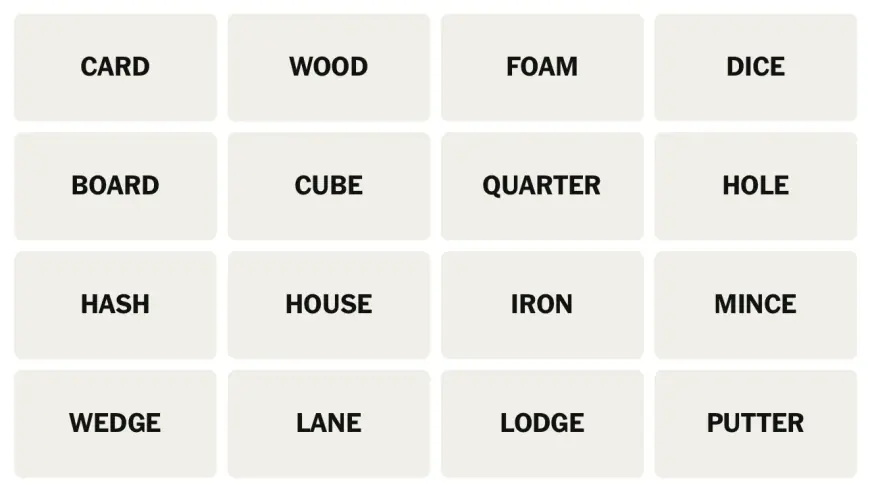
Tuesday’s Connections puzzle (#968) delivered a clean, approachable set of groupings that still managed to trip up plenty of solvers by mixing everyday verbs with specialized nouns. The grid for February 3, 2026 (ET) asked players to sort 16 words into four categories, with the hardest twist hiding in plain sight: “MEMORY ___” can point to very different objects depending on where your brain goes first.
The result was a board that felt “fair” to many players—recognizable themes, a couple of decoys, and a final category that rewarded patience rather than obscure trivia.
Puzzle #968 themes and answers
For anyone checking their work after finishing (or deciding to peek), here’s the full breakdown of the four groups. Spoiler warning: this is the complete solution set.
| Group | Theme | Words |
|---|---|---|
| Yellow | CUT INTO PIECES | CUBE, DICE, HASH, MINCE |
| Green | PROVIDE WITH A PLACE TO STAY | BOARD, HOUSE, LODGE, QUARTER |
| Blue | KINDS OF GOLF CLUBS | IRON, PUTTER, WEDGE, WOOD |
| Purple | MEMORY ___ | CARD, FOAM, HOLE, LANE |
Why “CUT INTO PIECES” felt easy—until it didn’t
The yellow set looked like a quick win because the verbs share a familiar kitchen rhythm. Still, it had a built-in trap: several of these words can read as nouns, too. “HASH” especially pulls double duty, and some solvers tend to hesitate when a word could belong to more than one possible theme.
That’s a signature Connections move: a group can be simple in meaning while still presenting ambiguity in grammar. Puzzle #968 used that tension lightly, which helped keep the board from turning into a slog.
The lodging group’s sneaky overlap
“BOARD,” “HOUSE,” “LODGE,” and “QUARTER” can all point to housing, but they don’t land in the same mental bucket at first glance. “BOARD” might evoke governance. “QUARTER” can feel like money or time. “LODGE” can read as a verb.
The green category worked because each word has a common, modern meaning tied to hosting or providing shelter. The misdirection comes from how often those same words appear in unrelated contexts—especially headlines and everyday speech.
Golf clubs as a clean, closed set
The blue group was one of the day’s most straightforward because it’s a closed vocabulary: IRON, PUTTER, WEDGE, WOOD. Even if you don’t follow golf closely, these are the terms that surface in sports coverage and casual conversation.
This kind of group often functions as an anchor. Once solvers lock it in, the remaining tiles narrow quickly—and the real battle becomes deciding which leftover four belong together, rather than hunting for the next theme from scratch.
“MEMORY ___” is the whole trick
Purple’s “MEMORY ___” category is the kind of pattern that rewards stepping back and letting phrases form naturally: memory card, memory foam, memory hole, memory lane. Each phrase is common on its own, but they don’t necessarily show up in the same context, which is why this group often becomes the last to click.
It also highlights a classic Connections design choice: the hardest category can be less about rare words and more about how many directions a familiar word can point. Here, “MEMORY” is the hinge—technology, bedding, politics, and nostalgia all collide on the same board.
What puzzle #968 says about Connections right now
The day’s grid reflected an approach that has helped the game keep its momentum: keep the words recognizable, then let ambiguity do the heavy lifting. Instead of relying on deep trivia, the challenge comes from polysemy (words with multiple meanings) and phrase-completion categories that punish rushing.
Looking ahead, that’s likely to remain the formula that keeps daily participation high. Puzzles like #968 are “shareable” because many players finish with a small number of mistakes, and the categories are easy to explain without pages of backstory. When the difficulty spikes, it tends to do so through misdirection, not obscurity—exactly the kind of challenge that invites discussion, rematches, and repeat play the next day.
Sources consulted: The New York Times; Forbes; TechRadar; Parade