





















Bad Bunny’s Album of the Year win sets up a massive February spotlight

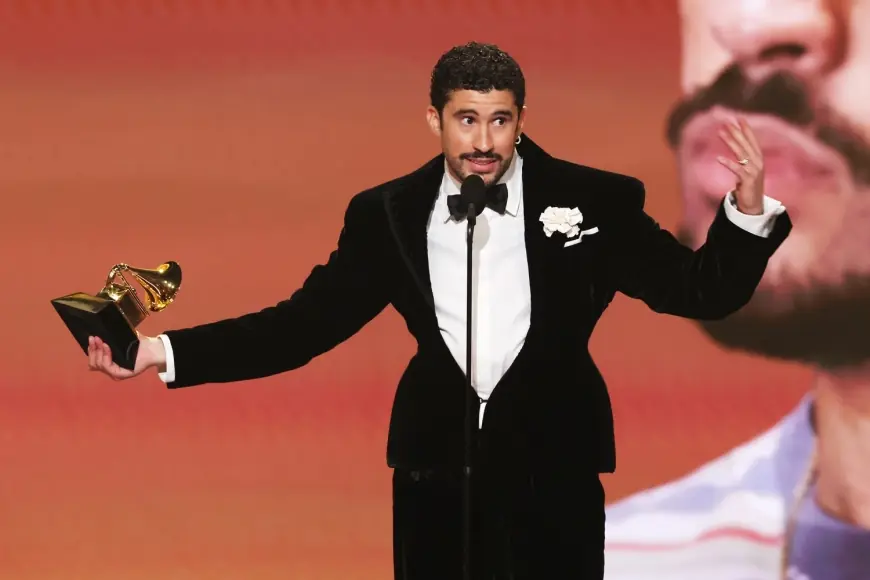
Bad Bunny entered February with two parallel storylines converging at once: a historic top prize at the Grammys and a looming prime-time performance that will put his music in front of the widest U.S. television audience of the year. On Sunday night ET, his album Debí Tirar Más Fotos won Album of the Year—an industry first for an all-Spanish-language project in that category—instantly reframing the conversation about what the Grammys’ biggest award can represent.
The timing matters. The win lands mid-run on his stadium world tour and days before his Super Bowl halftime set, turning one awards moment into a weeklong cultural runway.
A Grammy milestone that changes the frame
Album of the Year is the Grammys’ most symbolically loaded prize because it’s less about a single hit and more about a full statement—cohesion, vision, and broad voter appeal across genres. Debí Tirar Más Fotos winning as an all-Spanish-language album signals that the center of gravity has shifted: Spanish-language music is no longer treated as a “special category” success story, but as a mainstream contender capable of clearing the show’s highest bar.
The win also arrives after years in which global streaming habits have moved faster than awards institutions. This time, the trophy caught up to the listening reality, and Bad Bunny became the clearest proof point.
What Debí Tirar Más Fotos represents
The album’s title—roughly “I should’ve taken more photos”—telegraphs its core idea: memory, place, and the complicated feeling of looking back while still moving forward. The project has been widely read as unusually personal for a superstar who often thrives on swagger and spectacle. Here, the emotional center is more reflective, and the Puerto Rico-throughline is less a branding flourish than the album’s structural spine.
That approach matters commercially, too. A more intimate album can be a risk for stadium-scale artists. The Album of the Year win effectively de-risks that choice by stamping it as the defining statement of the cycle, not a detour.
February calendar: Grammys, Super Bowl, tour
Bad Bunny’s next two weeks stack major moments with almost no downtime. Here’s the practical timeline (all times ET where applicable):
| Date | Milestone | Why it matters |
|---|---|---|
| Sun., Feb. 1, 2026 | Album of the Year win | Biggest awards validation of his career |
| Sun., Feb. 8, 2026 | Super Bowl LX halftime show | Largest U.S. live-music stage of the year |
| Mid–late Feb. 2026 | South America + Australia stadium stops | Tests whether the era stays hot after the awards bump |
The scheduling creates a reinforcing loop: the Grammys win boosts attention, the Super Bowl multiplies it, and the tour converts it into sold seats and long-tail streaming.
Super Bowl halftime: a global artist on the biggest U.S. stage
The halftime show is its own kind of measuring stick. It’s not just a performance; it’s a statement about who is considered “mass audience” in American pop culture right now. Bad Bunny’s selection signals confidence that Spanish-language music doesn’t need translation to dominate a U.S. prime-time slot.
It’s also a creative challenge. Halftime sets are short, fast, and built for hooks—an exercise in editing a catalog into a tight, TV-friendly arc. For Bad Bunny, the question is how much the show leans into the new album’s reflective tone versus the high-energy back-catalog that plays best in a stadium.
What happens next after the win
The clearest near-term impact is measurable: a “winner bump” in streams and sales for the album, plus renewed interest in deep cuts that fans now treat as “Grammy-certified.” Another likely ripple is industry positioning—festival billing, brand partnerships, and awards-season campaigning for collaborators tied to the album’s production and writing.
The longer view is broader: Album of the Year tends to become a career divider. Before the win, Bad Bunny was already a defining artist of his era. After it, he sits in a different lane—one where his work is framed not only as culturally dominant, but institutionally unavoidable.
With the Super Bowl ahead and the tour already in motion, February is shaping up as a single, extended spotlight: a rare moment where critical validation, mass exposure, and commercial scale all align at once.
Sources consulted: Associated Press; Recording Academy; National Football League; Ticketmaster