
























Sunspot Unleashes 17 Explosions in Under 24 Hours

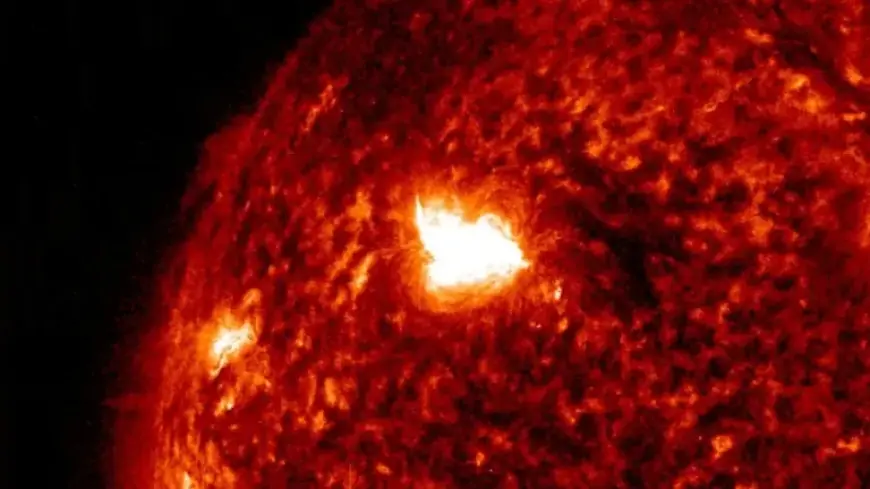
A significant sunspot, designated AR4366, has rapidly transformed into a source of intense solar activity. Over a span of less than 24 hours, it unleashed 17 minor solar flares along with three powerful X-class flares.
About Sunspot AR4366
AR4366 emerged just days ago, growing remarkably and now rivaling the size of the famous Carrington Event sunspot from 1859. This rapid expansion has raised concerns about increasing solar instability.
Historical Context
- The Carrington Event occurred in 1859 and is known for having unleashed the strongest solar storm ever recorded.
- Recently, on February 1, 2026, an X8-class flare peaked, causing significant disruptions.
Impact of Recent Solar Activity
The X8-class flare produced a severe extreme ultraviolet burst. This event ionized Earth’s upper atmosphere, resulting in a widespread shortwave radio blackout across the South Pacific, including countries like Australia and New Zealand.
- Ham radio operators reported signal losses below 30 MHz for several hours post-peak.
- Disruptions also affected aviation and maritime communication systems.
Subsequent Solar Events
Following the X8-class flare, additional X-class flares emerged from the same region, including an X2.9 flare classified as an R3 event by NOAA’s Space Weather Prediction Center. In total, AR4366 produced over 20 flares in the 24 hours leading up to February 1 UTC.
Reasons for Increased Solar Activity
Sunspot AR4366 has entered Earth’s line of sight from the sun’s northeast quadrant. Its growth is linked to twisted magnetic fields that release energy as explosive flares.
Coronal Mass Ejections and Potential Effects
NOAA and SOHO coronagraphs are monitoring for potential coronal mass ejections (CMEs), which are dense clouds of plasma that may travel toward Earth at extremely high speeds. If a CME is confirmed from the recent activity, auroras could be visible at high latitudes within 1 to 3 days.
- Past CMEs from similar sunspots have led to geomagnetic storms, power grid fluctuations, and satellite disruptions.
- Radio blackouts have already affected the sunlit hemisphere, and further disruptions are expected as AR4366 remains active.
Monitoring and Future Predictions
While no major geomagnetic storms have occurred yet, space weather experts are closely monitoring the situation via NOAA alerts. This surge in solar activity marks the strongest flares of 2026, as Solar Cycle 25 approaches its peak.
With forecasters warning that more flares are likely, astronomers and satellite operators are on high alert for potential future events related to AR4366’s instability.