























Elena Rybakina wins Australian Open, setting up a pivotal February stretch

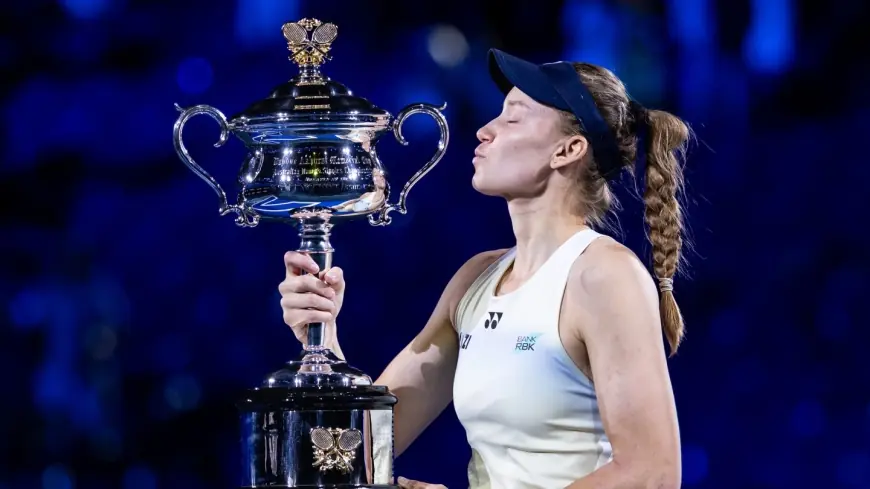
Elena Rybakina capped a blistering start to 2026 by winning the Australian Open women’s title on Saturday, Jan. 31, 2026 (ET), defeating world No. 1 Aryna Sabalenka in three sets. The victory gives the 26-year-old from Kazakhstan a second major trophy and immediately reshapes the early-season race for the top ranking as the tour heads into two high-stakes events in the Middle East.
Rybakina’s run in Melbourne also reopens questions that followed her much of last year: the stability of her team, the lingering noise around coaching controversies, and whether she can consistently convert deep major runs into titles. This time, she did.
Elena Rybakina wins Australian Open final
Rybakina beat Sabalenka 6-4, 4-6, 6-4 to claim the Daphne Akhurst Memorial Cup, closing the match with a clean finishing sequence and an ace on championship point. The win served as a measure of revenge for a previous Australian Open final loss to Sabalenka, and it underscored a familiar Rybakina pattern: compact shot production, heavy first-strike tennis, and a temperament that barely shifts in the biggest moments.
Her Melbourne path was packed with elite tests. She took out Iga Świątek in the quarterfinals and beat Jessica Pegula in the semifinals before edging Sabalenka in a tight final decided by a small number of swing points.
What the win means for the rankings race
The title is expected to lift Rybakina back near the top of the rankings—recent projections place her at No. 3—with the No. 1 spot back in realistic view if her form holds through February and into the spring hard-court and clay stretches.
The broader significance is that the women’s field now has a second major winner in the last few seasons who can win majors and the year-end championships-style events in the same arc. Rybakina’s recent results include a strong late-2025 finish, and her Australian Open title extends a run of dominant outcomes against top opponents that has tightened the gap between “contender” and “favorite” labels.
A key competitive takeaway is matchup-driven: her serve-plus-first-ball patterns shorten points against the most athletic defenders, while her improved movement has reduced the drop-off in longer exchanges that used to show late in matches.
The Vukov shadow and the team story
Rybakina’s on-court surge has unfolded alongside intense attention on her coaching situation. Her coach, Stefano Vukov, was suspended during last year’s Australian Open period amid allegations of verbal abuse. His suspension was lifted in August 2025, and his presence around this year’s tournament became a visible subplot.
Rybakina has repeatedly denied that she was mistreated and has emphasized that her support group is larger than any one person. Still, the episode remains a recurring talking point because it intersects with two realities: how tennis polices coach conduct and how players navigate power dynamics inside their teams.
For Rybakina, the practical question is less about headlines and more about continuity. She looked technically settled in Melbourne, particularly on serve rhythm and defensive footwork, which are the first areas to wobble when a team is in flux.
Key takeaways from Melbourne
-
Rybakina’s biggest gains showed in movement and point construction, not just raw power.
-
Her top-tier wins in consecutive rounds suggest she can sustain level under repeated pressure.
-
The sport’s focus on coaching behavior is not fading, and her team will remain under scrutiny.
What’s next: Doha and Dubai come fast
There’s little time to celebrate. The tour’s next major checkpoint is Doha, running Feb. 8–14, 2026, followed immediately by Dubai from Feb. 15–21, 2026. Those back-to-back tournaments are among the most form-revealing stops of the early season: fast courts, stacked draws, and minimal recovery time.
For Rybakina, the February swing will test whether her Australian Open peak is a one-off spike or the start of a season-long platform. If her first-serve percentage stays high and her lateral defense remains as sharp as it was in Melbourne, she’ll be a favorite to reach late rounds again—especially because her game style tends to translate well to these conditions.
The forward look is straightforward: two deep runs in February would put real pressure on the top of the rankings and set up a spring where Rybakina isn’t chasing validation, but chasing No. 1.
Sources consulted: Reuters, Associated Press, WTA, The Guardian