

























Ethereum price drops as ETH slides on risk-off mood and Fed uncertainty

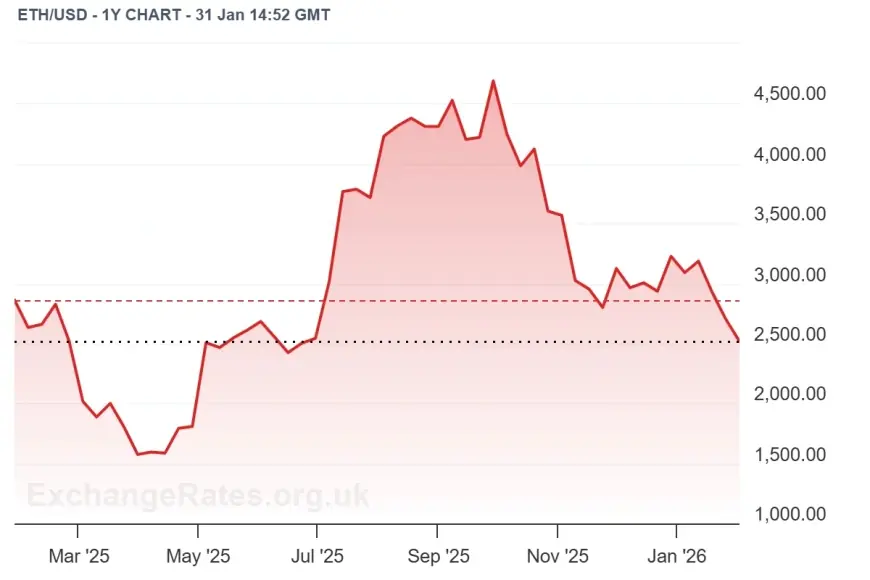
The ethereum price fell sharply on Saturday as ETH tracked a broader pullback in crypto tied to a stronger dollar, shifting rate expectations, and a fast unwind in leveraged positioning. The move matters now because it’s testing key risk appetite across digital assets at the same time markets are re-pricing the path for U.S. monetary policy.
As of 3:03 p.m. ET on Jan. 31, 2026, ETH was around $2,380, down markedly on the day after swinging through a wide intraday range.
| Snapshot | Level |
|---|---|
| ETH spot (as of 3:03 p.m. ET) | $2,380.32 |
| Day change vs prior close | -$355.56 (about -13.0%) |
| Intraday high | $2,735.88 |
| Intraday low | $2,289.41 |
Where the market stands now
Saturday’s decline left ETH trading near the lower end of its day’s range, reflecting a session where sellers stayed in control even after brief rebounds. In the same stretch, bitcoin also dropped to its lowest level since late November, reinforcing the sense that the selloff was market-wide rather than limited to one token.
The immediate takeaway for traders: volatility is back, and the market is behaving like a high-beta risk asset. That dynamic can amplify moves when liquidity thins out on weekends, as fewer large orders can push prices further than they might during peak weekday hours.
What’s moving the ethereum price today
Several forces converged at once:
A key driver has been renewed uncertainty around the future path of U.S. rates and the dollar’s strength, following political and policy developments tied to Donald Trump and the nomination of Kevin Warsh to lead the Federal Reserve. Crypto prices tend to struggle when markets brace for tighter financial conditions, since higher real yields and a firmer dollar can reduce appetite for speculative exposure.
Separately, the size and speed of ETH’s drop points to positioning as a factor. When prices slide quickly, leveraged traders can be forced to sell as collateral values fall. That can create a feedback loop: liquidations add sell pressure, which triggers more forced selling, especially in perpetual futures that trade around the clock.
Mechanically, ETH’s spot market runs 24/7 globally, while derivatives markets often set the tempo during stress. When funding and margin conditions tighten, derivatives-driven flows can pull spot prices down, even if longer-term holders don’t change their views.
Macro forces and liquidity
The broader backdrop is that crypto has been trading more like a liquidity-sensitive corner of the market than a standalone “digital gold” story. In recent weeks, shifts in expectations for rate cuts, the dollar’s direction, and cross-asset volatility have shown up quickly in crypto prices.
Weekend trading can magnify these effects. With fewer institutions actively rebalancing and thinner order books, large sell programs or liquidation cascades can move prices substantially in short windows. For retail investors, that often translates into sudden gaps lower and sharper rebounds that are hard to time.
ETF flows and positioning
Another pressure point has been the tone around crypto investment product flows. When investors pull money from major listed vehicles, it can weaken sentiment and reduce the marginal bid, even if the flows don’t translate one-for-one into immediate spot selling. Recent commentary and data snapshots have highlighted outflows and choppy demand in U.S.-listed crypto funds as the market digests macro uncertainty.
For institutions, flows can influence whether they treat dips as opportunities or as signals to reduce exposure. For market makers, softer creation demand can mean less natural absorption of sell pressure during fast drawdowns.
Network fundamentals and upcoming milestones
Despite the price drop, Ethereum’s underlying development roadmap continues to emphasize scalability and iterative upgrades. The network’s upgrade process typically involves months of testing, coordination among client teams, and staged deployment before changes reach the main network. That cadence can matter to long-term investors because it shapes expectations for fees, throughput, and the ecosystem’s ability to support growing activity.
Looking into 2026, developer discussions have pointed to a faster rhythm of major upgrades, including plans that have been discussed for the first half of 2026 and later in the year. While exact dates can shift with testing and coordination, the sequencing is part of the market narrative around medium-term fundamentals.
Stakeholder impact is uneven:
-
DeFi users and traders may see higher liquidation risk and wider spreads during volatile hours.
-
Stakers and long-term holders tend to focus more on network health and real yield, but sharp price drops can still alter risk management and collateral decisions.
What to watch next week
The next key signals are straightforward and observable: whether ETH stabilizes after the weekend swing, whether funding and liquidation pressure eases, and whether broader risk markets calm as investors reassess the rate outlook. If the dollar keeps strengthening and rate expectations stay elevated, crypto could remain under pressure; if financial conditions loosen, ETH may find firmer footing.
Near-term attention will also remain on any fresh flow readings from major listed products and on the tone of macro data releases and central-bank communications in the days ahead.