Are There Aftershocks After the Earthquake That Happened Now? Aftershocks Likely Following Southern California Quake Near Indio Hills

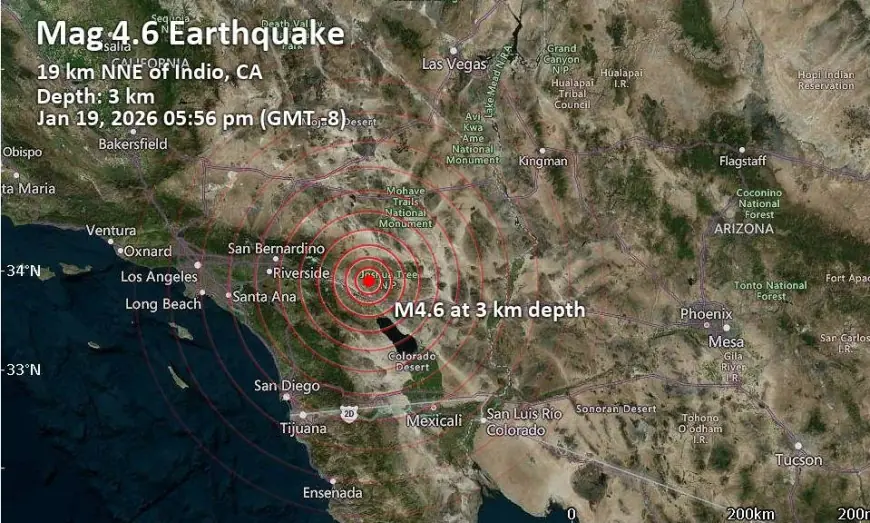
A moderate earthquake near Indio Hills in Riverside County has left many people across Southern California asking the same urgent question: Are there aftershocks after the earthquake that happened now? The answer is yes. Aftershocks are a normal part of how faults “readjust” after a main earthquake, and at least one notable aftershock was recorded shortly after the main shaking.
The main earthquake was measured at magnitude 4.9, occurring at about 5:56 p.m. Pacific Time, with a very shallow depth near 3 km (about 2 miles). Shallow earthquakes often feel sharper near the epicenter because the seismic energy reaches the surface quickly, which helps explain why the quake was widely felt across the Coachella Valley and reported in parts of Riverside County, Los Angeles, and San Diego.
What Is an Aftershock and Why Does It Happen?
An aftershock is a smaller earthquake that occurs in the same region following a larger “mainshock.” When the main earthquake ruptures part of a fault, it changes stress levels around the rupture zone. Nearby fault segments and surrounding rock then adjust to this new stress pattern, and those adjustments can trigger additional quakes.
Aftershocks are not “extra earthquakes out of nowhere.” They are part of the same overall sequence, and they can continue for:
-
Hours (common after moderate events)
-
Days (also common)
-
Sometimes weeks (less common, but possible)
Most aftershocks are smaller than the mainshock, but some can still be strong enough to feel—especially close to the epicenter.
Confirmed Early Aftershock Activity
Not long after the magnitude 4.9 mainshock near Indio Hills, a magnitude 3.4 aftershock was reported in the same general area, roughly around 5:57 p.m. Pacific Time, at an estimated depth near 4.9 km. A quick follow-up like this fits a typical aftershock pattern: the first hour after the mainshock can produce multiple smaller events as the crust settles.
Because seismic monitoring data can be refined as more stations report in, small updates to magnitude and location are normal. However, the overall takeaway remains the same: aftershocks are expected after a quake like this, and the early aftershock confirms the sequence is active.
Where Aftershocks Are Most Likely to Be Felt
Aftershocks are usually felt most strongly near the epicenter. For this event, that means people in or near:
-
Indio
-
Palm Desert
-
Palm Springs
-
Surrounding Coachella Valley communities
If you are farther away—such as in parts of Los Angeles or San Diego—you may still feel stronger aftershocks, but it’s less likely unless an aftershock is unusually large or local ground conditions amplify shaking.
How Strong Could Aftershocks Get Tonight?
Most aftershocks following a magnitude 4.9 earthquake will commonly fall in the magnitude 2 to 3 range, with some possibly reaching the low 4s. A stronger aftershock is less common but not impossible.
The most important practical point is this: even a smaller aftershock can cause problems if the main quake already loosened items. Things like unstable shelves, cracked glass, and shifted objects can become hazards during follow-up shaking.
Why People Are Searching “5.1 Earthquake”
In the minutes after a quake, early automated estimates can vary. That’s why many people see or search for a number like 5.1 even if later reviews settle closer to 4.9. Revisions happen as additional seismic data is processed, and the “final” posted magnitude can shift slightly.
What To Do If Another Aftershock Happens
If you feel shaking again:
-
Drop to the ground
-
Cover your head and neck under a sturdy table or desk (or next to an interior wall if nothing is available)
-
Hold On until the shaking stops
Additional smart steps for tonight:
-
Keep shoes and a flashlight nearby in case items break on the floor
-
Check for gas smells or hissing sounds near gas lines
-
Secure items that look ready to fall (frames, mirrors, top-heavy furniture)
-
Avoid standing under heavy objects or near windows during shaking
Aftershocks can be startling, but they are a standard part of earthquake sequences—especially after a shallow mainshock like this one near Indio Hills.
If you tell me your exact location (for example: Indio, Palm Springs, Palm Desert, Riverside, Los Angeles, or San Diego), I can describe what people in your area typically experience during aftershocks and what to prioritize for safety overnight.