Exploring Mosaic Lateral Heterostructures in 2D Perovskite Materials

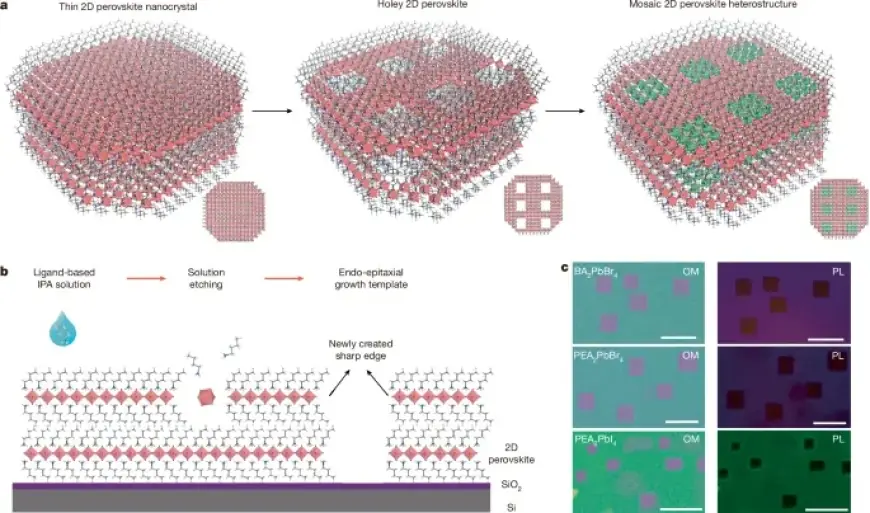
Recent advancements in 2D perovskite materials have introduced exciting possibilities for the development of mosaic lateral heterostructures. These structures demonstrate promise in various applications, particularly in optoelectronics.
Understanding Mosaic Lateral Heterostructures in 2D Perovskite Materials
Mosaic lateral heterostructures represent a significant innovation in the synthesis of two-dimensional materials. They are primarily developed through sequential edge-epitaxy, a method that ensures high quality and precise control during growth. These structures combine different materials at the atomic scale, enhancing their electronic and optical properties.
Notable Research and Techniques
- Single-Crystal Growth: Researchers have explored methods like layered growth to achieve large-area single-crystal films of transition metal dichalcogenides.
- Epitaxial Growth: The epitaxial growth of monolayers, such as WSe2 and MoS2, has further refined the creation of sharp interfaces in lateral p-n junctions.
- Moiré Superlattices: The exploration of twisted two-dimensional halide perovskites has uncovered the formation of moiré superlattices.
Key Studies in the Field
Several notable studies have contributed to our understanding of 2D perovskite materials:
- Shi et al. (2020) highlighted the development of lateral epitaxial heterostructures in halide perovskites.
- Blancon et al. (2020) focused on semiconductor physics of 2D halide perovskites, emphasizing their unique properties.
- Kang et al. (2017) discussed the layer-by-layer assembly of two-dimensional materials, paving the way for scalable applications.
Future Directions for Research
As the field evolves, the integration of these mosaic lateral heterostructures into practical devices, such as light-emitting diodes and solar cells, will be crucial. Research continues to address the challenges of scalability and material stability, ensuring the reliable performance of 2D perovskite technologies.
In summary, the study of mosaic lateral heterostructures in 2D perovskite materials is rapidly advancing. The continued exploration of their properties and potential applications could lead to significant breakthroughs in material science and technology.