Space ‘Ghosts’ Flashing Negative Energy May Unveil New Physics

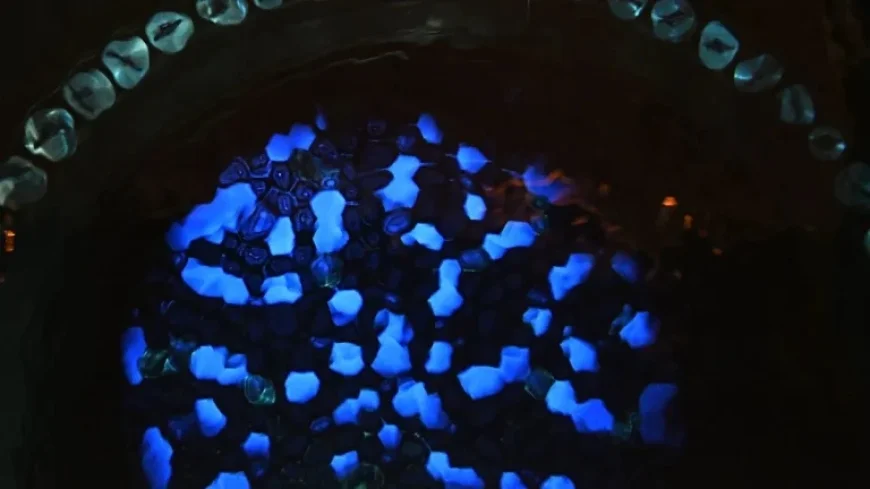
The study of light and particles has unveiled interesting concepts in physics, particularly with the phenomenon of Cherenkov radiation. This occurs when a particle exceeds the speed of light in a medium, resulting in a unique light reflection. The implications of this effect expand beyond conventional settings, indicating potential new physics in the vacuum of space.
Understanding Cherenkov Radiation and Ghost Instability
Theoretical physicist Eugeny Babichev from the University of Paris-Saclay proposes a novel interpretation of Cherenkov radiation. According to his findings, the distinctive blue glow associated with this radiation could signify the presence of negative-energy ghost perturbations in space.
The Implications of Negative Energy
Babichev’s paper suggests that detecting this type of radiation in a vacuum could provide valuable insights into the behavior of spacetime when current gravitational theories falter. Notably, he emphasizes that a ghost can be defined as a disturbance that contributes negative energy, leading to instability in physical systems.
- Cherenkov Radiation: A visible light signature that occurs when particles travel faster than light in a medium.
- Ghost Disturbance: A physical manifestation of negative energy that could indicate instability.
In simpler terms, these ghosts operate like ripples on a water surface. Normally, a disturbance requires energy to appear. However, in some theoretical scenarios, a ghost could create ripples spontaneously, drawing the total energy of the system down. This concept brings forward possibilities for new models of gravity.
Potential Discoveries in Cosmic Vacuum
Babichev’s analysis indicates that the dynamics of ghost instabilities may resemble Cherenkov radiation observed on Earth. If scientifically verified, it could redefine our understanding of the cosmic vacuum, suggesting it possesses structure and energy rather than being an empty void. This perspective challenges the traditional idea of the vacuum as the absolute lowest-energy state.
Future Directions in Theoretical Physics
While these discussions remain largely theoretical, Babichev encourages further studies into these unstable configurations under varying gravity theories. He mentions the exploration of ghost instabilities in black holes, predicting their effects on quasinormal modes.
Publication and Further Research
The insights presented by Babichev are documented in the journal Physical Review D. This research opens pathways for both analytical and numerical explorations of ghost instability, potentially bridging gaps between general relativity and quantum mechanics.
In conclusion, the notion that a cosmic vacuum may exhibit behaviors akin to a physical medium is groundbreaking. As physicists delve deeper into this subject, it could lead to significant advancements in our grasp of fundamental forces in the universe.
The po