

























Bright-Green Fireball Meteor Explodes Over Historic Viking Raid Site in UK

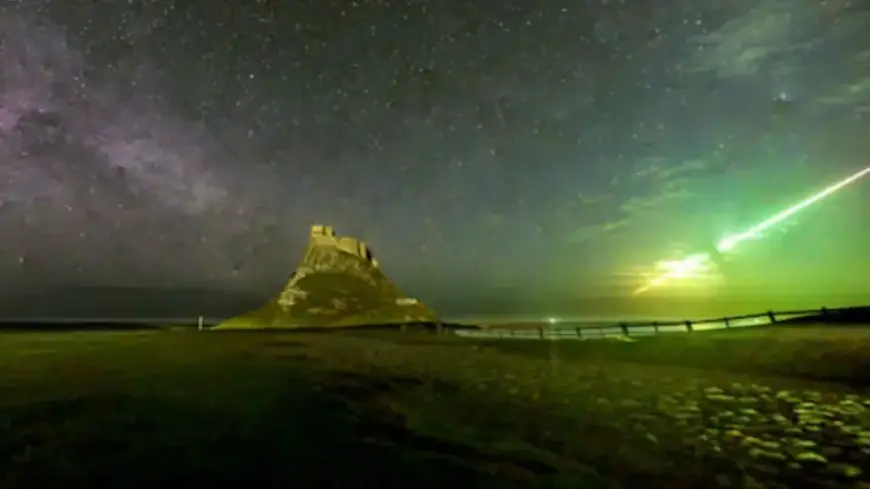
A photographer captured a bright-green meteor streaking over Lindisfarne early on Monday, April 13, 2026. The space rock exploded above the North Sea off England’s east coast. It left a long, vivid trail over the famous island and castle.
Where it happened
Ian Sproat photographed the event from Lindisfarne, also called Holy Island. The site is famed as the location of a historic Viking raid in 793.
Lindisfarne Castle sits on the island and dates to the 16th century. The meteor’s path crossed the starry sky above the castle as Sproat shot a Milky Way time-lapse.
Reports and recordings
At least 230 observers reported the sighting to the American Meteor Society. Reports came from across the U.K. and parts of Belgium, the Netherlands, and Germany.
Home doorbell and security cameras recorded the streak. Footage included clips from Warsop, Nottinghamshire, and an AMS entry from Epsom, England.
Witnesses said the luminous trail lasted up to seven seconds. No widespread sonic boom was reported.
Physical details and color
Analysts estimate the rock traveled about 20,000 mph (32,000 km/h). The object was very small, roughly 0.4 ounces (12 grams) in mass.
The meteor’s green hue likely arose from magnesium and nickel in the material. Fireballs often show color variations tied to chemical composition.
Most fragments would have burned up or fallen into the sea. Any surviving pieces would likely have landed in the ocean.
What causes fireballs
Fireballs occur when incoming rocks break apart under atmospheric friction. That breakup releases intense light and heat.
Smaller pieces sometimes survive as meteorites. Larger events can produce sonic booms and ground impacts.
Context and recent activity
Scientists call February through April a peak period for fireball observations. NASA estimates sightings in this interval can rise by 10 to 30 percent.
March saw unusually high activity in the United States. AccuWeather reported at least 10 major fireballs that month, the most for March since 2012.
Recent incidents included a roof-striking meteor in Texas and a rare daytime burst over Ohio. Europe also saw a bright fireball that showered meteorites on a German town.
Filmogaz.com compiled the reports from sources including the American Meteor Society, BBC, Spaceweather.com, NASA, AccuWeather, and Live Science. The event added a dramatic, bright-green streak to the skies above the historic Viking raid site in the UK.