

























250-Million-Year-Old Dicynodont Egg Discovered in South Africa

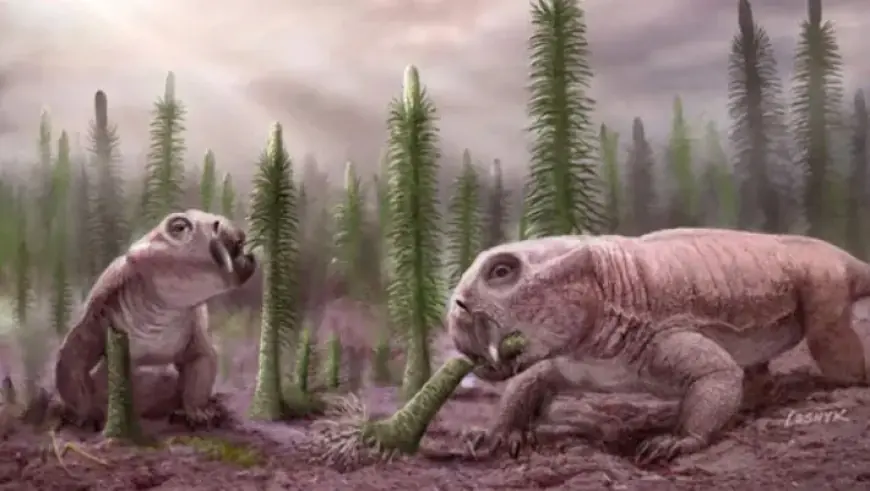
A fossil embryo from the Karoo Basin offers direct evidence that mammal ancestors laid eggs. The specimen contains an unborn Lystrosaurus revealed by high-resolution CT and synchrotron scanning.
Imaging and specimen details
Researchers scanned three perinate Lystrosaurus specimens recovered in South Africa. Advanced imaging captured tiny, delicate bones inside one tightly curled individual.
The team used both laboratory CT and synchrotron scanning at the ESRF. These methods allowed reconstruction of the embryo without damaging the fossil.
Anatomy of the embryo
The curled posture and absence of tusks indicate a prenatal stage. The lower jaw showed an unfused mandibular symphysis, meaning the animal could not yet feed.
Those features identify the specimen as an embryonated synapsid of the genus Lystrosaurus. The genus reached roughly 1.8 to 2.4 metres in length and bore upper tusks.
Reproductive interpretation
The researchers conclude the fossil represents an egg-bearing reproductive mode in early mammal relatives. The evidence supports the existence of soft-shelled dicynodont eggs, long absent from the record.
These were relatively large, yolk-rich eggs. Large yolks would allow hatchlings to develop without parental feeding, implying no lactation like modern mammals.
Development and survival strategy
Hatchlings were likely precocial and able to feed and flee soon after hatching. Large eggs would also resist desiccation in drought-prone landscapes after the end-Permian mass extinction.
Such reproductive traits likely helped Lystrosaurus dominate Early Triassic ecosystems. Their wide fossil distribution helped support the ancient concept of Pangea.
Significance and publication
Authors, including Professor Julien Benoit of the University of the Witwatersrand and Dr Vincent Fernandez of the ESRF, describe the find as a milestone. It resolves a long-standing question about egg-laying in non-mammalian synapsids.
The study appears in PLoS ONE in 2026. The full report lists J. Benoit and colleagues and includes the scanned data supporting the interpretation.
This 250-million-year-old dicynodont egg find from South Africa provides new insight into early synapsid reproduction. Filmogaz.com will continue to follow related research and updates.