



















Next-Gen Yellow Fever Vaccine Succeeds in Mid-Stage Trial

Researchers report that an investigational live-attenuated yellow fever vaccine met immunogenicity and safety benchmarks in a randomized phase II study. The vaccine was developed to speed production and increase global supply by using Vero cell culture instead of eggs.
Trial design and participants
The mid-stage trial randomized 568 healthy adults at 11 U.S. centers. Enrollment ran from July 2021 to May 2022.
Participants were 18 to 60 years old. Mean age was 39.7 years. Women made up 61.6%, and 65.1% were white.
Vaccines compared
The investigational vaccine, called vYF, is a next-gen live-attenuated shot. It is grown in serum-free Vero cells and derived from the YF-17D 204 substrain.
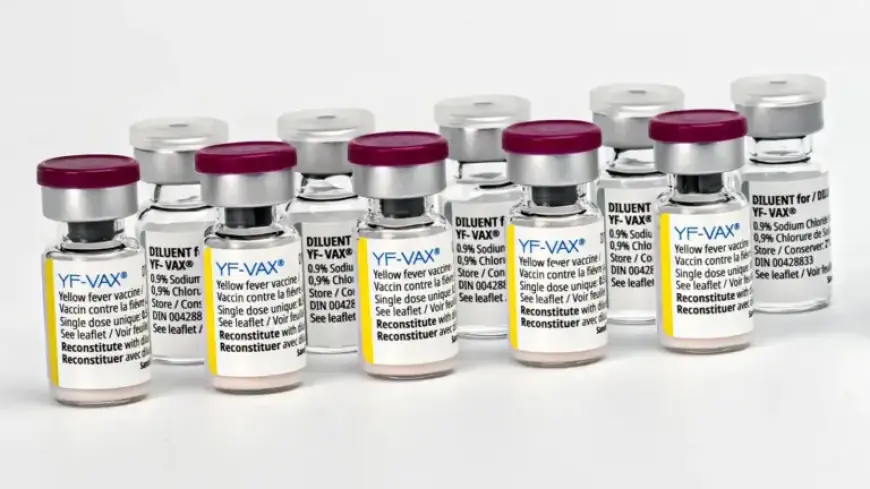
The comparator was the FDA-approved YF-VAX. YF-VAX is produced in eggs.
Immunogenicity results
Seroconversion at day 29 met noninferiority criteria for both vaccines. The rates were 99.7% for vYF and 99.4% for YF-VAX.
One year after vaccination, 97.5% in each group had neutralizing antibody titers of at least 1:10.
| Measure | vYF | YF-VAX |
|---|---|---|
| Participants randomized | 382 | 186 |
| Day 29 GMT (no prior immunity) | 1:2654 | 1:3147 |
| GMT at 1 year | 1:401 | 1:548 |
| Seroconversion at day 29 | 99.7% | 99.4% |
| Neutralizing ≥1:10 at 1 year | 97.5% | 97.5% |
Safety outcomes
Solicited adverse reactions occurred in 56.7% of vYF recipients. The YF-VAX group had 61.1%.
Unsolicited adverse events within 28 days were 26.1% for vYF and 21% for YF-VAX. Serious adverse events at six months were rare.
Rates of serious adverse events were 1.6% in the vYF arm and 1.1% in the YF-VAX arm. The trial was not large enough to detect very rare events.
Study limitations
The trial took place in a non-endemic country. Researchers excluded children, pregnant people, and immunocompromised individuals.
Authors noted the study could not rule out rare vaccine-associated viscerotropic disease. Larger or different trials will be needed.
Context and public-health implications
Yellow fever outbreaks and vaccine shortages motivated this work. Producing vaccine in Vero cells may allow faster, scalable manufacturing.
Emmanuel Feroldi, MD, of Sanofi in Lyon, France, led the trial team and published results in the New England Journal of Medicine.
Peter Hotez, MD, PhD, dean of Baylor College of Medicine’s National School of Tropical Medicine, warned that the United States has no yellow fever vaccine stockpile. He told Filmogaz.com that reintroduction into a largely naive U.S. population could be devastating.
Epidemiology
The World Health Organization estimates 67,000 to 173,000 severe yellow fever infections annually. Deaths range from 31,000 to 82,000 each year.
In 2025, seven South American countries reported 346 confirmed cases and 143 deaths. Spread from the Amazon into urbanized areas increased concern that year.
Yellow fever is a mosquito-borne flavivirus. The CDC recommends vaccination for people aged nine months and older traveling to or living in at-risk areas of Africa and South America.
What this means for vaccine development
The trial showed a next-gen yellow fever vaccine can perform on par with the licensed product. Using Vero cells may reduce reliance on egg-based manufacturing.
Investigators and public-health experts said a more reliable supply could help prevent shortages. Additional trials will be needed to confirm safety in broader populations.
- Phase II randomized trial, July 2021–May 2022, 11 U.S. centers.
- 568 participants randomized: 382 to vYF, 186 to YF-VAX.
- High seroconversion at day 29 and sustained antibodies at one year.
- Similar safety profiles, but rare-event assessment requires larger studies.
These findings support continued development of the next-gen vaccine. The results suggest that a mid-stage trial succeeded in meeting its key goals.