

























Artemis II Moon Mission Nears Completion: What’s Next for NASA?

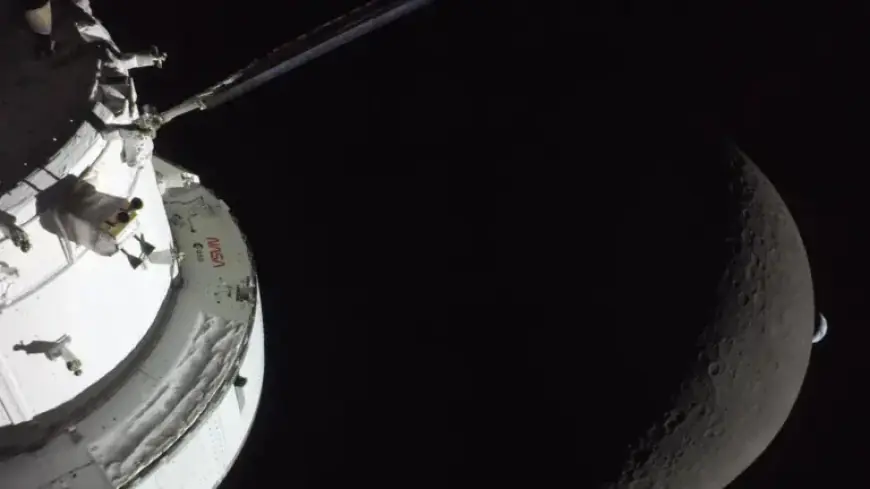
Crew milestones and reentry
The Artemis II crew is commanded by NASA astronaut Reid Wiseman. Crewmates include NASA astronauts Christina Koch and Victor Glover, and Jeremy Hansen of the Canadian Space Agency.
The mission logged about 695,081 miles since liftoff on April 1 from Kennedy Space Center in Florida. Koch became the first woman, Glover the first Black man, and Hansen the first Canadian to approach the moon on this mission.
Robotic precursors and near-term landers
Since 2024, NASA and commercial partners have landed three robotic vehicles on the moon. Those missions provided data and lessons for follow-up efforts.
At least four uncrewed lunar landers are in development for 2026. Astrobotic’s Griffin-1 appears on track for a July launch window. Other planned landers include Blue Origin’s Blue Moon Mark-1, Firefly Aerospace’s Blue Ghost, and Intuitive Machines’ Nova-C.
Under the Commercial Lunar Payload Services program, NASA expects a major surge in robotic activity in 2027. The agency has plans for up to 30 additional uncrewed landings to deliver cargo and science instruments.
Artemis III preparations
NASA is targeting 2027 for the Artemis III test mission. Engineers are readying a new core stage for the 322-foot Space Launch System rocket.
Artemis III will send a new crew aboard Orion to dock in Earth orbit with at least one commercial lunar lander. SpaceX and Blue Origin are developing those landers. NASA will also test extravehicular activity suits built by Axiom Space during the mission.
SpaceX was originally contracted to build a Human Landing System based on Starship. Concerns about development timelines have prompted NASA to also consider Blue Origin’s Blue Moon lander.
Human lunar landing and base plans
NASA aims to return humans to the lunar surface in 2028. That would mark the first crewed lunar landing since Apollo 17 in 1972.
The selected lander for the surface mission would rendezvous with Orion in lunar orbit. Astronauts would conduct moonwalks, perform science experiments, and then return to Orion for the trip home.
NASA has identified nine candidate landing sites near the moon’s south pole. These areas may hold water ice in permanently shadowed regions. That ice could support drinking water, breathable oxygen, and rocket fuel production.
The agency plans to use a sequence of crewed and uncrewed missions to build a sustained presence. Officials have discussed a roughly $20 billion moon base and a cadence of human landings up to twice a year after Artemis V, according to program comments attributed to NASA Administrator Jared Isaacman.
Looking toward Mars
NASA is also using the moon as a proving ground for Mars exploration. A new Mars mission, slotted for launch by the end of 2028, would be the first to use a fission nuclear-powered spacecraft.
That mission would arrive at Mars in 2030. It plans to deploy three helicopters to scout landing sites and search for subsurface water using radar. The helicopters would build on lessons from the Ingenuity technology demonstrator.
Program momentum
As Artemis II nears completion, planners and engineers are already moving the program forward. The moon mission’s success will shape what’s next for NASA across robotic and human exploration.
Reporting and analysis for this update were prepared by Filmogaz.com using public NASA briefings and program announcements.