
























Analyzing America’s Growing Catholic Population by the Numbers

Recent trends indicate a noteworthy shift in the Catholic population in the United States. As Easter Vigil approaches, thousands are anticipated to join the Church, either through baptism or formal reception into full communion. This can be seen as a sign of the Church’s vitality, but underlying statistics reveal a complex narrative about participation in Catholicism.
Analyzing America’s Growing Catholic Population by the Numbers
In recent decades, the number of adults entering the Catholic Church has shown a downward trend. Participation in key sacraments, such as marriages and infant baptisms, has also declined significantly. From 2000 to 2025, marriage ceremonies have fallen by 59%, infant baptisms by 53%, and funerals by 26%.
Shift in Trends
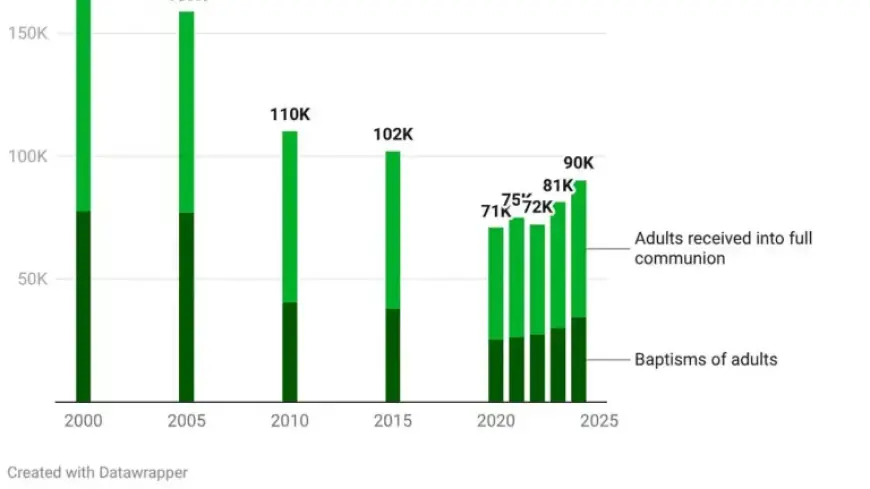
Despite this decline, expectations for 2026 suggest a potential resurgence in converts. Data from the Official Catholic Directory highlights an alarming trend; in 2000, there were 173,674 adults who were baptized or received into the Church. By 2020, this number had plummeted to just 70,796, primarily due to the COVID-19 pandemic.
Post-pandemic, numbers have stabilized and began to rise again. In 2021, there were 74,972 new Catholics, which increased to 90,157 by 2024, surpassing pre-pandemic levels.
Diocese-Specific Data
Reports indicate that 2026 could be a landmark year for Catholic converts. Data from CARA (The Center for Applied Research in the Apostolate) shows encouraging trends for most dioceses. Between 2022 and 2024, approximately 81% of U.S. dioceses recorded an uptick in new adult Catholics. In contrast, only 11% experienced increases from 2000 to 2019.
Notable Increases in Specific Dioceses
Significant increases were noted in several key dioceses:
- Archdiocese of Newark: 1,755 adults are set to enter the Church in 2026, over four times the 2024 number.
- Archdiocese of Philadelphia: A jump from 283 in 2024 to 1,162 new members in 2026, the highest since 2005.
Across 16 dioceses evaluated, the average increase in new adult Catholics since 2024 was 83%. Despite the positive trend, only Newark and Washington D.C. surpassed 2000 levels, illustrating a wider issue within the Church’s growth.
Broader Context
The growth of new adult Catholics occurs against the backdrop of continuing declines in infant baptisms—down over 50% since 2000. This raises concerns about the long-term health of the Church, as fewer children are being baptized, signaling potential future declines in active participation.
Interestingly, this phenomenon is not exclusive to the United States. Other nations, such as France, report similar “baptism booms” among adults, despite a steady decrease in infant baptisms. However, countries like Germany show no significant increase in adult conversions, highlighting diverse trends across secularizing cultures.
The data indicates that while the Catholic Church may see a short-term resurgence in adult converts, systemic issues regarding participation and growth remain challenging. Future projections will determine if this trend can be sustained or if it represents a temporary fluctuation in a larger pattern of decline.