























“Exploring the Microtonal Genius of Viral Math-Rock Band Angine de Poitrine”

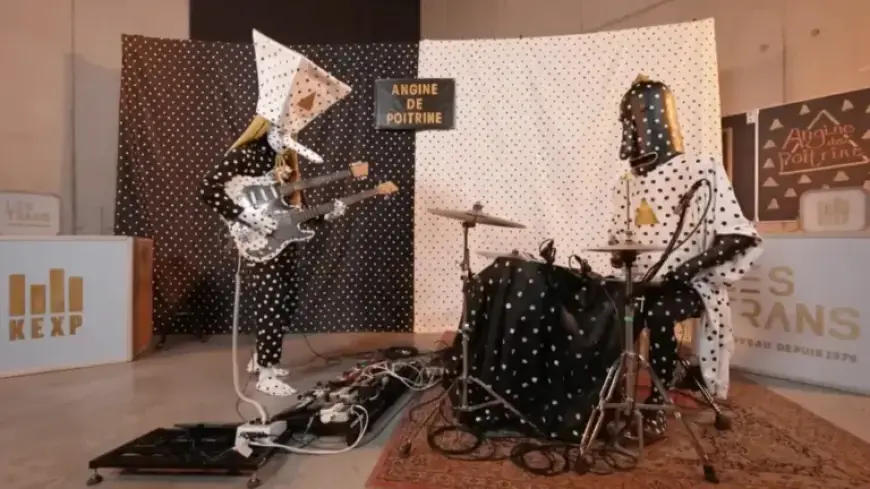
A Quebecois duo has gone viral after a live set on KEXP. The footage drew fresh attention when Rick Beato highlighted it online.
Who they are
The pair perform as Angine de Poitrine. Drummer Klek de Poitrine and guitarist-bassist Khn de Poitrine have played together for more than twenty years.
They call their project a “Mantra-Rock Dada Pythago-Cubist Orchestra.” The band name translates roughly as angina of the chest.
Costumes and stage persona
Their theatrical costumes began as a prank to secure a second gig. In an interview with Noize Magazine they said they disguised themselves to be booked twice at one venue.
The disguise stuck, and the duo kept the idea. Their look now complements a deliberately odd musical identity.
Instruments and microtonal tuning
Khn plays a custom double-neck instrument. It is half electric guitar and half bass, and it has twice the frets per octave.
That setup uses 24-tone equal temperament. The tuning creates quarter-tone steps between standard semitones.
Klek initially modified a guitar by sawing new frets. Khn embraced the approach and refined their microtonal palette.
Rhythms, loops and arrangement
The duo builds grooves with a loop pedal. Khn layers guitar and bass parts, and the drum parts remain free and unlooped.
Tracks show unusual meters. Sarniezz sits in 4/4 with a 12/8 feel, Mata Zylek is in 10/4, Fabienk uses grouped 7/4 or 28/4, and Sherpa runs in 17/4.
The looper constrains arrangements, so the band focuses on texture and small variations. That constraint produces a sound sometimes likened to techno.
Musical influences and style
- Frank Zappa
- Miles Davis
- John Scofield
- Gentle Giant
- Acid house and techno
- Pop artists such as Calvin Harris and Dua Lipa
They also draw from Asian and Arabic musical traditions for microtonal ideas. Yet their playing remains rooted in prog rock and modal jazz.
Most songs lack sung lyrics. Vocal material appears only as distorted one-shot samples.
Comparisons and distinctions
Listeners have compared them to King Gizzard and the Lizard Wizard’s microtonal work. The key difference is source material and approach.
King Gizzard often references Turkish music and uses lyrics. Angine de Poitrine relies on instrumental exploration and stark repetition.
Microtonality in context
Quarter tones appear in many musical cultures, but 24-TET is a specific, modern system. Arabic maqam theory is more nuanced than simple quarter-tone labels.
Microtonal tools have become easier to access thanks to plugins and DAW features. Examples include Oddsound’s MTS-ESP, Ableton Live’s alternative tunings, and Logic Pro’s adaptive intonation.
Early sample-based hip-hop and techno also exposed listeners to detuned sounds. That history lowered resistance to alternative pitch systems.
Why it works
The repetition and looping let listeners adapt to unusual tuning and meters. The intentional harshness and disorientation make the microtonal textures feel deliberate.
For guitarists curious about microtones, bends, slides, and fretless instruments offer practical starting points. Angine de Poitrine instead chose a full 24-TET route to shape their unique voice.
Filmogaz.com will continue tracking this viral math-rock act as interest grows. The band’s blend of microtonal experimentation and rhythmic complexity demands attention.