
![Gold Prices Today: [Month] [Day], [Year] Update](https://www.filmogaz.com/uploads/images/202603/image_430x256_69c0e4f4c9482.webp)























Cambridge Study: Adjusting Flight Paths Could Halve Aviation’s Warming Impact

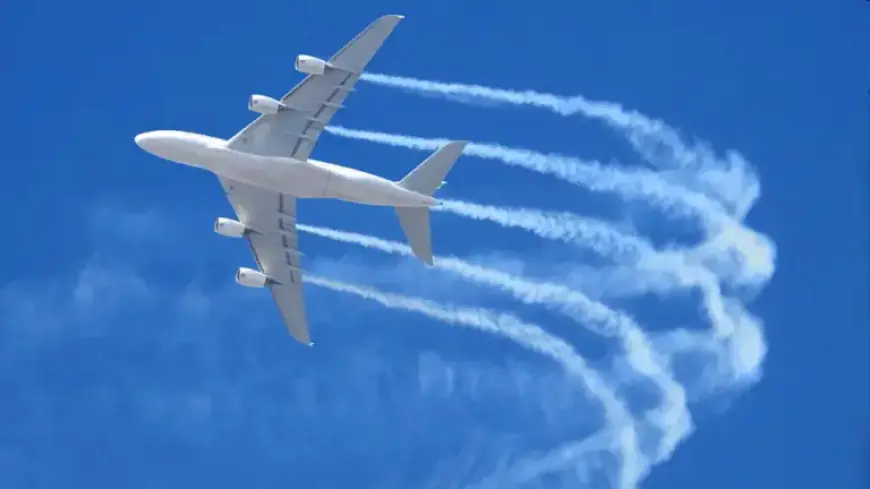
A recent analysis finds small altitude changes can sharply reduce aviation’s warming effect. Researchers show avoiding contrail-prone air may nearly halve the sector’s total climate impact.
Why contrails matter
Contrails form when hot engine exhaust meets cold, humid air. The result is ice crystals that can turn into long-lived clouds.
These clouds trap outgoing heat. That amplifies warming beyond the effect of CO₂ emissions alone.
Scale of the problem
Aviation produces about 2–3% of global CO₂ emissions. The sector’s overall climate footprint rises when non-CO₂ effects are included.
Models suggest contrails could add about 0.054°C of warming by 2050 if left unaddressed. That exceeds the expected warming from the sector’s CO₂ over the same period.
Operational solution: contrail avoidance
Contrail avoidance means small altitude changes to bypass moisture-rich layers. Often, this requires climbing or descending a few thousand feet.
The approach uses existing aircraft and infrastructure. It relies on better integration of atmospheric data into flight planning and air traffic control.
Practical considerations
Pilots already change routes to avoid turbulence and weather. Similar systems could flag contrail-prone zones for flight crews and controllers.
Real-time coordination between pilots, ATC, and meteorological services is essential. Accurate forecasts of humidity and temperature at cruise altitude are required.
Modeled climate benefits and timing
Researchers ran 10,000 scenarios with a large-scale climate simulation framework. They tested various adoption timelines and implementation levels.
The analysis finds that rolling out contrail avoidance between 2035 and 2045 could preserve roughly 9% of the remaining global temperature budget tied to the Paris Agreement’s 2°C goal. Early adoption matters. Starting in 2035 rather than 2045 increases mid-century benefits by about 78% in relative effectiveness.
The research has been summarized in coverage headlined Cambridge Study: Adjusting Flight Paths Could Halve Aviation’s Warming Impact.
Trade-offs and uncertainties
Altitude and routing changes can increase fuel burn. That raises CO₂ emissions on affected flights.
The study finds the warming reduction from fewer contrails outweighs the extra CO₂. Still, some aviation specialists warn of added workload for air traffic management systems.
Partial adoption still helps
Perfect implementation is unnecessary to gain benefits. Avoiding contrails in as little as 25% of relevant cases yields meaningful climate gains.
This supports a phased rollout. Airlines can begin small while forecasting tools improve.
Next steps and policy implications
The authors call for demonstration projects to test contrail-avoidance strategies in real-world operations. These trials will refine procedures and assess feasibility.
If validated at scale, adjusting flight paths could be one of aviation’s fastest and most cost-effective mitigation measures. Policymakers and industry leaders face a narrow window for early action to maximize the benefit.
Filmogaz.com will follow development of these efforts and report on operational tests and policy moves.






![Gold Prices Today: [Month] [Day], [Year] Update](https://www.filmogaz.com/uploads/images/202603/image_140x98_69c0e4f51169c.webp)