Spring Break Travel Disrupted by Long TSA Lines and Flight Delays at JFK

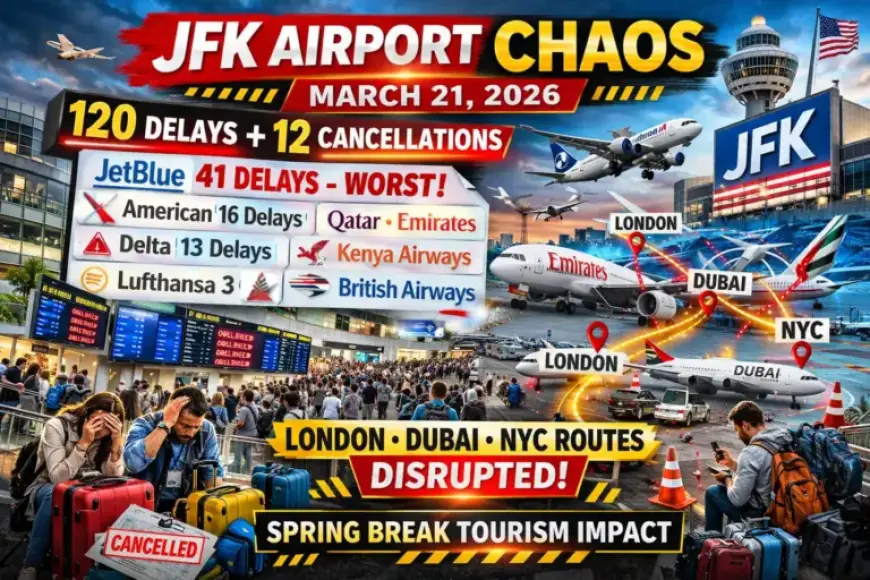
Friday, March 21, 2026 brought major disruption at John F. Kennedy International Airport. Airlines logged 132 total flight disruptions. That total included 120 delays and 12 cancellations during a peak spring break period.
Disruptions by the numbers
The scale was significant and measurable. JFK handles roughly 60 million passengers each year, and spring break travel was in full swing.
| Total disruptions (March 21, 2026) | 132 (120 delays, 12 cancellations) |
| Cancellation rate (of disruptions) | 9.1% |
| Delay rate (of disruptions) | 90.9% |
| Estimated passengers affected | ≈19,800+ (150 passengers per flight average) |
| Spring break period | March 6–24, 2026 (March 21 = day 16) |
Airlines and routes hit hardest
One carrier accounted for a disproportionate share of delays. JetBlue recorded the single-worst delay performance.
JetBlue
JetBlue logged 41 delays on March 21. The carrier reported no corresponding cancellations that day. Those delays represented roughly 31% of the airport’s total delays.
American and Delta
American Airlines reported 16 delays. Delta Air Lines logged 13 delays. Both legacy carriers added to the network strain at JFK.
Other carriers
International operators also experienced disruption. Lufthansa recorded three delays. Qatar Airways and Emirates faced cancellations and delays tied to wider Gulf hub issues. Kenya Airways and British Airways reported delayed services to and from JFK.
Top affected routes
- London Heathrow (LHR)
- Dubai (DXB)
- Doha (DOH)
- Nairobi (NBO)
- Chicago (ORD), Boston (BOS), Los Angeles (LAX), Miami (MIA)
Context and root causes
Several forces converged to create the disruption. Peak spring break demand limited recovery options for delayed aircraft and crews.
Earlier Middle East hub failures worsened the situation. Between March 18 and 20, Gulf and regional networks were already strained.
Middle East hub collapse (March 18–20)
On March 19, regional carriers logged hundreds of disruptions. That day’s total included about 743 disruptions. The breakdown was approximately 515 delays and 228 cancellations.
Reported impacts included roughly 400 cancellations attributed to Emirates’ Dubai operations and more than 600 cancellations tied to Turkish service at Istanbul.
Qatar reported roughly 120 grounded aircraft during the same window. Those problems continued to ripple into transatlantic and transoceanic schedules by March 21.
Economic and traveler impacts
JFK serves as the nation’s main international gateway. The airport’s role amplifies the economic effect of delays.
New York’s tourism economy exceeds $70 billion annually. Missed shows, hotel nights, and meetings translate to real financial losses.
What travelers should do now
- Avoid JetBlue when possible. The carrier showed the highest delays on March 21.
- Book refundable or flexible fares. Nonrefundable tickets carry higher risk during peak periods.
- Add long connection buffers. Allow six or more hours for tight international transfers.
- Monitor apps and trackers. Airline apps and FlightAware provide near-real-time status updates.
- Consider alternative airports. Newark (EWR) and LaGuardia (LGA) may offer more reliable options.
- Know your rights. Operational delays rarely trigger mandatory refunds. Cancellations do.
- Document costs. Keep receipts and screenshots for insurance and reimbursement claims.
- Expect Long TSA Lines and airport screening delays during peak travel days.
- For international arrivals, avoid scheduling critical meetings the same day as travel. Flight Delays at JFK can derail same-day plans.
Short-term outlook
Analysts expect elevated disruption levels through the end of spring break. March 24 should mark the demand peak’s end.
Recovery will depend on fleet and crew repositioning, Gulf hub normalization, and improved weather. Improvements are likely in late March, with gradual normalization in April.
Wild cards
- Late-season Northeast weather could produce new delays.
- TSA staffing or payroll disruptions could worsen airport processing times.
- Any renewed Middle East operational problems would create further cascading effects.
Filmogaz.com will continue to monitor developments. Travelers should check airline communications and airport advisories frequently.