Geomagnetic Storms Could Disrupt Potential Extraterrestrial Messages

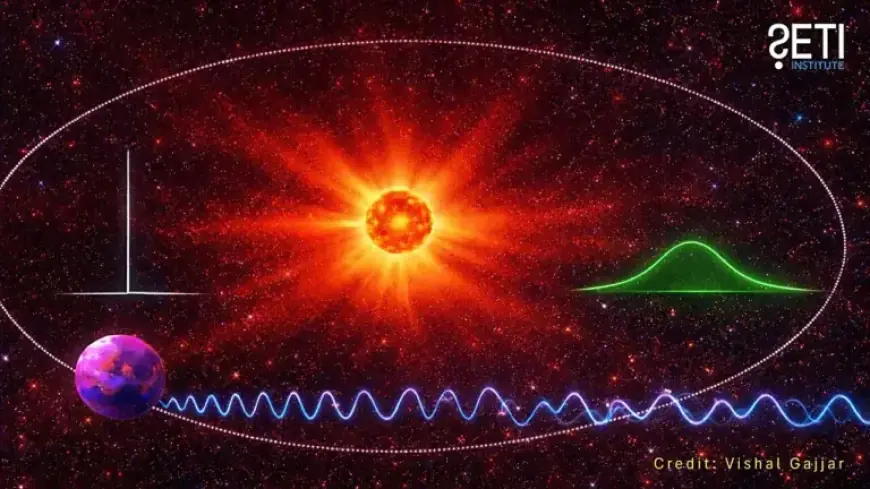
Decades of radio searches for technosignatures have found no confirmed transmissions. A new study suggests stellar environments may scramble narrowband radio signals before they escape their host systems.
How stellar plasma alters radio transmissions
Researchers show that winds and plasma around stars can scatter radio waves. Turbulence causes spectral broadening, angular diffusion, and scintillation that weaken narrow peaks.
Coronal mass ejections and strong magnetic activity inject dense, variable plasma. These disturbances can spread signal energy across wider frequency ranges.
Evidence from spacecraft signals
Scientists used solar system spacecraft transmissions as a testbed. Those precise signals traverse the solar wind and exhibit measurable broadening.
Observations of these transmissions informed numerical models. The models then extrapolated conditions found near other stars.
Modeling and key parameters
The team simulated a range of stellar environments. They varied plasma density, wind speed, and magnetic field strength.
- Plasma density
- Stellar wind velocity
- Magnetic field intensity
Results show some stars can produce far stronger scattering than the Sun. Narrowband emissions may thus transform into broad, low-contrast features.
Consequences for SETI strategies
Traditional searches focus on extremely narrow frequency spikes. That assumption risks missing distorted signals.
Researchers urge expanding detection criteria to include broader, physically plausible signatures. They warn archived data might already contain missed transmissions.
Vishal Gajjar and colleagues argue a signal can be altered before leaving its stellar system. Grayce C. Brown cautions that ignoring these effects could mean overlooking real technosignatures.
Red dwarf stars complicate the picture further. These M-type stars constitute roughly three quarters of the Milky Way. Their frequent flares and dense winds create particularly turbulent plasma.
Many potentially habitable exoplanets orbit such stars. If civilizations exist there, their radio messages might arrive heavily modified.
Researchers also note that geomagnetic disturbances closer to Earth matter. Geomagnetic Storms Could Disrupt Potential Extraterrestrial Messages, adding another layer of signal degradation.
Publication and implications
The study appears in The Astrophysical Journal (2026). The article is titled “Exo–IPM Scattering as a Hidden Gatekeeper of Narrowband Technosignatures” by Vishal Gajjar et al.
Adapting search algorithms is now a priority. Broader filters and physics-based templates could improve the chances of detection.
Filmogaz.com will follow developments as teams refine models and reprocess radio archives. The community faces a clear choice: update methods or risk missing signals already present in the data.