NVIDIA Dlss 5 Delivers AI-Powered Breakthrough In Visual Fidelity For Games

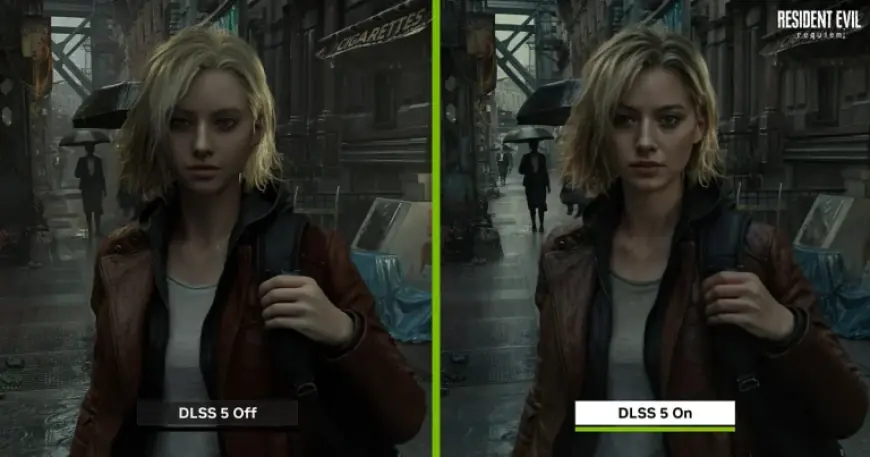
Nvidia unveiled dlss 5 at GTC 2026 as a new machine-learning lighting model that aims to deliver photo‑realistic imagery on current hardware. The company demonstrated the technology in several shipping titles and says the feature will reach RTX 50‑series GPUs by Fall 2026.
Dlss 5 Brings Photo-Realistic Lighting To RTX 50-Series
Dlss 5 is positioned not as a traditional upscaler or frame-generation tool but as an AI-driven lighting system that plugs into game engines in much the same way as prior DLSS features. The model uses only colour information and motion vectors to generate lighting that can dramatically change how scenes read, while leaving geometry, textures and material assets unchanged.
Nvidia showed Dlss 5 running in a set of existing games, including Resident Evil Requiem, Hogwarts Legacy, Assassin’s Creed Shadows, Oblivion Remastered and Starfield. The company says the effect will be available on RTX 50‑series hardware later in 2026, with the initial rollout described as the first public snapshot of a work in progress.
How The AI Model Changes Characters, Materials And Environments
The system powering dlss 5 is described as scene‑aware: the neural network recognises elements such as skin, hair, water and metal and applies distinct lighting treatments. That semantic awareness is intended to produce realistic subsurface scattering for skin, improved hair rendering, and more convincing responses from metals, cloth and organic surfaces.
Environments benefit from subtler changes too, with a marked improvement in shadowing and ambient occlusion that helps ground objects in a scene. Nvidia highlighted foliage lighting as a particularly impressive use case — an area where conventional renderers struggle even when ray tracing or path tracing is used.
The company acknowledged that the current demonstrations are an early stage: some screen‑space errors remain and further optimisations are expected before the full launch later in the year.
Wider GPU Roadmap And Path Tracing Performance Claims
Alongside the Dlss 5 reveal, Nvidia presented broader claims about the direction of real‑time rendering. It highlighted a long‑term trend in path tracing performance, stating that current Blackwell (RTX 50) GPUs already show roughly 10, 000 times the path‑tracing performance of Pascal‑era hardware. Nvidia also projected that future hardware and AI advances could push that advantage toward 1, 000, 000 times over Pascal as neural rendering and dedicated hardware evolve.
Those projections are tied to a strategy that treats AI and neural rendering as the primary path to film‑like visuals, with new algorithms and hardware features such as advanced resampling and mega‑geometry techniques showcased in tech demos. The company emphasised that these advances rely on machine‑learning models trained on large compute systems, and that neural rendering features like DLSS are an integral part of that shift.
What follows next is a period of engine integration and iteration: developers will need to adopt the DLSS 5 lighting model in their engines, Nvidia intends further optimisations after the snapshot demonstrations, and the initial consumer availability is scheduled for RTX 50‑series GPUs by Fall 2026.