From Frankenstein to Marty Supreme: Have Prosthetic Transformations Become the Key to Winning Oscars? Mike Hill Frankenstein

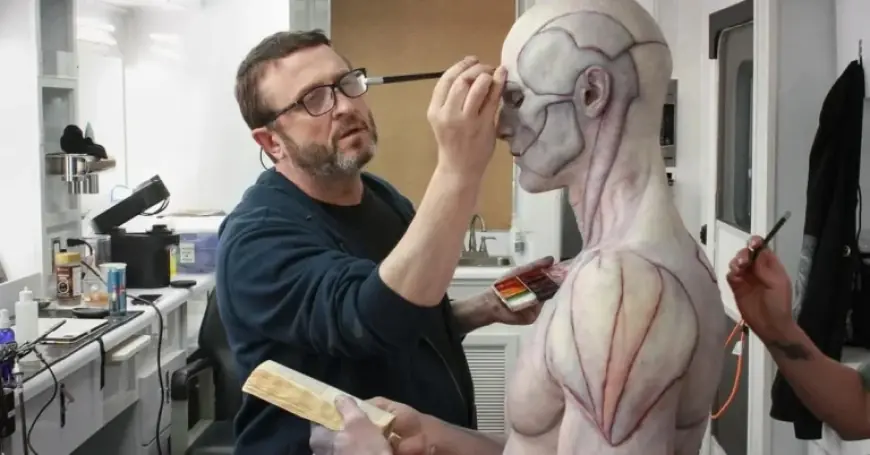
Prosthetic makeup has moved from spectacle to status symbol in prestige filmmaking, and Mike Hill Frankenstein is a central example of that shift. The designer’s work on Jacob Elordi’s Creature involved marathon makeup sessions and exceptionally fine appliances intended to preserve performance, and it’s part of a wider trend in which prosthetic-heavy roles are drawing awards attention.
Mike Hill Frankenstein: Sculpting Performance Under Layers
Mike Hill brought Jacob Elordi’s Frankenstein Creature to life, spending roughly 10 hours in the makeup chair to transform the actor into a blue-hued monster while keeping emotional nuance intact. Hill previously collaborated on the Amphibian Man for an earlier film, work that did not earn him an Oscar nod; Frankenstein did. Hill says he learned from an interview with makeup artist Dick Smith that prosthetic appliances should be sculpted and then pared back so the pieces move with the actor rather than stiffen the face. For Elordi, Hill made the prosthetic pieces as fine as possible so the actor’s expressions could still shine through.
Hill connects the acclaim for such work directly to the underlying acting: “I think that’s literally the performance. Jacob really sold the character. He really used the makeup, but it was his acting that made the character so memorable, ” he says.
Full-Body Transformations on Screen: Time, Patience and Precision
The modern era of prosthetics extends beyond one film. On television and in horror films, actors are regularly concealed behind elaborate, full-body makeup. Bill Skarsgård vanishes into Pennywise in IT: Welcome to Derry after a six-hour application process, and Jamie Campbell Bower becomes the veiny, villainous Vecna on Stranger Things after seven hours each day of work and the application of 25 prosthetic pieces, with carefully choreographed “prosthetic pit stops” to attach pieces in stages.
These transformations have produced nominations and acclaim across mediums: one actor’s performance under heavy prosthetics emerged as an Oscar nomination, and another performer’s work led to an Emmy nomination for a role as a mutated Ghoul. Makeup artists who handle these creatures stress the balance between technical achievement and the actor’s ability to perform through the layers. “Bill’s a trooper when we apply the makeup, ” says Shane Zander of his long collaboration on Pennywise, and he adds that actors often must overcompensate with their facial movements when pieces are thicker. “We’ll design pieces to achieve this, but actors still usually have to overcompensate with their facial movements. ” The conclusion is simple: the thinner the appliance, the more the performance can come through.
Why Prosthetics Are Now Part Of The Awards Conversation
Prosthetics were once a novelty; now they’re a hallmark of a prestige project. As craft has advanced, makeup teams have learned to deliver both extreme visual transformation and the subtle mobility that lets an actor inhabit a role. That dual achievement—technical wizardry combined with preserved expressiveness—helps explain why prosthetic-clad performances are drawing industry recognition and piling up accolades.
With teams designing ever-finer pieces and building application processes that protect performance, prosthetic makeup is no longer just about hiding an actor. It’s become a tool to enhance and display a committed performance, prompting the central question that frames the current debate: is the combination of skillful prosthetic work and strong acting now the key to awards success?
The conversation continues as more projects push the limits of full-body and face-obscuring makeup while keeping performance at the center of the result.